The Challenge
Out of curiosity I decided to compare how well different free AI models would interpret the same image generation prompt, as I came across a scan of an old watercolor sketch:
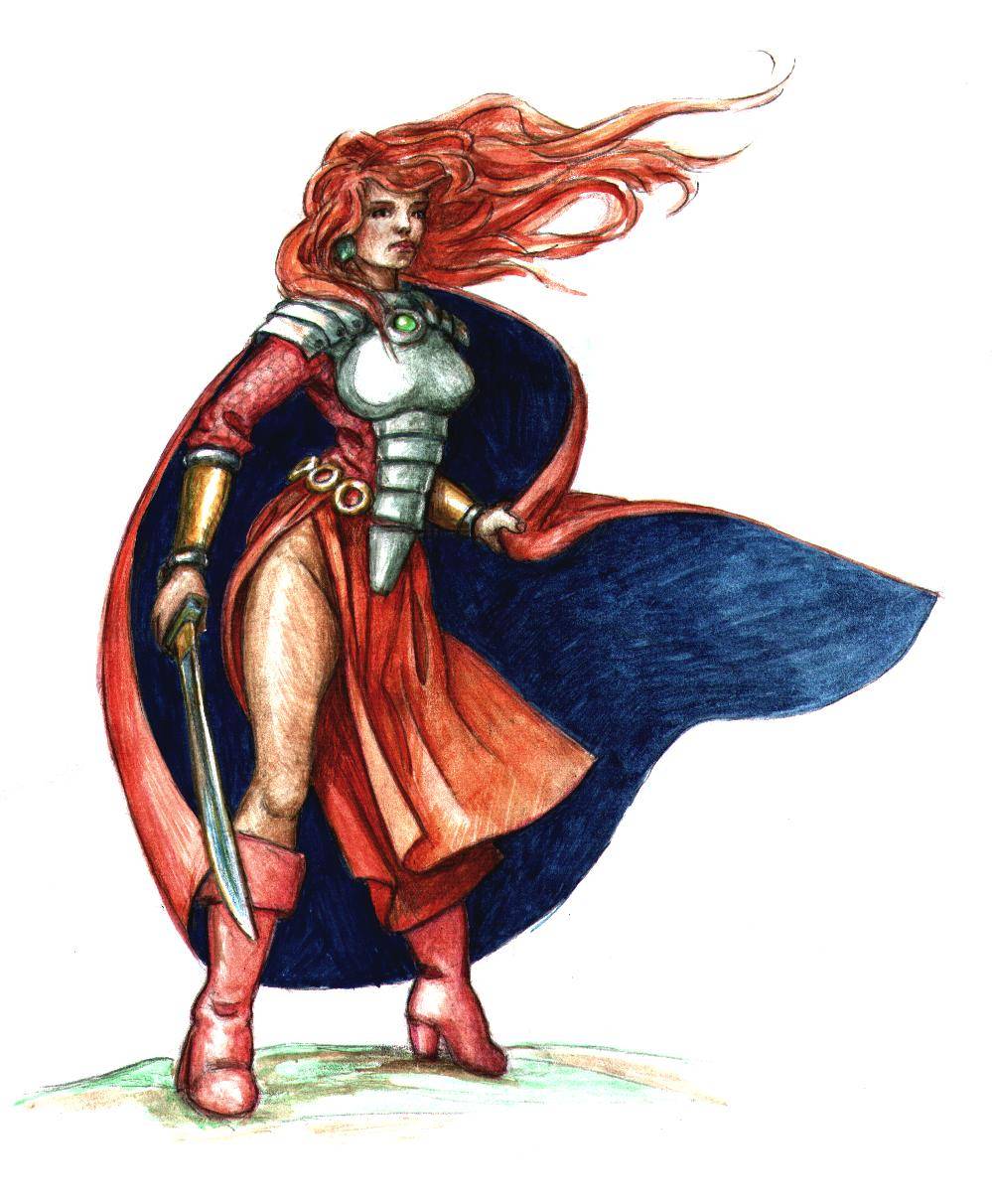
The prompt I used was:
this is a watercolor concept of a fantasy redhaired amazon warrior wearing some plate armor over a red garment, red leather boots and a billowing cloak, holding a sword. generate a photorealistic fantasy movie promotion image based closely on the uploaded art. Late afternoon sunlight, cinematic photography, realistic materials, background is the top of a windswept grassy height overlooking a medieval-style fantasy landscape of sparsely populated, fertile kingdom
The Result
I threw this task at ChatGPT, Copilot, and Gemini (free versions) in November 2026. These were the results:
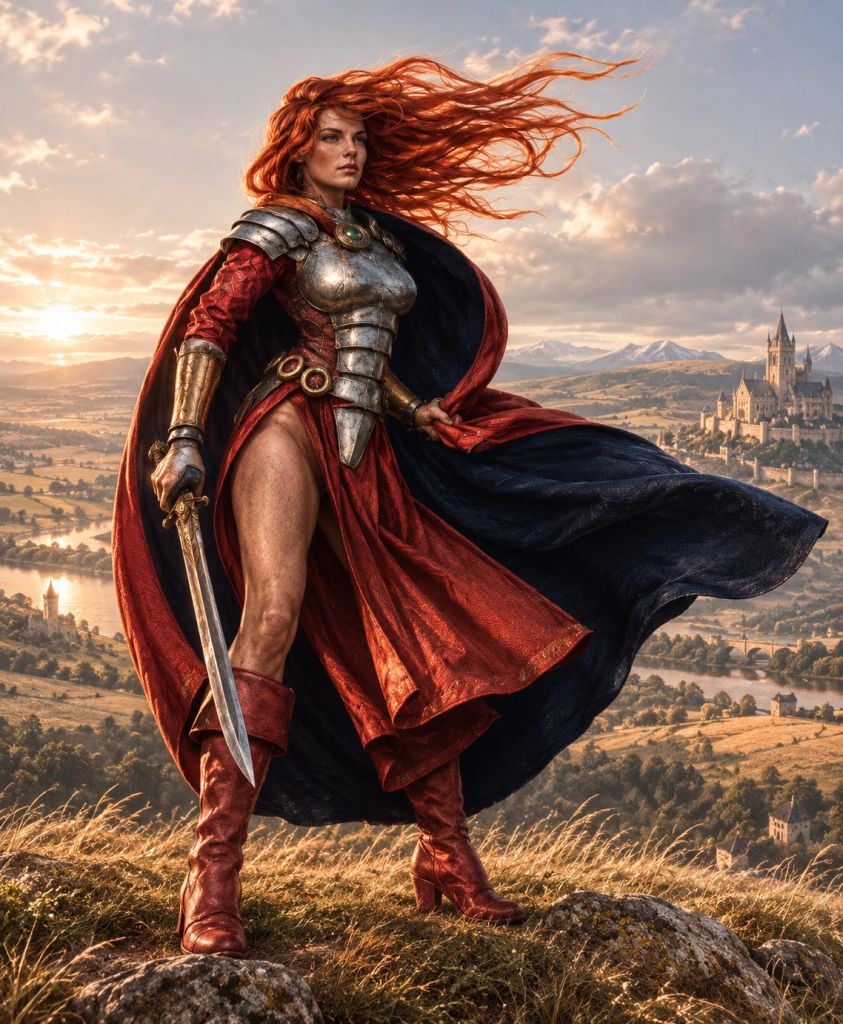
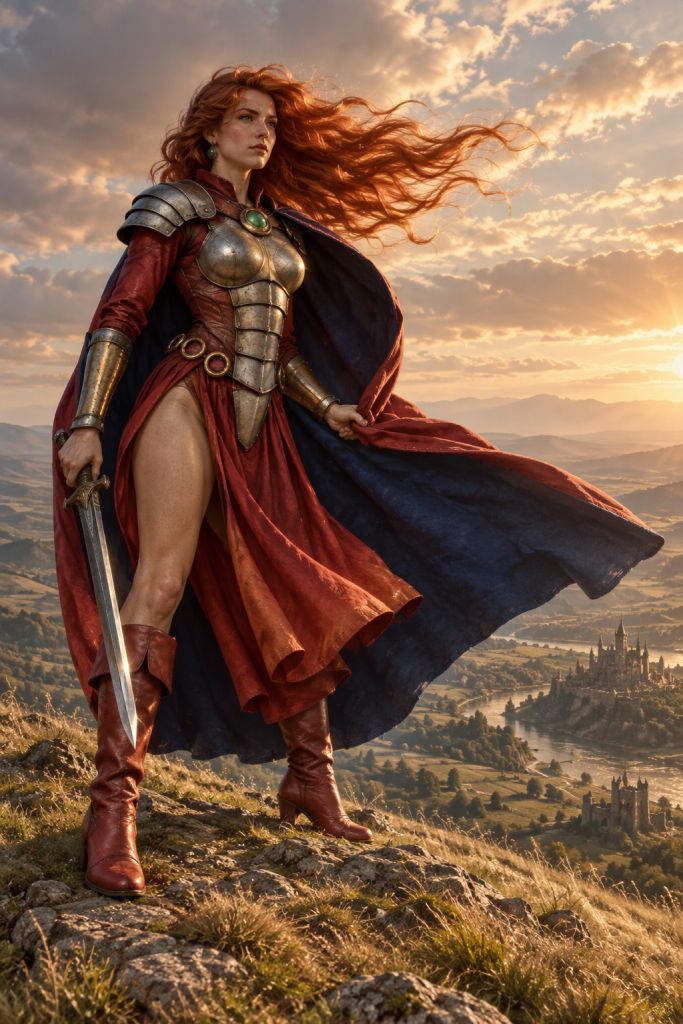
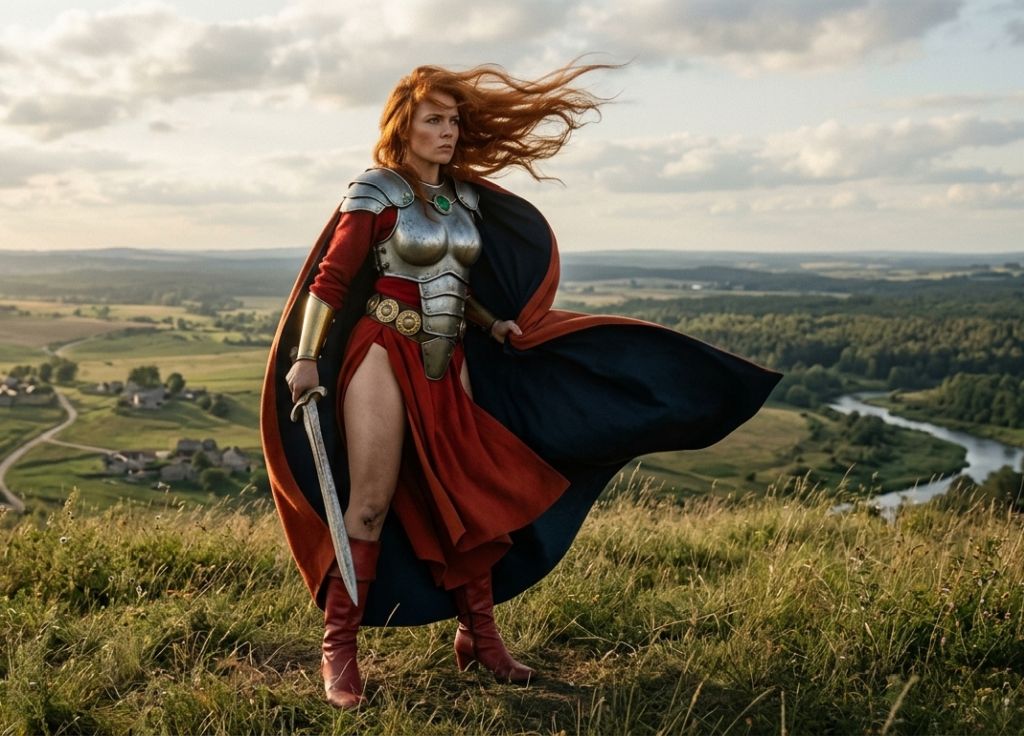
In terms of accuracy to the reference, ChatGPT did best to capture the character and the pose but botched the hand holding the cape, Copilot has probably the prettiest character and background at the loss of some muscle, whereas Gemini is so photorealistic that it looks like a cheap cosplay – even including a zipper on the boots – in a modern countryside complete with asphalt roads. None of the models seem to have understood the sword as a falchion style blade with a copper collar and small rectangular crossguard. I’d say ChaptGPT wins on effort to stay close to the reference, whereas Copilot wins on creatively interpreting the reference, and Gemini wins at being aggressively boring. Curiously, Gemini very closely matches the outline of the cape and even the exact folds in the tunic/skirt, while hallucinating on almost everything else.
In the interest of objective comparison, I threw the results back to all three models and asked them to “objectively evaluate pros and cons of each generated image in how well they match the prompt and the reference“.
The Evaluations
ChatGPT’s Evaluation
Judging strictly against the supplied watercolor reference + the exact prompt, there is a fairly clear difference between the three. The important distinction is that “best-looking photograph” and “best interpretation of the reference” are not necessarily the same thing.
Overall ranking
| Reference fidelity | Prompt fidelity | Photorealism | Overall | |
|---|---|---|---|---|
| ChatGPT | 9/10 | 9/10 | 9/10 | 9.0/10 |
| Copilot | 8.5/10 | 9.5/10 | 9/10 | 9.0/10 |
| Gemini | 8/10 | 8.5/10 | 9.5/10 | 8.7/10 |
There isn’t a huge gulf between them. All three understood the core character extremely well. The interesting differences are in how much they preserved the original drawing versus how much they “cinematized” it.
1. ChatGPT — best balance of reference fidelity and cinematic interpretation
My pick for the strongest overall translation of the sketch.
What it gets particularly right
The character silhouette is exceptionally faithful.
The reference has a very distinctive combination:
- long flowing red hair sweeping dramatically to the character’s right
- silver/steel breastplate
- red sleeves and red lower garment
- tall red boots
- enormous dark-blue/black cloak
- sword hanging down in the character’s left hand
- one hand holding/pulling the cloak outward
- broad, heroic stance
ChatGPT preserves essentially all of those major visual identifiers.
The cloak in particular is important. In the drawing, it isn’t just a normal cape hanging behind her; it is a large, sweeping mass extending dramatically to the right. ChatGPT reproduces that almost literally, while converting it into believable cloth.
It also retains the general pose and gesture very well. The weight distribution, sword arm, cloak-holding arm and leg positioning all feel like the same character rather than merely “a red-haired warrior inspired by her.”
It also follows the prompt very closely
The generated scene has:
- late-afternoon/golden sunlight
- dramatic clouds
- a windswept grassy elevated position
- expansive fertile countryside
- a medieval-looking settlement/castle in the distance
- cinematic depth and atmospheric perspective
- convincing metal, leather, cloth and hair
The distant landscape is particularly successful because it doesn’t just put her on a generic mountain. You can see fields, roads, settlements, rivers and a substantial medieval-looking city/castle.
Where it deviates
The biggest departure is that the character becomes somewhat more glamorous and conventionally heroic than the sketch.
The reference has a slightly eccentric, almost illustrated fantasy-comic quality. ChatGPT turns her into a very polished fantasy-film protagonist.
The armor is also more elaborate and anatomically fitted than the sketch. That’s appropriate to “photorealistic fantasy movie promotion,” but it means this isn’t a literal reconstruction.
There is also a subtle issue with the cloak/garment relationship: the generated red dress is considerably fuller and more layered than the relatively simple red garment in the drawing.
Verdict
Best reference-to-photorealism translation.
It feels like someone took the original illustration and said: “What would this exact character look like if she were standing in a $150-million fantasy film?”
2. Copilot — arguably the best prompt compliance
Copilot is extremely strong, and in some respects I would actually give it the highest score for following the textual prompt.
What it does exceptionally well
The environment is superb.
The character is visibly standing on a rocky, grassy elevated ridge, with:
- windswept grass
- golden late-afternoon illumination
- huge sky
- rolling fertile terrain
- rivers
- fields
- distant settlements
- a prominent medieval-style city
Of the three, this one arguably gives the clearest impression of:
“the top of a windswept grassy height overlooking a medieval-style fantasy landscape of a sparsely populated, fertile kingdom.”
The camera also has a convincing fantasy-movie-poster composition.
The lighting is excellent. The sun is low behind her, the metal armor catches warm highlights, and the landscape falls away beneath her. It has a very deliberate cinematic quality.
Its character rendering is also excellent
The armor is arguably the most convincing of the three from a fantasy-costume standpoint.
The silver armor has:
- believable segmented construction
- shoulder plates
- chest contours
- metallic reflections
- leather/cloth integration
The red fabric and dark cloak are also very convincing.
And importantly, it retains the sword + cloak + red dress + red boots + red hair combination.
Where it loses points relative to the reference
Its biggest problem is pose fidelity.
Compared with the watercolor, Copilot has changed the character’s posture more substantially.
The reference has a rather specific, slightly stylized stance. Copilot makes her more of a conventional wide-legged heroic warrior pose.
Her torso and hips are also more frontal/three-quarter and the proportions have been interpreted differently.
The cloak remains highly faithful conceptually, but its shape and attachment have been redesigned somewhat.
Another subtle difference: the reference character has a somewhat simpler, more graphic armor design, whereas Copilot invents additional armor structure and detailing.
One thing it does better than ChatGPT
It makes the landscape read as a kingdom rather than simply beautiful countryside.
That’s a meaningful distinction. The prompt didn’t ask merely for “a fantasy landscape.” It specifically asked for a fertile kingdom with sparse medieval habitation, and Copilot really delivers that.
Verdict
Best environment and perhaps best literal adherence to the written scene description.
If the evaluation were:
“Which AI followed my text prompt most completely?”
I’d give Copilot a very slight edge.
If the evaluation were:
“Which AI preserved my drawing most closely?”
I’d put ChatGPT ahead.
3. Gemini — best photographic realism, but the biggest conceptual simplification
Gemini is the most interesting case because it arguably produces the most convincing photograph of the three.
The character looks less like an AI-generated fantasy illustration and more like an actress photographed on location.
Its strongest qualities
The lighting and photographic treatment are excellent.
The image has:
- natural-looking atmospheric haze
- subdued daylight
- realistic grass
- convincing depth of field
- believable distant terrain
- relatively restrained color grading
- natural skin texture
- convincing hair
- physically plausible cloth
It is noticeably less “fantasy poster” looking than the other two.
That’s actually a significant achievement because your prompt specifically asked for cinematic photography and realistic materials, rather than merely a photorealistic illustration.
Gemini also gives the landscape a very convincing real-world geography. The river, fields, woodland and scattered settlements feel geographically coherent.
It also preserves the character surprisingly well
The essential design is still there:
- red hair
- silver armor
- red clothing
- red boots
- dark cloak
- sword
- cloak being held outward
- windswept hair
- elevated grassy landscape
And the cloak is still a major part of the silhouette.
But this is where the reference comparison becomes important
Gemini simplifies the fantasy world considerably.
The background is much more like real historical countryside than a clearly medieval-fantasy kingdom.
There is a little settlement visible, but the dramatic medieval architectural presence that you get in the ChatGPT and Copilot images is largely absent.
So ironically:
Gemini is more realistic but less fantastical.
That’s not necessarily a failure of the image. It’s a tradeoff.
The prompt says “medieval-style fantasy landscape,” and Gemini interpreted the landscape closer to real medieval/rural Europe than to a fantasy film kingdom.
Its character also feels somewhat less imposing
The reference depicts the Amazon as a very dominant figure occupying a large part of the composition.
Gemini pulls the camera back and gives considerably more visual space to the countryside.
That’s excellent for environmental photography, but less faithful to the character-focused promotional illustration.
The original sketch is fundamentally a character design with a cloak, whereas Gemini turns it into a landscape photograph containing a character.
That’s an important compositional difference.
Verdict
Best pure photographic realism, but weakest of the three at preserving the original image’s visual hierarchy.
The most interesting comparison: what each AI “understood”
I’d characterize their interpretations like this:
ChatGPT
“Take this exact fantasy character and make her into a movie hero.”
It prioritizes character identity + reference fidelity.
Copilot
“Take this character and build the fantasy movie world around her.”
It prioritizes scene construction + textual prompt compliance.
Gemini
“Take this character and photograph her as though she really existed.”
It prioritizes photographic realism + naturalistic environment.
That distinction explains most of the differences.
One important caveat about the reference itself
The watercolor has very little environmental information. Most of the actual visual specification is the character.
So the models had considerably more freedom in interpreting the landscape than the character.
That means I would weight the character silhouette, costume, cloak, sword, hair and pose more heavily when judging “based closely on the uploaded art.”
On that criterion, I think the ranking is:
1. ChatGPT → 2. Copilot → 3. Gemini
But if I weight the exact written prompt equally heavily:
1. Copilot → 2. ChatGPT → 3. Gemini
And if I judge pure photorealistic photographic quality:
1. Gemini → 2. Copilot → 3. ChatGPT
My overall assessment
ChatGPT — best overall translation
The strongest combination of reference fidelity + fantasy-film aesthetic + prompt compliance. It changes the least about the character’s fundamental design and gesture while successfully making the illustration believable as a live-action fantasy movie image.
Copilot — best scene interpretation
Possibly the strongest prompt follower. Its kingdom, terrain, lighting and cinematic composition are outstanding, and its armor is excellent. It loses the top spot because it takes more liberties with the character’s original pose and costume construction.
Gemini — best realism
Probably the most convincing as an actual photograph. Its restraint is impressive. But that very restraint makes it somewhat less faithful to the fantasy-movie-promotion aspect and to the dramatic visual hierarchy of the watercolor. It turns the scene toward realistic historical/fantasy countryside rather than the more explicitly fantastical kingdom seen in the other two.
So, objectively, I would not call Gemini the “worst” image. It is arguably the best photograph. It’s simply the least successful at answering the combined question of “make this particular drawing into a photorealistic fantasy movie image.”
The particularly interesting result is that ChatGPT and Copilot are actually solving slightly different problems, despite receiving the identical prompt: ChatGPT preserves the artist’s character design more rigorously, while Copilot preserves the writer’s environmental brief more rigorously.
Copilot’s Evaluation
Evaluating the three generated images against both the prompt and the watercolour reference, I’d break it down into several criteria.
1. Fidelity to the character design
Reference characteristics
The sketch shows:
- Long bright red hair blown strongly to the right
- White/silver plate cuirass
- Red undergarment/dress
- Red boots
- Large dark blue cloak with red lining
- Sword held downward
- Relatively stylised fantasy proportions
- Wind-swept, heroic pose
ChatGPT
Strengths
- Captures the overall silhouette extremely well.
- Hair volume and direction are very close to the sketch.
- Cloak shape closely reproduces the broad blue mass extending to the right.
- Armour design preserves the segmented silver breastplate look.
- Sword orientation matches well.
- Red boots and red garment are clearly present.
Weaknesses
- Adds considerably more realistic anatomy and exposed leg than the sketch suggests.
- Armour becomes more detailed and ornate than the original concept.
- Face diverges somewhat from the sketch.
- The cloak is somewhat reduced in visual dominance compared to the original.
Score for character fidelity: 9/10
Copilot
Strengths
- Very strong preservation of pose.
- Hair movement and cloak flow are excellent.
- Retains the central armour-and-red-garment colour balance of the sketch.
- Sword position is highly faithful.
Weaknesses
- Armour shape drifts slightly toward a bronze-toned breastplate rather than silver armour.
- The red dress is more elaborate and flowing than the original.
- Character proportions become even more heroic and cinematic than ChatGPT’s version.
- Some details feel “fantasy movie poster” first and “adaptation of this drawing” second.
Score for character fidelity: 8.5/10
Gemini
Strengths
- Retains the key costume elements.
- Red hair, armour, boots, cloak and sword all remain present.
- Keeps a practical-looking medieval-fantasy aesthetic.
Weaknesses
- Largest departure in pose.
- Character stance is noticeably different.
- Hair direction differs from the sketch.
- Cloak composition differs significantly.
- The figure feels like “a similar character” rather than a direct photorealistic version of the drawing.
Score for character fidelity: 7/10
2. Fidelity to the specified environment
Prompt:
top of a windswept grassy height overlooking a medieval-style fantasy landscape of sparsely populated, fertile kingdom
ChatGPT
Strengths
- Shows elevated position.
- Strong kingdom vista.
- Visible castle/city.
- Rich agricultural landscape.
- Strong sense of scale.
Weaknesses
- Kingdom appears somewhat densely developed for “sparsely populated.”
- Background feels slightly high-fantasy and idealised.
Environment score: 9/10
Copilot
Strengths
- Excellent elevated vantage point.
- Multiple settlements visible.
- Strong fantasy atmosphere.
- Deep landscape recession.
Weaknesses
- More mountain-epic fantasy than fertile kingdom.
- Slightly less agricultural richness.
Environment score: 8.5/10
Gemini
Strengths
- Most believable agricultural landscape.
- Sparse settlement density is closest to the wording.
- Excellent grassy foreground.
Weaknesses
- Least “fantasy kingdom” feel.
- Almost resembles real-world countryside.
- Lacks obvious medieval architectural landmarks.
Environment score: 8/10
3. Late afternoon sunlight / cinematic photography
ChatGPT
- Strong golden-hour lighting.
- Dramatic sky.
- Strong cinematic contrast.
- Movie-poster quality.
Score: 9.5/10
Copilot
- Most dramatic sky.
- Strongest cinematic mood.
- Excellent rim lighting.
- Most obvious “fantasy film poster”.
Score: 10/10
Gemini
- More realistic photography.
- Sunlight appears overcast rather than golden-hour.
- Less epic but very natural.
Score: 7.5/10
4. Realistic materials
ChatGPT
- Good armour materials.
- Cloth behaves believably.
- Hair slightly glamour-shot polished.
Score: 8.5/10
Copilot
- Strong cloth rendering.
- Good atmospheric lighting.
- Armour becomes slightly stylised.
Score: 8.5/10
Gemini
- Most realistic photography overall.
- Grass, cloth and lighting feel the most believable.
- Less fantasy-art stylisation.
Score: 9.5/10
5. Transformation of the sketch into a film adaptation
This is arguably the most important category.
When people say “generate a photorealistic version of this artwork”, they usually want:
“If this exact painting were adapted into a live-action fantasy movie, what would it look like?”
ChatGPT
Closest overall translation.
The generated image preserves:
- silhouette
- costume
- pose
- colour distribution
- composition
while upgrading realism.
Score: 9.5/10
Copilot
A close second.
The image is arguably more beautiful and dramatic, but it starts making its own artistic decisions rather than faithfully translating the sketch.
Score: 9/10
Gemini
Produces a convincing fantasy photograph but adapts the source material the least.
Score: 7/10
Overall ranking
| Category | ChatGPT | Copilot | Gemini |
|---|---|---|---|
| Character fidelity | 9 | 8.5 | 7 |
| Environment | 9 | 8.5 | 8 |
| Cinematic quality | 9.5 | 10 | 7.5 |
| Realism | 8.5 | 8.5 | 9.5 |
| Adaptation fidelity | 9.5 | 9 | 7 |
| Overall | 9.1 | 8.9 | 7.8 |
My objective conclusion
- Best match to the reference artwork:ChatGPT
- Preserves the pose, cloak shape, costume colours, sword placement and overall silhouette most faithfully.
- Best fantasy movie poster:Copilot
- Most dramatic lighting and strongest cinematic presentation, though it departs slightly more from the source sketch.
- Most realistic photograph:Gemini
- Strongest real-world photographic feel, but weakest adherence to the original composition and fantasy-poster intent.
An interesting observation is that each model appears to have optimised for a different interpretation of “photorealistic fantasy movie promotion image”:
- ChatGPT: “faithful live-action adaptation of the sketch.”
- Copilot: “epic fantasy poster inspired by the sketch.”
- Gemini: “realistic fantasy-world photograph of a similar character.”
Gemini’s Evaluation
Here is an objective comparison of the three generated renders against both your reference sketch and your prompt.
1. ChatGPT
- Pros:
- High fidelity to the watercolor sketch: Preserves the pose, sword angle, billowing dark-blue/red cloak silhouette, red garment folds, and red boots very closely.
- Strong prompt adherence for the setting: Delivers late afternoon sun low on the horizon, windswept grassy foreground terrain, and a fertile medieval-style valley with distant architecture.
- Cohesive promotional mood: Warm golden rim light and atmospheric depth fit a fantasy movie poster/promo aesthetic well.
- Cons:
- Slightly stylized realism: Leans a bit toward high-end digital concept/fantasy art rather than raw live-action film photography, particularly in the lighting contrast and hair/cloak flow.
- Minor detail drift: The armor and belt/buckle details are interpreted with extra ornamental/cinematic polish compared to the looser sketch strokes.
2. Copilot
- Pros:
- Faithful character & costume translation: Keeps the stance, wind-swept red hair, red outfit, red boots, sword grip, and large billowing cloak closely aligned with the original drawing.
- Golden-hour lighting & landscape: Captures late afternoon sunlight, grassy ridge foreground, and a sprawling valley below with medieval-feeling settlements/structures.
- Cons:
- Aspect ratio / framing mismatch: Uses a taller vertical portrait framing compared to the wider/horizontal panels around it, which slightly alters how the horizon and cloak wing sit in the frame.
- Slightly painterly/glossy finish: Like ChatGPT, certain metallic and fabric highlights feel somewhat illustrative/CGI-polished rather than strictly candid live-action camera footage.
3. Gemini
- Pros:
- Most photographic / live-action look: Closest to “cinematic photography” and “realistic materials” in terms of natural daylight, skin texture, fabric weight, grass blades, and photographic depth of field.
- Strong “sparsely populated, fertile kingdom” reading: The rolling green fields, winding river, scattered small settlements, and open sky match the sparse, fertile landscape phrasing very naturally.
- Accurate character pose and costume elements: Retains the red hair blowing right, red garment and boots, sword, and billowing cloak.
- Cons:
- Less dramatic “late afternoon” warmth: The light reads more like overcast/diffused afternoon daylight than golden low-angle sun.
- Less overt fantasy architecture: Compared to the distant castle/spires visible in the earlier two renders, the background looks more grounded/historical than overtly high-fantasy.
Summary Comparison
If your priority is closest match to the sketch + golden afternoon drama, ChatGPT and Copilot are very close (with framing differences). If your priority is raw photographic realism and a natural, sparsely populated landscape, Gemini is the strongest match.
Summary
Both ChatGPT and Copilot gave a ranking, whereas Gemini did not. Both gave Gemini the lowest score. Copilot scored ChatGPT higher than itself whereas ChatGPT rated Copilot as equal.
| ChatGPT | Copilot | Gemini | |
| ChatGPT | 9.0 | 9.0 | 8.7 |
| Copilot | 9.1 | 8.9 | 7.8 |
| Gemini | – | – | – |
In my experience, ChatGPT is generally better at following references, such as restoring an old damaged photo so it still looks like the same person. Copilot takes a bit more creative license, which can be better or worse depending on the requirements. Gemini seems to take references as a vague hint, and thus will often create something that looks more “realistic” but also more generic and boring. Gemini is almost impressive in that it manages to create a hyper-realistic rendering that looks like a real photo taken with a real camera, by an extremely mediocre photographer who doesn’t understand lighting and composition.