0. A curated memory landscape
A visit to Beauraing today begins in an atmosphere of curated calm. The Sanctuary of Our Lady of Beauraing sits just beyond the town center, a landscaped devotional park that feels more like a retreat garden than the site of a mass‑vision wave. Paved paths guide visitors past lawns, flowerbeds, and devotional statues. The serenity is striking, especially when one remembers that in the winter of 1932–33, thousands crowded into this same space, jostling for a glimpse of five children who claimed to see the Virgin Mary.
Most visitors begin at the hawthorn tree, now fenced off and elevated slightly above the garden. In 1932 it was simply a garden tree in the convent schoolyard, surrounded by mud and trampled earth as crowds pressed forward. Today it is a curated relic, framed by candles and flowers. Visitors pause, take photographs, or stand quietly. The tree is no longer a witness to events; it is a symbol of memory.
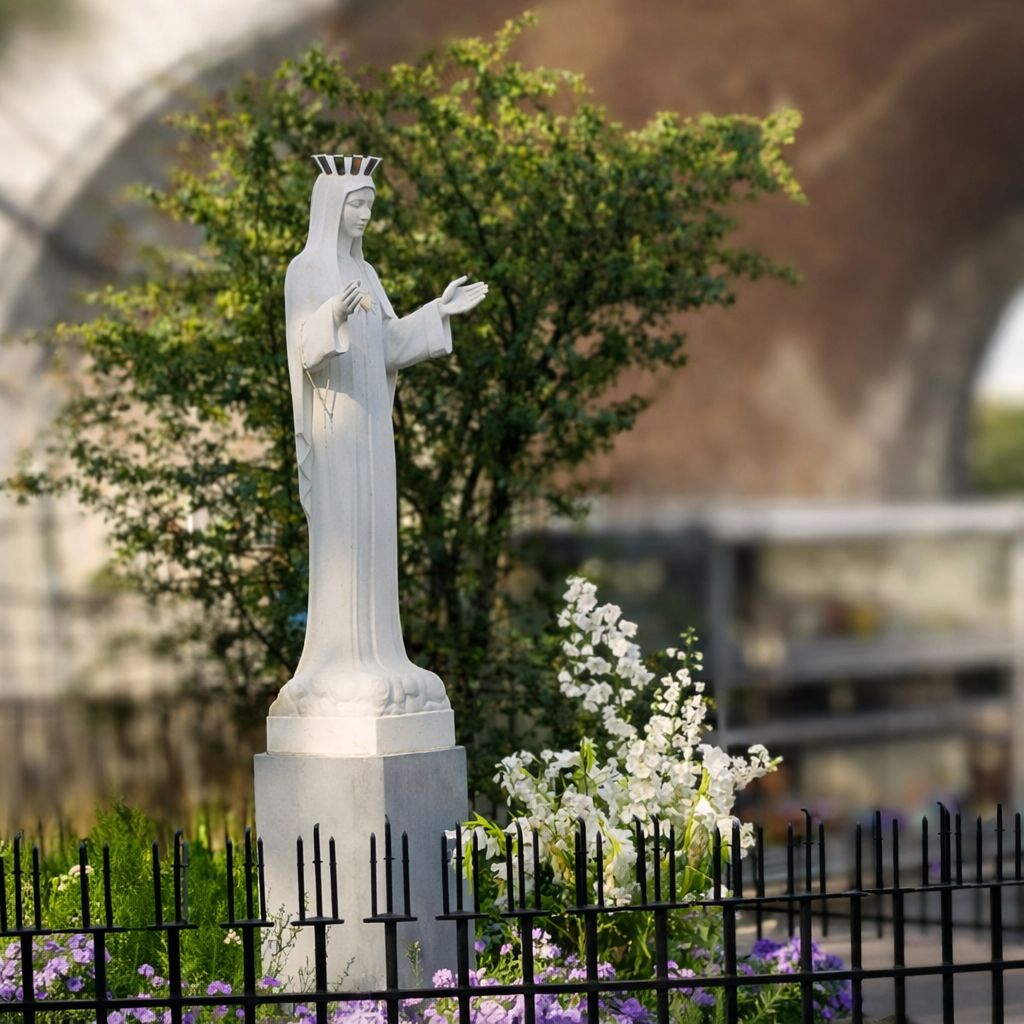
A few steps away stands the statue of the Virgin with the Golden Heart, now the sanctuary’s visual centerpiece. The radiant heart motif has become the defining emblem of Beauraing. It appears on mosaics, prayer cards, and signage, giving the impression that it was central from the beginning rather than introduced only late in the children’s visionary sequence. The sanctuary’s design subtly elevates this late‑emerging detail into the core of the narrative.
The Chapel of the Apparitions offers a quiet, controlled space for reflection. Soft lighting and devotional art create an atmosphere of reverence. It is difficult to imagine the original scenes: children standing rigid and unresponsive, crowds kneeling or crying, the air thick with expectation. The chapel replaces the unpredictability of those nights with contemplative stillness.
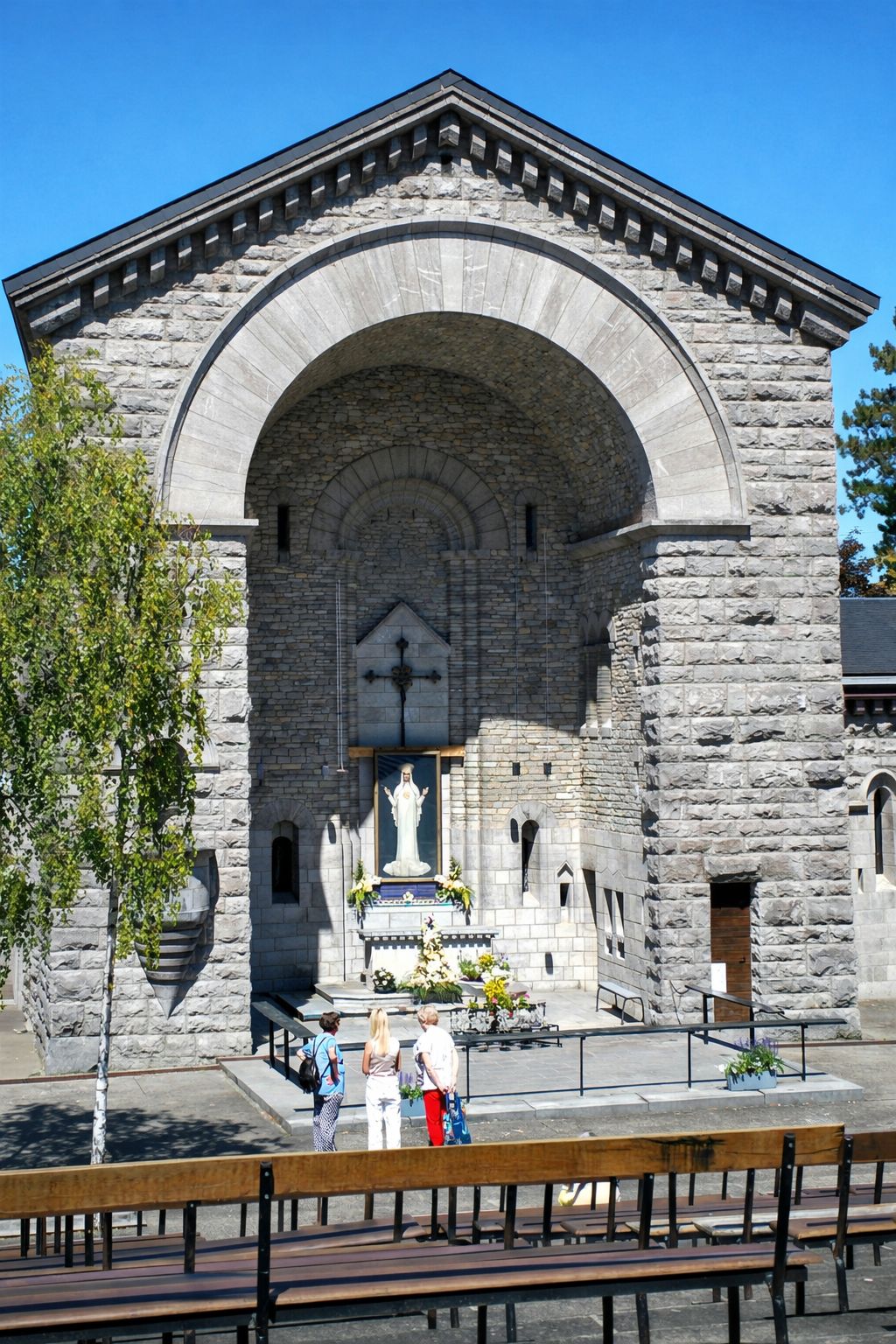
Visitors often continue along the Rosary Way, a sculpted devotional path through the gardens, before entering the modern basilica, built to accommodate large pilgrim groups. Its architecture conveys institutional stability and the Church’s endorsement of the site.
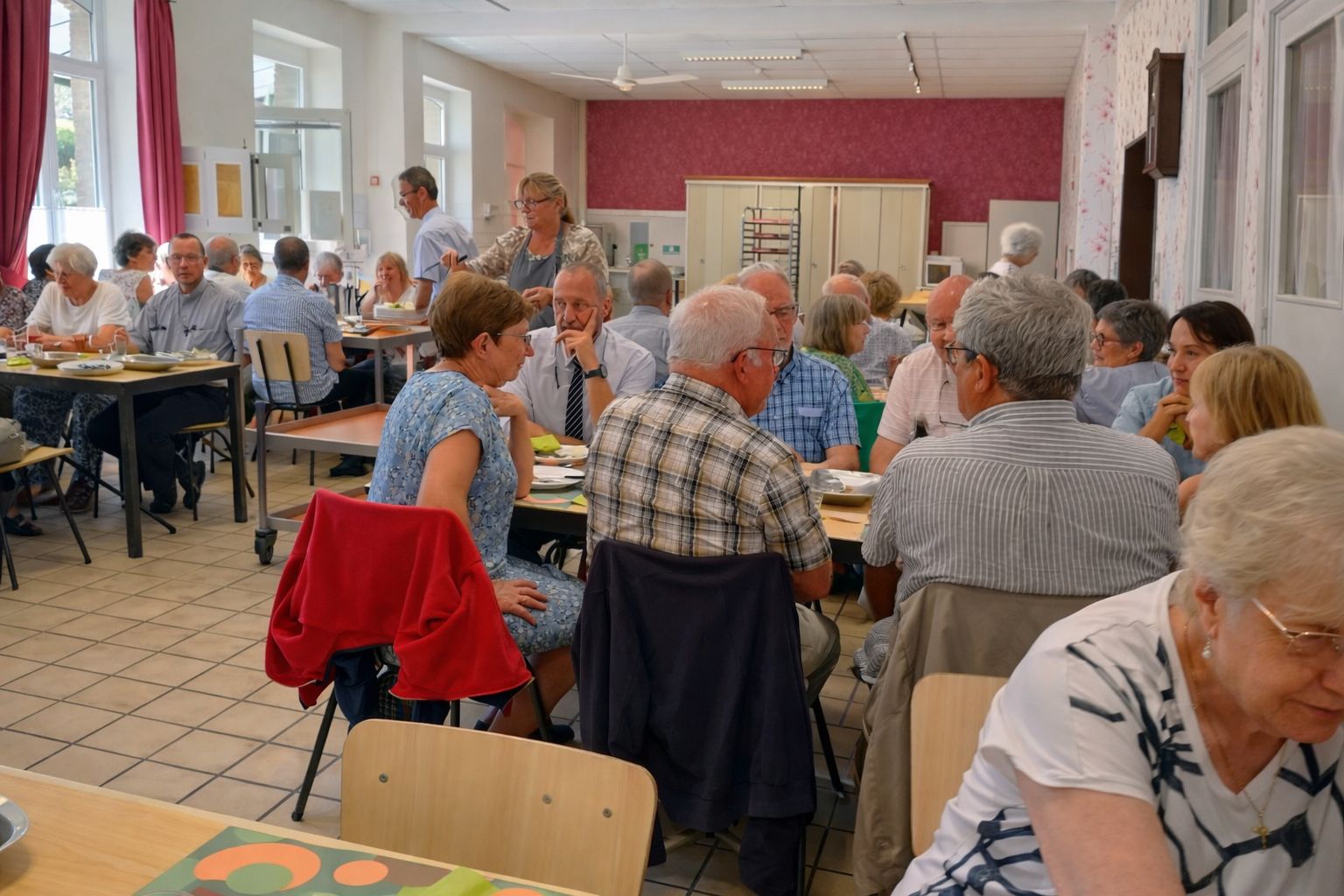
Afterward, many stop at the pilgrim refectory for a simple meal, before lighting a candle in one of the designated areas. The final stop is the gift shop, where books, statues, and official histories present a unified, devotional narrative.
There is, however, an absence in this landscape. It is not obvious to the casual visitor, and it would not mean much if encountered too early. The absence matters only once one returns to the first reports and sees how uncertain the opening moments were. It is the clue that becomes visible after the story has been reconstructed.
Beauraing became an approved apparition site through a process of selection. Certain details were emphasized, others faded, and some were physically removed from the landscape. The modern sanctuary preserves a devotional narrative while leaving out much of the event’s historical complexity. To understand Beauraing, one must look at the visions and at the machinery that made one version of those visions endure.
1. What seems to have happened
1.1. Accounts of the events
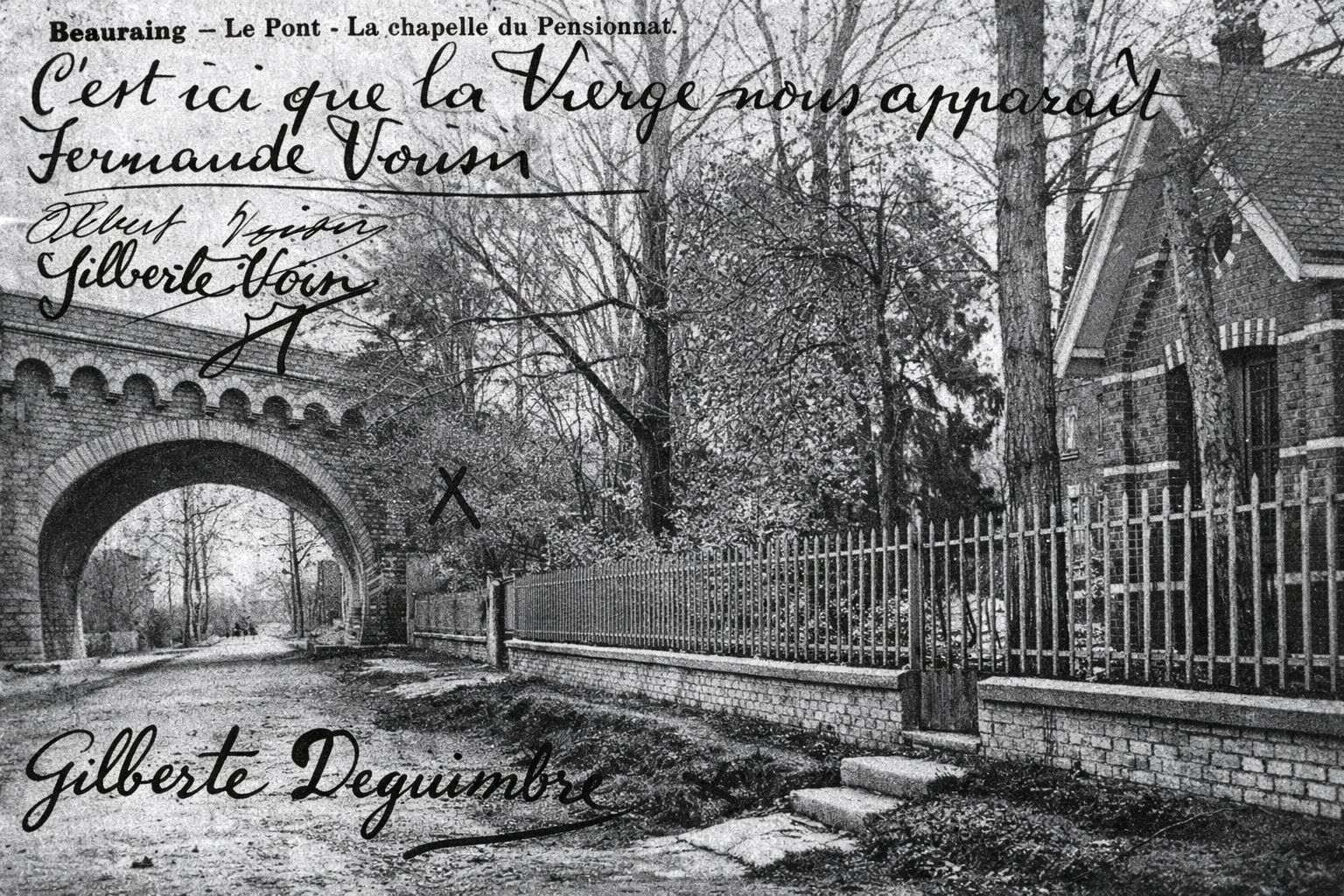
The official, devotional account of Beauraing begins with the kind of quiet provincial setting that, in retrospect, seems almost designed to heighten the contrast with what followed. In late 1932, the town was an unremarkable Ardennes community of two thousand inhabitants, its rhythms shaped by the parish church, the schools run by the Sisters of Christian Doctrine, and the castle ruins overlooking the valley. Nothing in this landscape suggested that it was about to become the focal point of a national devotional surge. Yet on the evening of 29 November, four children – Fernande and Albert Voisin, Andrée and Gilberte Degeimbre – set out to fetch Gilberte Voisin from the convent school, and the narrative that would later be canonized as “the apparitions” began. But the first moments were not clean. The earliest layer of the story appears to have been more uncertain, more local, and more visually entangled with the convent’s existing devotional environment than the stabilized account suggests.
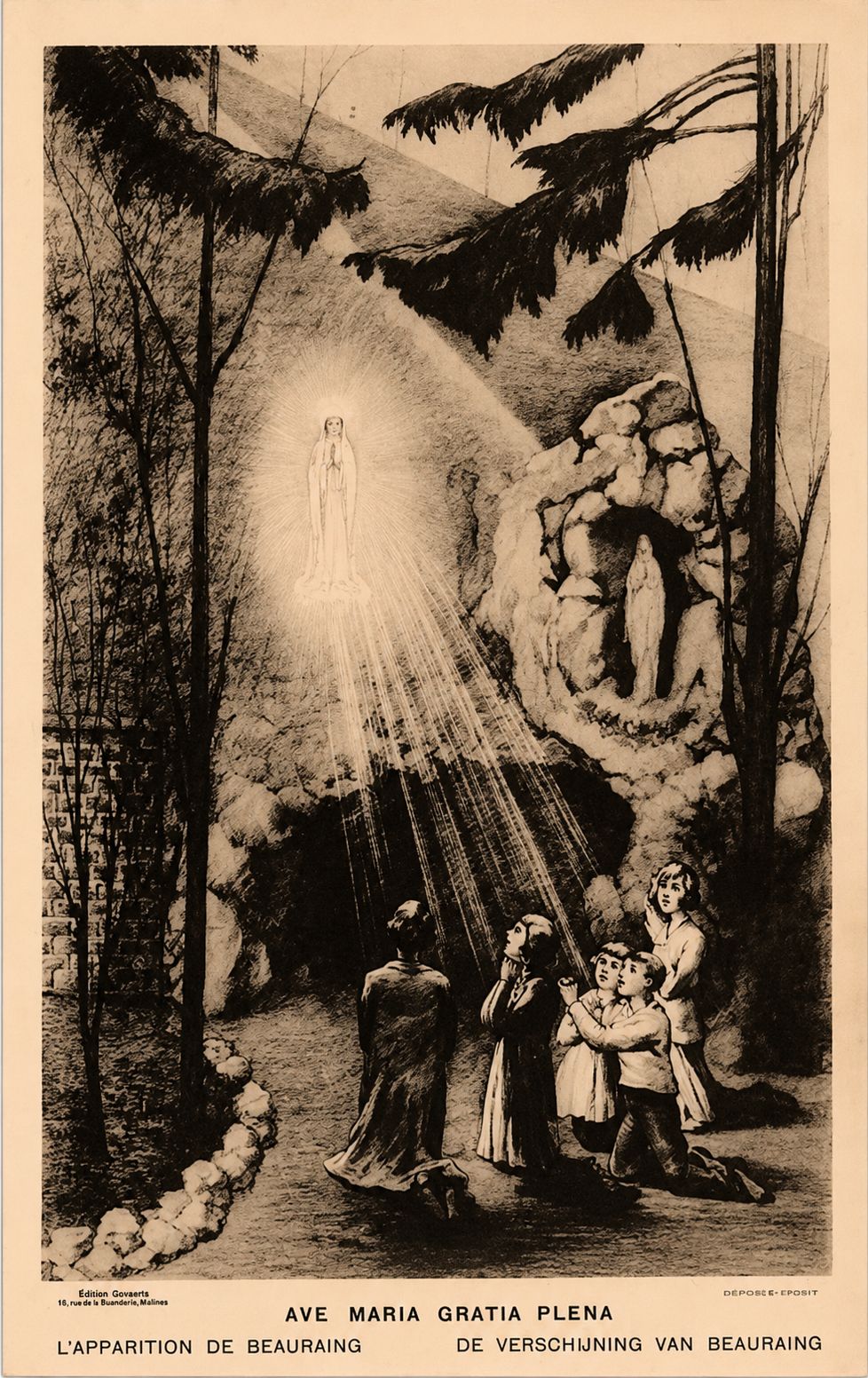
According to the children, the first encounter was abrupt. While waiting at the school door, Albert cried out: he saw something, close to the Lourdes grotto near the school.
A devotional account gives the scene in dramatic reported speech: Albert looked toward the embankment over the grotto and cried, “Look! The Blessed Virgin, dressed in white, is walking above the bridge!” That is the stabilized form of the story, but it should not be smuggled back into the earliest perception as though it were secure. Even the devotional version does not preserve a perfectly clean first recognition. The girls did not all immediately accept Albert’s interpretation. The same account has them first brushing him off: “It’s only the light of an automobile, silly”. That small line is more important than it looks. It preserves the first apparition not as a unified report but as an argument about an ambiguous stimulus.
Sister Valéria, who opened the door, reportedly dismissed the claim with the practical objection that “a statue cannot move,” referring to the Lourdes grotto statue. Some accounts give her demystifying reply in two phrases: “It’s only a branch in the wind” and “Statues don’t walk.” When Gilberte Voisin joined them, she too reportedly glimpsed the figure, exclaiming, “Oh, Look!” The children fled home in fear, and the first thread of the official narrative was established.
this seemingly minor point will become of interest in a later section.
The difficulty is that these accounts cannot all be treated as a single transcript of the first evening. They represent different layers of narration. In the devotional layer, Albert recognizes the Virgin almost immediately and the others catch up. In the critical material, the safest common core is much thinner: a light, perhaps vaguely human-shaped, near the grotto and railway bridge. The more specific claims – a light, a moving statue, a man, a frightening man, the Virgin walking in the air – look like competing interpretations or later narrative sharpening, not equally secure first observations. The attribution of the surviving phrases therefore matters.
A sympathetic retelling includes the children arriving at the Degeimbre house in a burst of overlapping speech, without assigning each sentence to a named child:
“I think we saw the Blessed Virgin!”; “I think it was the statue that moved!”; “The Blessed Virgin was walking!”
That is not the language of a perception that arrived fully categorized. It is the language of children trying to interpret something frightening and luminous beside a ready-made Marian tableau. The child-specific accounts intensify the problem. Albert is later placed at the origin of the clean Marian identification, yet early material has him speaking first of the statue and later of a man.
According to Hallet, the most that can be established with reasonable certainty about the first vision is that the children appear to have seen “une lumière de forme vaguement humaine” – a vaguely human-shaped light.
The children’s initial descriptions were notably diverse. Albert Voisin first spoke of the statue, and subsequently of a man, rather than of a young woman in a robe. Dr Rouvroy’s notes record Gilberte Voisin saying: “je croyais que c’était un homme qui nous faisait peur” (“I thought it was a man who was frightening us”). More strikingly, on the following day Gilberte reportedly told her schoolmates that “la statue de la grotte avait bougé” – the statue at the grotto had moved.
The evidence becomes even more problematic when later testimony is compared with these early reports. Hallet cites Gaston Robert, a convinced supporter of the apparitions, who recorded a later conversation with Albert:
“L’enfant m’affirma que c’était la personne même de la Vierge qu’il avait vue le premier jour et non sa statue se déplaçant.”
Albert was therefore later said to have insisted that he had seen the person of the Virgin herself, rather than a moving statue. Yet this contradicts the earlier account in which he had spoken of the statue and then of a man. The contradiction is especially significant because Robert was himself convinced of Beauraing’s authenticity and had no obvious reason to manufacture an inconsistency damaging to the case.
Hallet identifies a broader pattern, describing “la construction progressive du témoignage des enfants” as established. In later questioning by Professor Étienne De Greeff, Albert reportedly said:
“Le premier jour, après avoir sonné, on n’avait pas vu que c’était la Vierge, mais on le pensait bien.”
Fernande similarly stated:
“Déjà, en disant que c’était une auto, je croyais que c’était la Vierge.”
And “la petite Gilberte” (Degeimbre) declared:
“Nous avons bien pensé que ce n’était pas la Vierge de la grotte, mais nous avons dit tout de même que c’était elle, parce que nous étions si sûrs !”
A natural translation is:
“We did think that it wasn’t the Virgin from the grotto, but nevertheless we said that it was her, because we were so sure!”
There is an apparent tension in the statement itself: they thought it was not the Virgin, yet said that it was the Virgin.
That is potentially much more revealing than a simple later inconsistency. It suggests that the children were already distinguishing their immediate perception from an interpretation they nevertheless asserted. Their own testimony distinguishes between the initial visual perception and the conclusion that the phenomenon was the Virgin. These statements retrospectively reconcile the children’s initial uncertainty with their eventual certainty: they had supposedly not recognized the Virgin at first, but had nevertheless already “thought” that the phenomenon was the Virgin. Hallet regards this as an “construction à-posteriori” rather than a faithful reproduction of the original perception.
The issue, therefore, is not simply that there were minor discrepancies between otherwise identical accounts. The discrepancies concern the identity and nature of the phenomenon itself: a light → the statue → a man → a frightening man → the Virgin.
Nor is it necessary to determine what caused the original light in order to establish this point. Various possibilities were put forward, most involving car headlights illuminating something – a house, perhaps a Touring Club roadside marker – distorted through tree branches. Some suggested railway workers carrying lanterns inspecting the tracks. Everyone in Beauraing was familiar with Joséphine, also known as “dame blanche” because of a habit of haunting the local cemetery while draped in bed-sheets. Hallet himself acknowledges that the origin may never be known, observing that “On ne le saura sans doute jamais faute d’avoir réalisé, alors, une enquête sérieuse.” – the question may be impossible to resolve for lack of serious investigation at the time.
The historical evidence does, however, allow a more modest conclusion: the later claim of a clear and consistent identification of the Virgin from the beginning is not supported by the earliest testimony. Indeed, the evidence suggests the reverse. The initial reports were uncertain and divergent, while the Marian interpretation became progressively more definite.
The children were almost certainly sincere. That matters, and it should be said more than once because the alternative is too easy. Sincerity, however, does not settle the question of what occurred. Children can sincerely misperceive. Several children can sincerely converge. A frightening light near a grotto can sincerely become a Marian apparition when the symbolic vocabulary is already waiting in the garden.
The next evening, at roughly the same hour, the children returned and again reported the same figure. On 1 December, accompanied now by parents and neighbors, they saw the apparition first on the viaduct, then near a holly tree in the convent garden, and finally beneath a hawthorn tree near the gate. This last location became the fixed point of all subsequent visions.
Wikipedia’s summary preserves the roughness of this third-night return: the widow Degeimbre came along “armed with a big stick” because she wanted to find the person who was scaring the children. That detail is more than local color. If the children had come home saying only that they had seen the Mother of God walking in the sky, searching the grounds with a stick would be an odd response. If, however, the earliest report sounded like a white figure, something moving near the grotto, someone hiding, or a statue that had moved, then an adult search for a culprit becomes perfectly logical. The stick-carrying search therefore belongs to the middle layer of the story: after the first shock, before the narrative had fully stabilized. It suggests that the adults closest to the children initially understood the report as something potentially concrete and earthly, not as an already settled heavenly apparition. The historical puzzle is not that the parents were skeptical, it is that their skepticism appears to have been directed toward finding a person or object on the grounds, which implies that the earliest reports may have sounded far more ambiguous than later devotional summaries imply.
The children fell to their knees in unison, while the adults saw nothing. The Sisters, uneasy, closed the garden and attempted to halt what they feared was a childish “comedy,” even releasing the convent dogs. Yet when the children returned on 2 December, the apparition appeared (to them) beyond the gate – and the dogs, in a detail the official narrative preserves with quiet satisfaction, lay silently on the ground.
That evening, Albert asked the figure, “Are you the Immaculate Virgin?” She smiled and nodded. When he asked what she wanted, she spoke for the first time: “Always be good.” Later that night she reframed it into a question – “Is it true that you will always be good” – a moment that would later be cited as evidence of her maternal solicitude.
From this point, the narrative accelerates. The apparitions continued daily, and the crowds grew with remarkable speed. By 3 December, 150 people stood in the street; by 8 December, the Feast of the Immaculate Conception, between fifteen and twenty thousand pilgrims filled the garden and surrounding roads. Doctors and psychologists subjected the children to tests during their ecstasies – bright lights in their eyes, pinches, needle pricks, even a burning match. The children allegedly showed no reaction and bore no marks. The details vary across retellings, which is itself an important sign. Some tests surely happened in some form; the miraculous interpretation of them rests on a much weaker record.
Through mid‑December, the figure usually appeared silently smiling, hands open. On 6 and 17 December she asked for “a chapel.” On 21 December, pressed for her name, she replied: “I am the Immaculate Virgin.” On 23 December she explained her purpose: “So that people might come here on pilgrimage.” The narrative thus acquired its teleology: the apparitions were not merely events but invitations.
Only on 29 December did a new motif appear: Fernande reported seeing a radiant Heart of Gold between the apparition’s open arms. The others did not report seeing it until the following day. That sequence matters. The symbol that would later dominate the sanctuary’s iconography did not enter the group testimony all at once; it appears to have passed from one visionary into the shared narrative. That same evening she warned that the apparitions would soon end. On 30 December she urged: “Pray, pray very much.” On 1 January: “Pray always.”
The final apparition occurred on 3 January 1933 before a crowd said to number tens of thousands. The children received individual messages. To Gilberte Voisin: “I will convert sinners.” To Fernande, who had continued praying even when she saw nothing: “Do you love my Son? Do you love me? Then sacrifice yourself… for me. I am the Mother of God, the Queen of Heaven. Pray always. Goodbye.” The devotional account ends with moral clarity. The historical account should end with a more cautious recognition: a first ambiguous perception had become a stable Marian narrative, performed nightly before a mass audience, then fixed by repetition.
1.2. Detailed Timeline: Apparitions, Words & Context
The chronology below is a composite reconstruction drawn from later reports, press summaries, retrospective memoirs, and secondary accounts. No complete contemporaneous verbatim record of the children’s statements survives, so this section should be read as a working historical sequence rather than a definitive transcript. Dates and wording are therefore approximate. Unclear, questionable, or devotional details are reported here without comment to keep the timeline uncluttered.
1.2.1. Initial Apparitions & Establishing the Location (Nov 29 – Dec 7)
- Nov 29: First vision above the railway bridge. Silent.
- Nov 30: Vision appears above the bridge again. Silent.
- Dec 1: Vision moves to the hawthorn bush inside the convent garden. Silent. A small group of curious neighbors accompanied the children.
- Dec 2: Albert asked, “Are you the Immaculate Virgin?” Mary speaks her first words: asking if the children will “be good.” A crowd of around 50 people watched the children fall to their knees simultaneously.
- Dec 3: Albert asked: “What day should we come?” Mary answered: “On the day of the Immaculate Conception.” Albert asked: “What do you want from us?” Mary answered: “That you come here on pilgrimage.” Around 150 people gathered. Local clergy and the school sisters remained distant, under orders from the Bishop of Namur to avoid encouraging publicity.
- Dec 4: Silent vision. Crowd grew to several hundred. Local police began monitoring traffic.
- Dec 5: Silent vision. Crowd estimated at over 1,000.
- Dec 6: Albert brought a small rosary and asked Mary to bless it. Mary asked: “A small chapel.” First presence of external journalists and regional doctors observing the children’s behavior.
- Dec 7: Silent vision. Thousands began arriving by train and bus ahead of the Feast of the Immaculate Conception.
1.2.2 The Dec 8 Gathering & Silent Daily Visits (Dec 8 – Dec 16)
During the eight-day period following December 8, crowds fluctuated between 1,000 and 5,000. Observers noted that the children went back to normal play within seconds of exiting their trances.
- Dec 8 (Feast of the Immaculate Conception): 15,000-20,000 people assemble. Doctors test the children in ecstasy (pinching, burning, light tests). Mary appears extremely bright but remains completely silent. Expected miracle doesn’t occur.
- Dec 9: Silent vision.
- Dec 10: Silent vision.
- Dec 11: Silent vision.
- Dec 12: Silent vision.
- Dec 13: Silent vision.
- Dec 14: Silent vision.
- Dec 15: Silent vision.
- Dec 16: Silent vision.
1.2.3. Words Resume (Dec 17 – Dec 23)
- Dec 17: Mary speaks again, asking for “a chapel.”
- Dec 18: Mary speaks: “Be good.”
- Dec 19: Silent vision.
- Dec 20: Silent vision.
- Dec 21: Mary speaks, declaring: “I am the Immaculate Virgin.”
- Dec 22: Mary speaks: “I shall convert sinners.” Albert did not see her.
- Dec 23: Fernande alone heard Mary say: “I want a chapel built here so that people may come on pilgrimage.“ Albert did not see her. Crowds swelled again as local newspapers reported the new spoken messages.
- Dec 24: Silent vision. Gilberte Voisin and Andrée asked the Lady for a sign. Only Albert claimed to hear an answer.
1.2.4. The Break (Dec 25 – Dec 28)
During this break, rumors spread that the apparitions were over. Crowds thinned significantly, and skeptics claimed the phenomenon had run its course.
- Dec 25: Children visit garden, No apparition.
- Dec 26: Children visit garden, No apparition.
- Dec 27: Children visit garden, No apparition, then return later with grandparents (21:45) and apparition occurs. According to some accounts only Fernande saw the Lady.
- Dec 28: Children visit garden, accounts conflict on who saw her that evening; Fernande alone, or all five. The Lady says her last appearance will be soon: “Ce sera bientôt ma dernière apparition”.
1.2.5. The Climax & Final Words (Dec 29 – Jan 3)
- Dec 29: All five see her again. As Mary opened her arms to depart, Fernande saw a glowing, brilliant heart surrounded by golden rays on Mary’s chest for the first time.
- Dec 30: Mary shows her Golden Heart to all the children and says to Fernande alone: “Pray, pray very much!” The first claims of spontaneous physical healings began emerging from sick and disabled pilgrims in the crowd who had come to pray near the fence. Albert Voisin was absent from the garden that evening because he had been detained at his school (the Institut Saint-Joseph in Beauraing) for disciplinary reasons or school obligations.
- Dec 31: Golden Heart shown again in silence. Tens of thousands returned to Beauraing as news of the Golden Heart broke in national newspapers.
- Jan 1: Gilberte heard Mary speak: “Pray always.” Albert said he saw nothing, Andrée thought she saw the Lady’s lips move. Fernande said the Lady wanted to speak but that she deliberately did not listen because she was afraid of being the only one to hear.
- Jan 2: Mary announces to Fernande: “Tomorrow I shall say something to each of you in particular.” Police estimated over 20,000 pilgrims arrived in town, preparing for the final night.
- Jan 3 (Final Apparition): Over 30,000 gather. Mary imparts secret personal messages to Gilberte Voisin and Gilberte Degeimbre. To Fernande Voisin she said: “Do you love my Son? Do you love me? Then sacrifice yourself for me.”. She speaks her final words to Fernande: “I am the Mother of God, the Queen of Heaven. Goodbye.” Multiple healings were reported that evening. Most famous among them was Tilmant Côme, a man suffering from severe chronic spinal rheumatism who reported being instantly cured on site.
1.3. Ecclesiastical inquiry and recognition
The Church’s treatment of the events followed a familiar trajectory. The children were questioned repeatedly by clergy and civil authorities; their accounts, the official narrative emphasizes, remained consistent. In 1935, Bishop Thomas‑Louis Heylen of Namur opened an investigation. After his death, Bishop André‑Marie Charue continued the work. In 1942, the Holy See authorized him to proceed toward canonical judgment. On 2 February 1943, he permitted public devotion to Our Lady of Beauraing.
This phrase – permitted public devotion – is central. It does not declare the apparitions historically factual or supernaturally certain. It simply allows Catholics to venerate the site without doctrinal obligation. The Church’s official narrative highlights the children’s sincerity, the simplicity of the messages, and the spiritual fruits that followed: conversions, healings, and the growth of pilgrimage. It is a narrative designed to inspire faith, not to interrogate the psychological or social complexities of the events.
1.3.1. What recognition means
The Church distinguishes between public revelation – the teachings of Scripture and apostolic tradition – and private revelation, which includes apparitions. Public revelation is binding; private revelation is not.
The Catechism states:
“They do not belong, however, to the deposit of faith. Their role is not to ‘improve’ or ‘complete’ Christ’s definitive Revelation.”
Even approved apparitions do not require belief. Approval simply means the Church finds nothing in the event that contradicts doctrine and that the associated devotion is spiritually beneficial.
Present day criteria, formalized in the 1978 Normae Congregationis, focus on orthodoxy (no doctrinal errors), psychological stability (no obvious pathology), moral integrity (no fraud or scandal), absence of manipulation (no financial exploitation), and spiritual fruits (conversions, prayer, charity). Notably, the Church does not require empirical evidence of supernatural origin. It does not attempt to prove that Mary literally appeared. It evaluates whether the devotion is harmless and pastorally useful. The Church’s approach is pastoral rather than forensic.
When Beauraing was investigated (1935–1949), the Church relied on the classical criteria laid out by Prospero Lambertini, later Pope Benedict XIV, in his monumental work De Servorum Dei Beatificatione et Beatorum Canonizatione (“On the Beatification of the Servants of God and the Canonization of the Blessed”) written between 1734 and 1738, this was the authoritative reference until the 1978 Normae Congregationis.
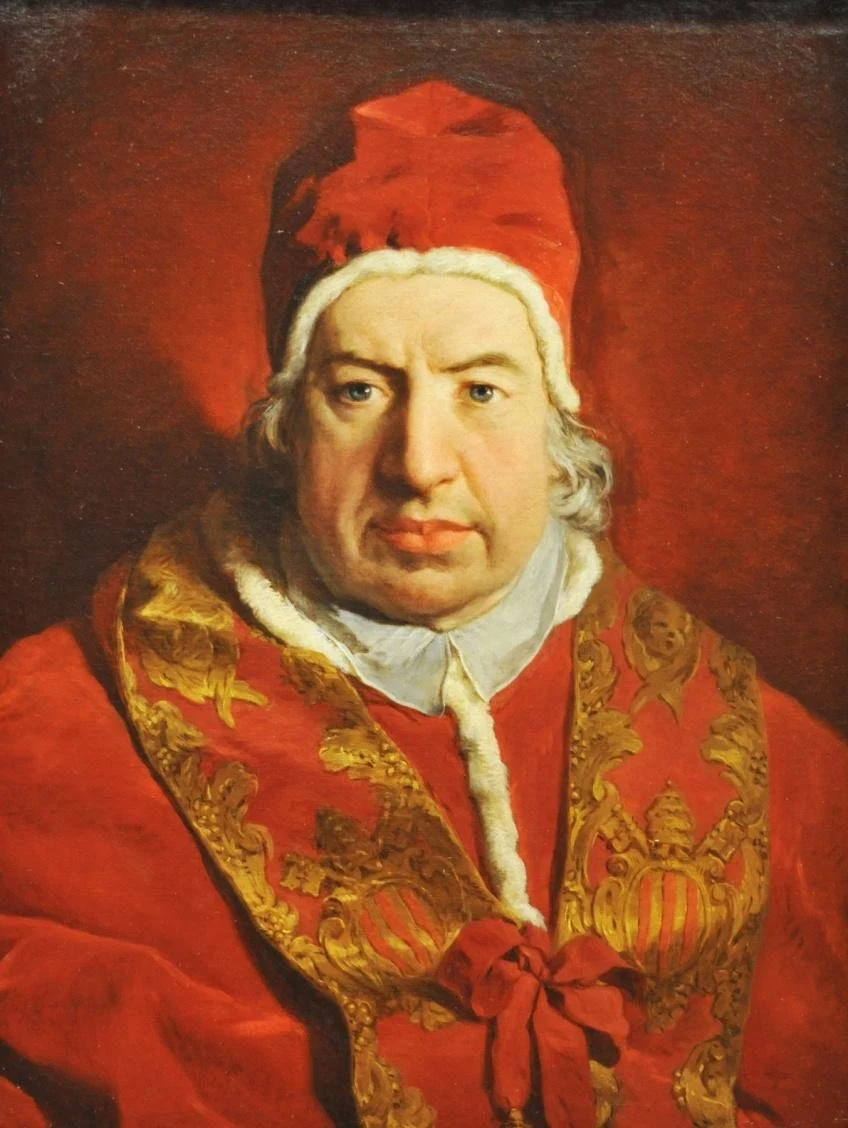
Lambertini’s criteria were surprisingly cautious and skeptical, and not substantially different from the 1978 guidelines:
- 1. Apparitions must be judged with “great prudence”
- He warned bishops not to rush to approve visions and to assume natural causes first.
- 2. The Church must examine the visionaries’ character
- Are they honest? Stable? Free from deception or delusion?
- 3. The content must contain nothing contrary to faith or morals
- This is the same criterion used today.
- 4. The Church must look for “signs of God’s hand”
- But these signs were spiritual fruits, not physical evidence.
- 5. Even approved apparitions do not require belief
- Lambertini explicitly stated that private revelations are never binding.
1.3.2. How these criteria were applied to Beauraing
When the Bishop of Namur investigated Beauraing in the 1930s–40s, he used the Lambertini framework:
- 1. Examine the children’s sincerity and psychological stability
- The commission interviewed them repeatedly. They appeared consistent and not obviously pathological.
- 2. Ensure no doctrinal errors
- The messages were simple: prayer, love, devotion. Nothing controversial.
- 3. Look for spiritual fruits
- Pilgrimages, conversions, healings, renewed devotion.
- 4. Ensure no fraud or manipulation
- The children did not seek money or fame.
- 5. Avoid declaring supernatural origin
- The final declaration in 1949 was cautious:
“We judge that the apparitions are worthy of belief.”
This is classic Lambertini language – permission, not assertion.
- The final declaration in 1949 was cautious:
Just like today, the Church did not require physical evidence, photographs, scientific verification, historical certainty, or proof of supernatural origin. The Church was evaluating harmlessness and spiritual usefulness, not historical truth. The Church doesn’t require supernatural proof because the Church explicitly teaches that apparitions add nothing essential. They are not necessary for salvation, they are not part of doctrine, hence they are not binding.
There is historical precedent for apparitions that were approved or tolerated locally and later came to seem dubious, psychologically unstable, or pastorally awkward. Our Lady of La Salette is one example, with one visionary later becoming involved in apocalyptic cultism. Our Lady of All Nations in Amsterdam is another: devotion was permitted, but the messages were later condemned. Montichiari, or Rosa Mystica, is a further case where devotion persisted despite serious doubts. These examples help explain why harmlessness can outweigh strict historical authenticity.
Put bluntly, the Church is very reluctant to approve miracles or apparitions unless extensive and prolonged public interest compels them to take an official position. At that point, the evaluation depends mainly on whether the recognition would increase devotion without negatively affecting the doctrine or reputation of the Church. But that same caution can produce the opposite tempo when claims multiply: during the 1933 wave, when a new visionary seemed to surface every few weeks, restraint about authenticating anything translated into moving quickly to suppress; Lokeren was shut down within five days. Slow to approve and quick to contain are not opposite policies; they are the same reluctance to lend supernatural authority, responding to a normal case in one tempo and to a contagion in another.
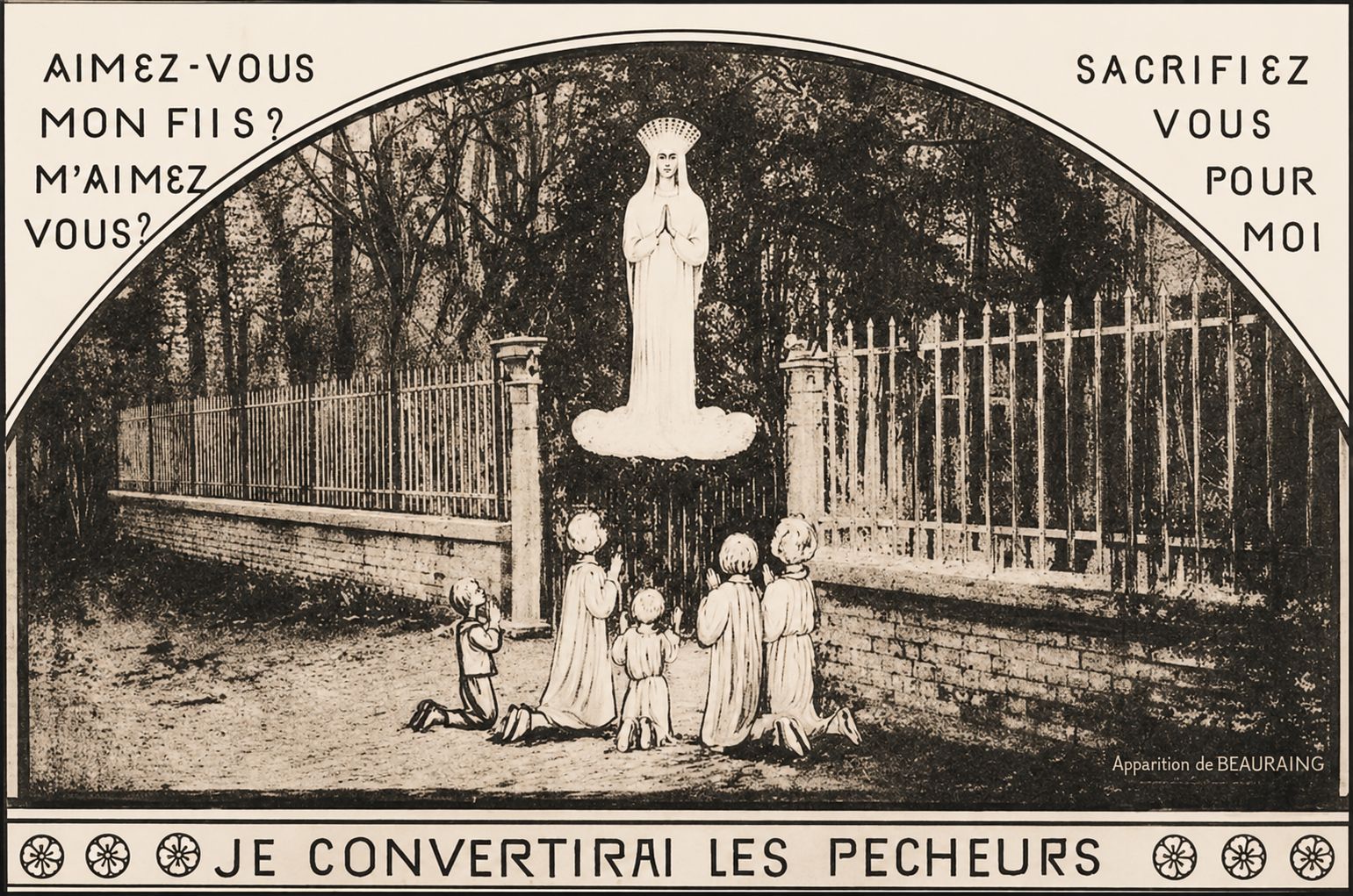
The chapel requested in the apparitions was eventually built, and Beauraing became a recognized place of pilgrimage. In the official memory, the winter evenings of 1932–33 remain moments of luminous intervention: five children, a lady in white, and a message of goodness, prayer, sacrifice, and the conversion of hearts.
1.4. Côme Tilmant and the limits of the story
In the months after the final apparition of 3 January 1933, Beauraing did not settle into stable devotion. It continued to generate visionary overflow. The most important of the local imitators was Côme Tilmant, sometimes written Tilman Côme, a 58-year-old working man or farmworker from Pontaury-Mettet. He had apparently been regarded as physically disabled, and his reported recovery made him a minor celebrity at Beauraing as “Tilmant le miraculé.”
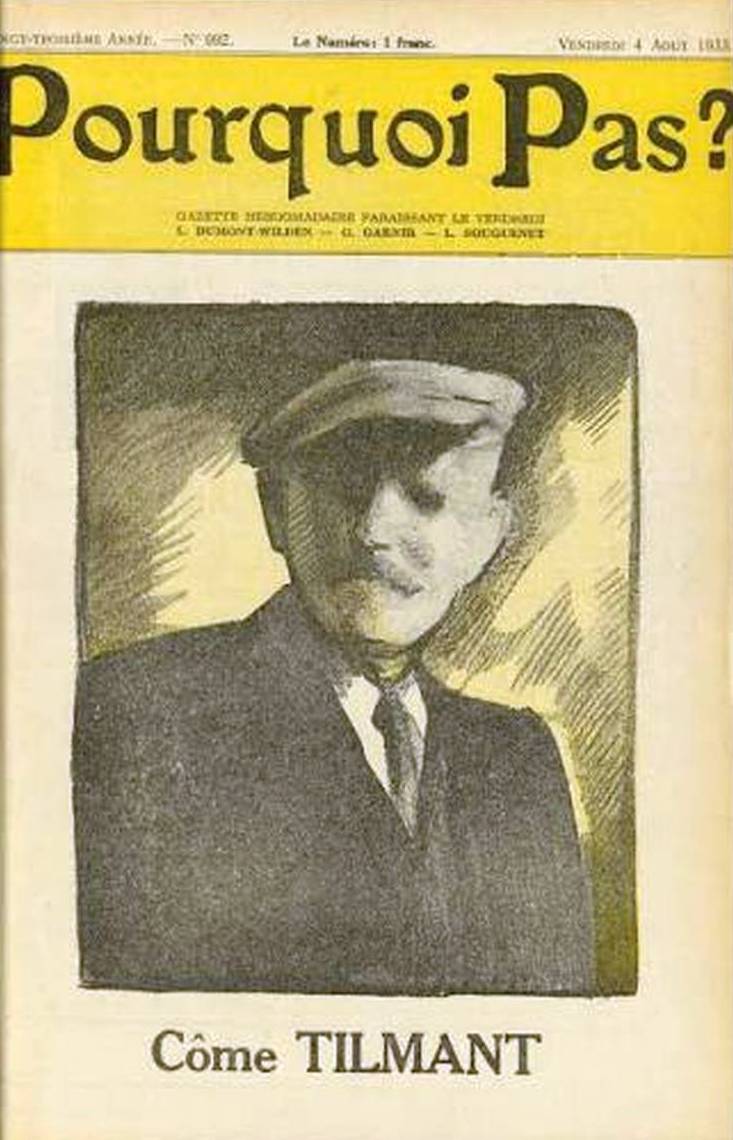
Tilmant had returned to Beauraing on 11 June 1933, months after the children’s final apparition on 3 January. He claimed his first vision after becoming unconscious at the grotto, followed by further visions on June 12 and 15. One later account gives nine visionary experiences between 12 June and 15 August 1933.
His claims went considerably beyond the relatively sparse messages attributed to the children.
The New Yorker, reporting in September 1933, noted that the children’s originally rather sparse account had subsequently been “amplified” by Tilmant. It reported his description of the Virgin shining, St Joseph dressed in grey, and Jesus in black with his hand over his heart and a dove above him. He also “received” detailed instructions concerning the future shrine/pilgrimage.
The children were initially drawn to Tilmant, “comme s’ils étaient ravis de voir qu’un adulte venait confirmer leurs allégations” – as though delighted that an adult had appeared to confirm their claims. They were present at some of his “visions”, although they didn’t claim to see what he saw. In Les apparitions de la Vierge et la critique historique Hallet recounts that on 15 June 1933, when Côme Tilmant was having one of his reported visions, Fernande Voisin was present. Hallet writes:
“En tournant la tête du côté où l’homme regardait, elle crut voir une ‘fumée’ que personne d’autre qu’elle ne vit.”
In other words:
“Turning her head toward where the man was looking, she thought she saw a ‘smoke’ which nobody else saw.”
Then:
“Brusquement, Fernande s’évanouit.”
She subsequently explained that she fainted because she had been frightened by a change in Tilmant’s facial appearance.
Tilmant was supposed to reveal a secret entrusted to him by the Virgin on 5 August 1933, when an enormous crowd of roughly 100,000 pilgrims gathered at Beauraing. According to Pourquoi Pas?, government representatives and plain-clothes gendarmes were specifically assigned to listen to Tilmant and take stenographic notes. Their transcription allegedly differed from the version subsequently supplied to the press and pilgrims by Beauraing’s organizers.
The suppressed passage reportedly began:
“La Vierge m’a dit que les enfants se sont trompés…”
“The Virgin told me that the children were mistaken…” It apparently continued with a demand for a basilica instead of a chapel. The magazine explicitly suggested that the organizers had removed this passage because:
“Déclarer, pour commencer que les enfants se sont trompés… c’est risquer de flanquer tout par terre.”
In other words, saying at the outset that the children had been mistaken risked undermining the entire Beauraing enterprise.
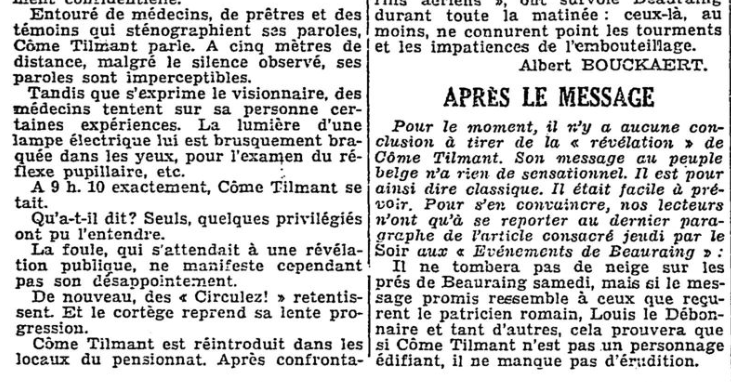
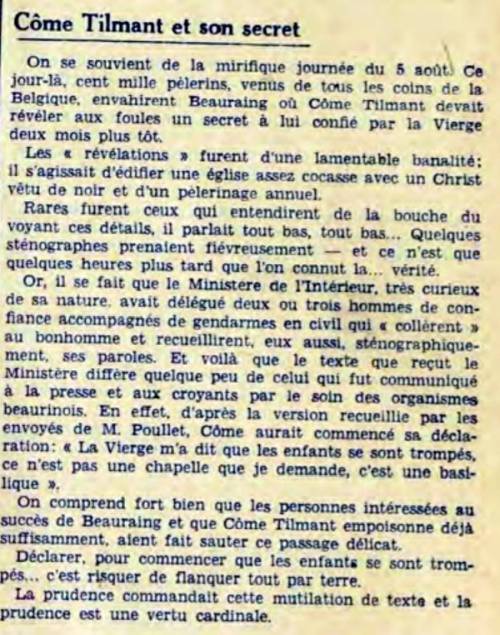
If the Pourquoi Pas? account is accurate, it would demonstrate that the public presentation of visionary testimony at Beauraing could itself be selectively edited when a particular formulation threatened the established narrative.
After 5 August, Tilmant’s reputation rapidly deteriorated. He received bad press, including in Catholic circles, and the Annales de Beauraing et de Banneux began urging caution. This sudden reversal lends some support to the story that he had said something unwelcome. Before that point he had been useful: an adult confirmation of the children’s visionary world. After that point he became dangerous: a visionary whose revelations disrupted the narrative he had been expected to support. There is a small historical irony here: Beauraing eventually got both a chapel and a basilica.
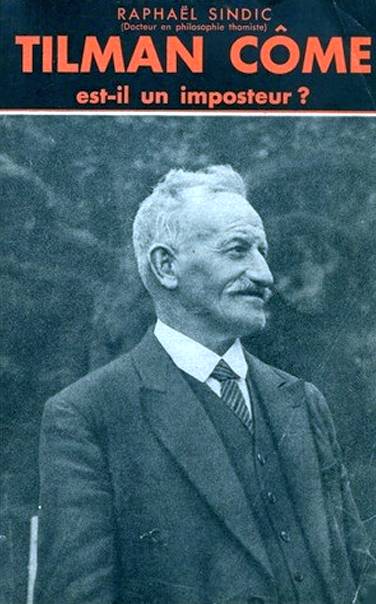
afterwards he apparently became inconvenient
Tilmant therefore matters more than a footnote. He shows the boundary conditions of Beauraing’s credibility. A visionary could be welcomed when he confirmed the children’s story, promoted when he strengthened the site, and rejected when his message threatened the established shape. By rejecting the imitator, Beauraing protected the coherence of the story as much as the children themselves.
2. Hynek–Vallée as a framework for understanding Beauraing

It may seem counterintuitive to begin an analysis of Marian apparitions by invoking the intellectual toolkit of UFO researchers. Yet the work of J. Allen Hynek and Jacques Vallée is useful precisely because it shifts attention from the claimed identity of the entity, to the structure of the encounter. Vallée’s major insight was that reports of anomalous experience often share a common grammar across otherwise different traditions: selected witnesses, altered states, culturally familiar imagery, messages, repetition, symbolic elaboration, and social reinforcement.
Hynek’s taxonomies organized reports before explaining them. Vallée went further, comparing the structures of UFO encounters, fairy encounters, Marian apparitions, and miracle reports. His shift can be compressed into one useful line:
The phenomenon is not the object; the phenomenon is the pattern.
The useful question is what the reported agent does before accepting what it claims to be.
2.1. Hynek’s Taxonomy: the first attempt at order
Hynek’s early work was an attempt to impose structure on a chaotic field. His classification system – still widely cited – divided UFO reports into types based on proximity and interaction:
- Nocturnal Lights
- Daylight Discs
- Radar‑Visual Cases
- Close Encounters of the First, Second, and Third Kind
Later writers would add further categories, but the original usefulness of the system was methodological. Before one explains a phenomenon, one first sorts the reports.
That same taxonomic impulse is useful for Marian apparitions. They too can be sorted before being explained: solitary visionaries versus clusters; single events versus repeated sessions; private visions versus public performances; static imagery versus symbolic elaboration; silent apparitions versus communication events. Once the reports are sorted this way, Beauraing becomes less exceptional. It falls squarely into the repeated, clustered, public type, precisely the type most exposed to expectation, imitation, role formation, and narrative convergence.
2.2. Vallée’s Shift: from objects to patterns
Vallée’s contribution was to move the question away from the literal object and toward the structure of the encounter. A UFO witness may describe a craft. A child visionary may describe the Virgin. A medieval villager may describe a fairy or saint. The content changes with culture, but the encounter often follows the same grammar: a marginal or ordinary witness, a luminous or elevated figure, selective visibility, altered consciousness, brief messages, repeated returns, symbolic intensification, and social aftershock.
Vallée gives permission to compare form without collapsing content. Saying that Beauraing resembles other anomalous encounter reports does not make Mary an alien, or UFOs Marian apparitions in technological costume. It means that human communities repeatedly generate structured accounts of extraordinary agents, and that those structures can be analyzed before deciding what, if anything, stands behind them.
2.3. Vallée’s system of types: a typology of human experience
Vallée’s classification system is not a taxonomy of flying machines so much as a typology of reported experience. Type I cases involve anomalous objects or lights. Type II cases include claimed physical effects: traces, burns, marks, electromagnetic disturbances, or physiological changes. Type III cases involve entities. Type IV cases involve abduction or immersive altered-state experiences. Type V cases involve communication: messages, teaching, warnings, commands, symbolic disclosures.

Beauraing sits at the intersection of several of these types. It begins almost as a Type I report: a light or luminous figure near the bridge and grotto. It quickly becomes Type III: a visible humanoid entity. It includes Type IV elements: trance-like absorption, fixed gaze, loss of ordinary responsiveness, and the children’s collective ecstatic posture. It is also Type V: the figure eventually delivers messages, requests a chapel, names herself, gives private secrets, and reveals symbolic content. The late claims of insensitivity to pain are the closest Beauraing comes to Type II, but they remain the weakest part of the dossier because they were never documented with scientific rigor.
This classification matters because it separates the layers of the claim. A light is not yet a person. A person is not yet the Virgin. A message is not yet proof of supernatural origin. A physiological anecdote is not yet a measurable effect. The devotional narrative tends to collapse all these layers into one luminous certainty. A classification framework forces them apart again.
2.4. Cultural vocabulary and the adaptability of the phenomenon
One of Vallée’s most durable observations is that anomalous encounters adapt to the symbolic vocabulary of their witnesses. Medieval Europe saw saints, demons, and fairy beings. Nineteenth-century America saw mysterious airships. The late twentieth century saw black triangles, greys, and technologically framed visitors. The form of the encounter may remain surprisingly stable, while the costume changes.
In Beauraing, the available vocabulary was Catholic, Marian, and explicitly Lourdes-shaped. The children were not neutral observers encountering an uninterpreted light in an empty field. They were Catholic children in a convent-school garden, beside a Lourdes grotto, under the eyes of sisters, parents, neighbors, doctors, journalists, clergy, and eventually thousands of pilgrims. A light near that setting did not have to travel far before becoming a Lady; a Lady did not have to travel far before becoming the Virgin; and once the Virgin had appeared, the expected grammar of apparition culture supplied the rest: prayer, goodness, pilgrimage, chapel, secrets, heart, rosary, farewell.
Beauraing therefore fits a recognizable pattern: repeated sessions, clustered witnesses, public performance, selective visibility, sparse messages, and late symbolic enrichment. The following sections treat those elements separately, because their cumulative force is stronger when the layers are not collapsed into a single devotional certainty.
3. Characteristics of the Beauraing Entity
3.1. Analysis of the Entity’s appearance
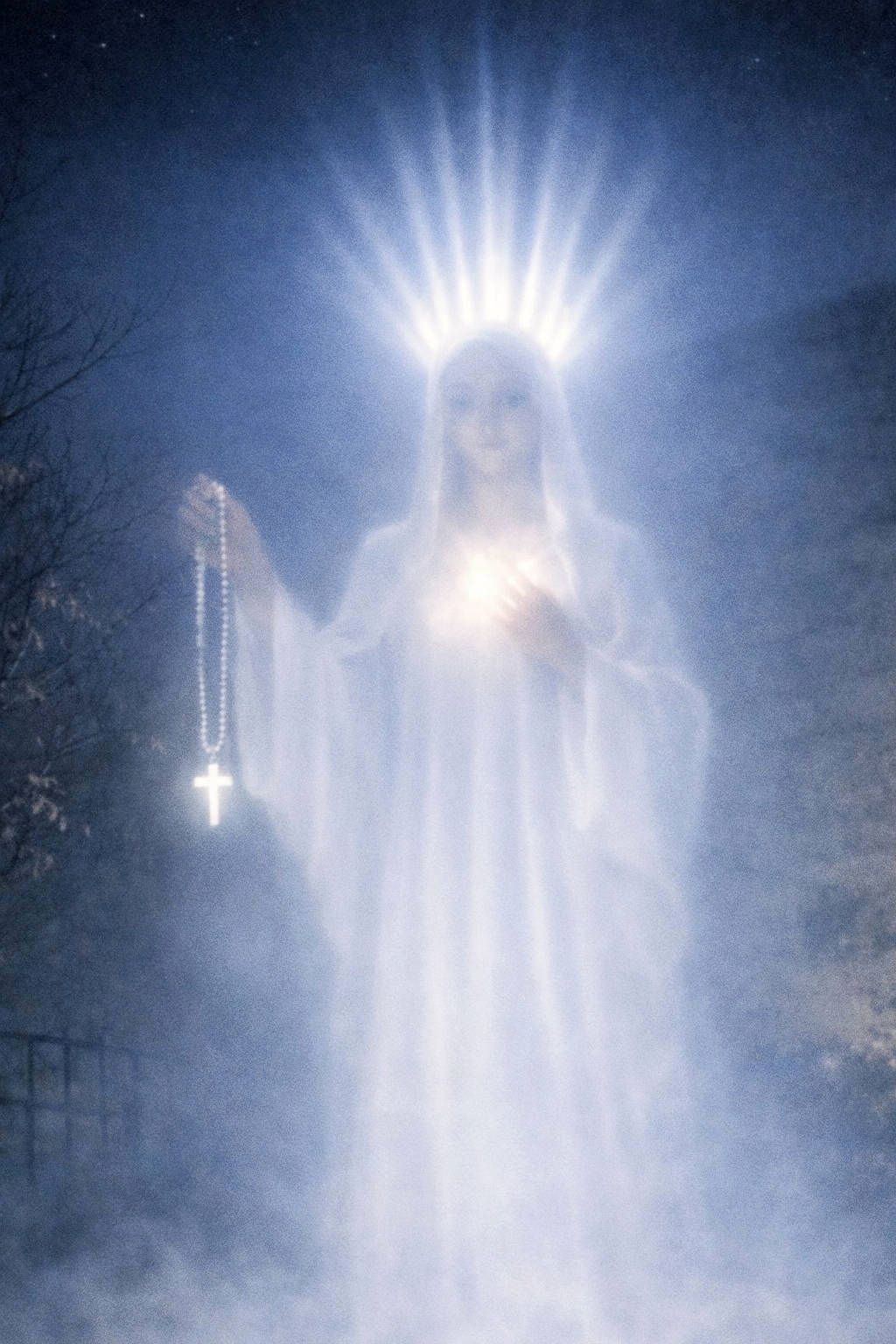
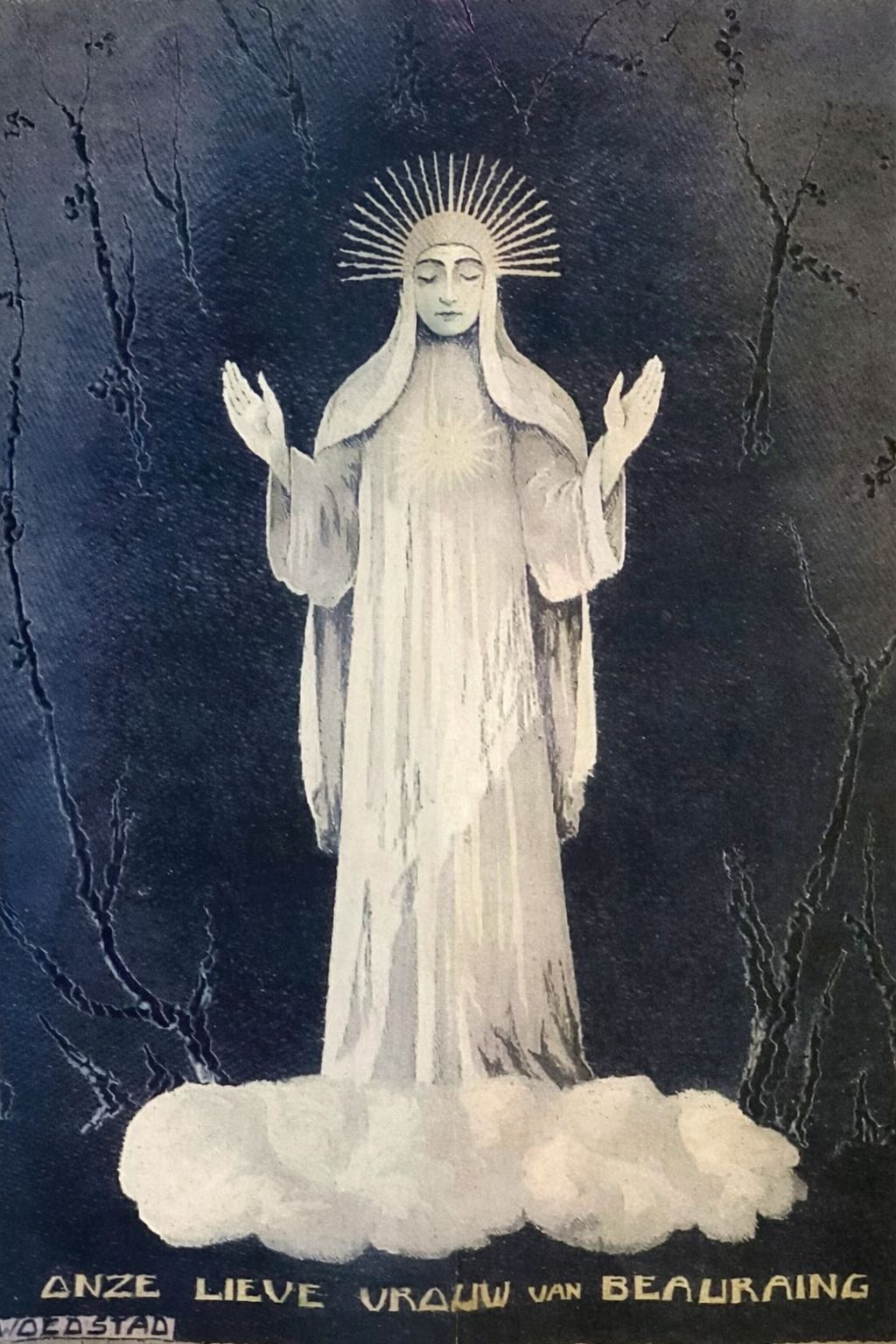
- Female, luminous, elevated
- Age: Appears as a young woman (late teens–20s).
- Dress: Long robe, described as luminous, white or pastel blue, stylized.
- Described with a crown or radiance.
- Holds a rosary; encourages its use.
- Bears a glowing heart (later stylized as the “Golden Heart”)
- Silent or speaking only to the children
3.1.1. The Golden Heart
The Golden Heart is not a historical attribute of Mary. It is a devotional symbol, representing love, compassion, emotional purity, and Marian intercession. It aligns with the Sacred Heart tradition, which itself is a medieval and early‑modern development.
The theological concept behind the symbol comes directly from the Gospel of Luke: during the Presentation of Jesus in the Temple, the holy man Simeon prophesies to Mary: “And a sword will pierce your own soul too.” Luke also notes twice that Mary “treasured all these things, pondering them in her heart.”
During the Middle Ages, Catholic mystics began focusing intensely on the human anatomy of Christ and Mary to emphasize their humanity.
- St. Anselm and St. Bernard (12th Century): These theologians wrote extensively about the emotional and spiritual depth of Mary’s heart, laying the groundwork for visual devotion.
- St. John Eudes (1601–1680): A French priest regarded as the “Father of the Devotion to the Sacred Hearts,” Eudes popularized the physical depiction of the heart. He promoted public liturgical feasts dedicated to the Heart of Mary. In 1648, he published a book featuring a prototype of the symbol: a single heart representing the combined love of Jesus and Mary.
By the late 17th and 18th centuries, artists began painting Mary’s heart with specific, standardized symbols to distinguish it from the Sacred Heart of Jesus (which features a crown of thorns and a cross on top). The Immaculate Heart symbol is defined by three core visual elements:
| Visual Element | Meaning & Symbolism | Origin Context |
|---|---|---|
| The Piercing Sword | Represents her intense grief and sorrow during the Crucifixion. | Derived directly from Simeon’s biblical prophecy in Luke 2:35. |
| The Wreath of White Roses | Represents her purity, sinlessness, and the dogma of the Immaculate Conception. | White roses have traditionally symbolized virginal purity since medieval heraldry. |
| The Flames and Light | Represents her burning, unquenchable love for God and humanity. | Inspired by the Holy Spirit (often depicted as fire) and her divine charity. |
The symbol moved from localized European devotion to a global Catholic icon due to two major events in France and Portugal:
- The Miraculous Medal (1830): a Catholic devotional medal whose design comes from visions reported by (later Saint) Catherine Labouré at the convent of the Daughters of Charity in Paris. According to Catherine, the Virgin Mary appeared to her several times and requested that a medal be struck according to a specific design. Mary reportedly said that those who wore it with faith would receive special graces.
The medal was first produced in 1832, during a cholera epidemic in Paris. Reports of healings and answered prayers spread rapidly, leading people to call it the “Miraculous Medal.” The reverse side of a medal explicitly featured two hearts side-by-side: the Sacred Heart of Jesus crowned with thorns, and the Heart of Mary pierced by a sword. Millions of these medals were distributed globally. - Our Lady of Fátima (1917): In Portugal, three shepherd children reported seeing Mary holding her heart in her hand, surrounded by thorns. Mary explicitly requested the establishment of the “Devotion to the Immaculate Heart” to bring peace to the world during World War I. Following Fátima, mass-produced holy cards, paintings, and plaster statues depicted Mary pointing directly to her glowing, rose-wreathed, sword-pierced heart. This imagery became a staple in Catholic homes and parishes worldwide.
Thus even before Beauraing, the Immaculate Heart of Mary was widely depicted with flames, flowers, swords, or radiance. Gold was a common symbolic color for divine love. So a glowing golden heart on Mary is not a conceptual leap; it’s a small variation on existing imagery.
The Golden Heart also only appeared after repeated sessions, early visions did not mention the heart. Only after many evenings, with crowds gathering, clergy questioning, emotional intensity rising, and the children entering trance-like states did the “Golden Heart” appear in the narrative. Fernande reported seeing it first, and the others only reported it the next day. This is classic “vision elaboration”. In visionary psychology, repeated sessions often lead to narrative expansion, symbolic enrichment, increased detail, and convergence on culturally familiar motifs. This happens in Marian apparitions, UFO abductions, séance phenomena, spiritualist circles, and hypnotic regressions. The longer the phenomenon continues, the more symbolic detail accretes.
The heart appears after the children were already treated as visionaries. By that point, they had a role to perform, they were under intense observation, were emotionally invested, and were expected to “receive messages”. Adding a symbolic element like a glowing heart is exactly what happens when a narrative stabilizes and deepens.
| Apparition | Symbol added later in the sequence | Interpretation |
|---|---|---|
| Lourdes | The title “Immaculate Conception” appears only after weeks | Narrative crystallization |
| Fátima | The “Miracle of the Sun” was not predicted until late | Escalation under crowd pressure |
| Medjugorje | The Queen of Peace title emerges gradually | Symbolic elaboration |
| Beauraing | The Golden Heart appears after repeated séances | Same pattern |
The Golden Heart is exactly what you’d expect from Belgian Catholic children in 1932. Belgium had strong Sacred Heart devotion, especially in Wallonia, where Sacred Heart statues, Sacred Heart processions, holy cards, catechism illustrations, and Sacred Heart badges/medallions were extremely common. The children were immersed in this imagery. If anything, it would be surprising if the children didn’t eventually introduce a heart motif.
3.1.2. The blue-white dress
As with the Golden Heart, this is a post-biblical symbol whose visual meaning evolved through changing materials, devotional practice, and historical context.
The association between Mary and blue stems from the Middle Ages, blending medieval art trends, biblical symbolism, and the royal status of a heavenly queen. Three main historical and theological factors solidified this connection:
- Imperial Status: Originating in the Byzantine Empire around 500 A.D., blue was considered the color of an empress. When artists depicted Mary as the “Queen of Heaven,” they dressed her in blue to signify her supreme royal dignity.
- The High Cost of Pigment: During the Renaissance, blue paint (specifically ultramarine) was made from crushed lapis lazuli, a rare gemstone imported from Afghanistan. Because it was often more expensive than gold, patrons and artists reserved it for the holiest figure in the painting: Mary.
- Biblical Typology: The Old Testament instructed that the Ark of the Covenant be covered with a “cloth of solid blue” (Numbers 4:6). Christian tradition equates Mary to the “New Ark” because she carried the living Word of God, making blue the perfect symbolic color.
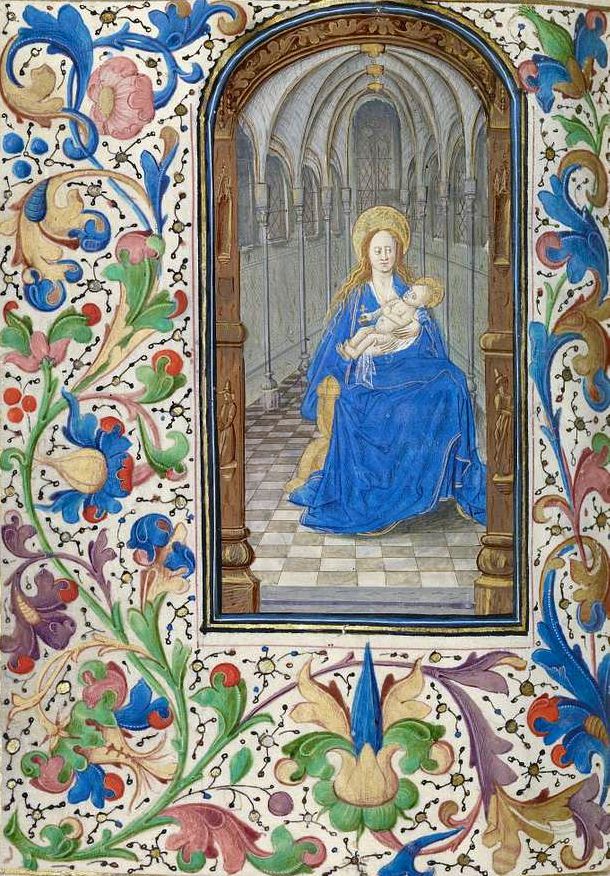
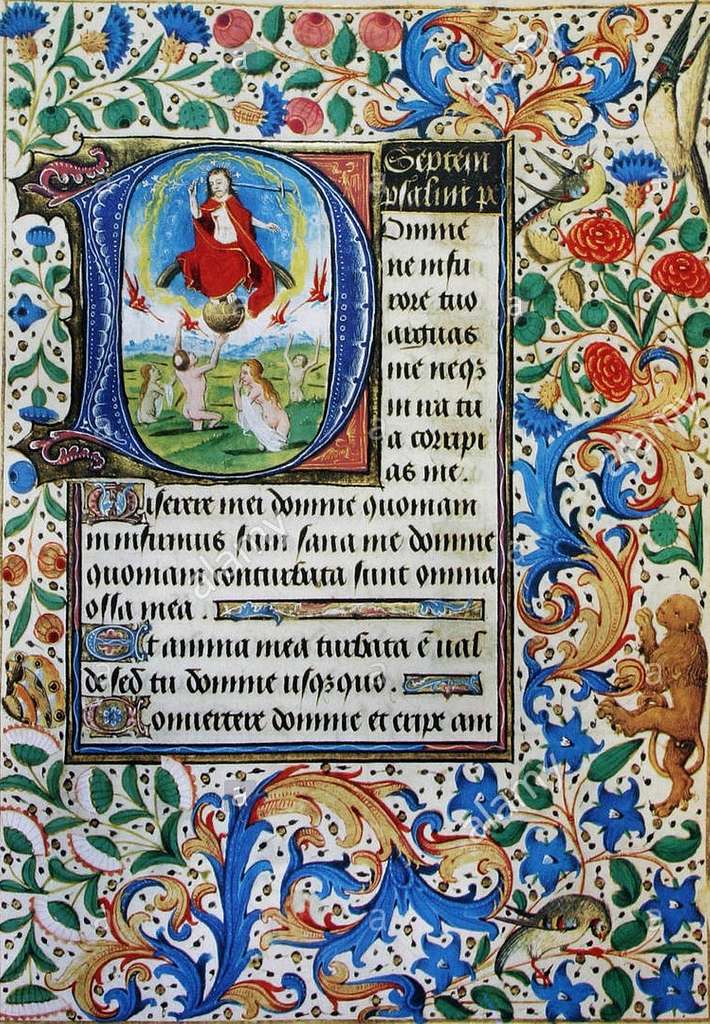
The transition of Mary’s signature color from deep, regal ultramarine to a soft pastel or powder blue occurred primarily during the 19th century, driven by the invention of synthetic paint, highly publicized 19th century Marian apparitions, and a shift in theology and culture.
For centuries, true ultramarine required crushing lapis lazuli. In 1828, French chemist Jean-Baptiste Guimet successfully formulated “French Ultramarine” using cheap, abundant materials like clay, soda, and sulfur. Because blue paint was suddenly cheap and mass-produced, artists and church decorators no longer had to use it sparingly as a pure, concentrated glaze. Instead, they began heavily mixing the new synthetic blue with zinc white or lead white. This mechanical shift in paint-mixing gave birth to the soft, powdery “Marian blue” we see in modern statues.
The physical shift in paint chemistry perfectly aligned with a wave of major Marian apparitions in France, where visionaries explicitly described Mary wearing lighter shades:
- The Miraculous Medal (1830): As noted in the Golden Heart section, the Rue du Bac apparitions generated mass medal circulation; in this context, its blue enamel and luminous Marian palette helped standardize soft blue Marian imagery.
- Our Lady of Lourdes (1858): In southern France, 14-year-old Bernadette Soubirous saw a vision of a “tiny maiden”. Instead of a heavy medieval royal cloak, Bernadette explicitly described Mary as wearing a simple pure white dress with a bright, light-blue sash around her waist.

While Renaissance ultramarine symbolized majesty and the high material cost of devotion, pastel blue shifted the focus toward her gentleness, humility, and accessibility to ordinary people. As the Catholic Church formalized the dogma of the Immaculate Conception in 1854, theological focus shifted from Mary’s role as an Imperial Queen to her role as the sinless, gentle “Spiritual Mother” of humanity. Pastel tones visually represented this new emphasis on approachable purity, innocence, and heavenly peace. By the early 20th century, mass-produced plaster statues painted in soft baby blue became standard in Catholic churches and schools worldwide, and so too in the school of Beauraing.
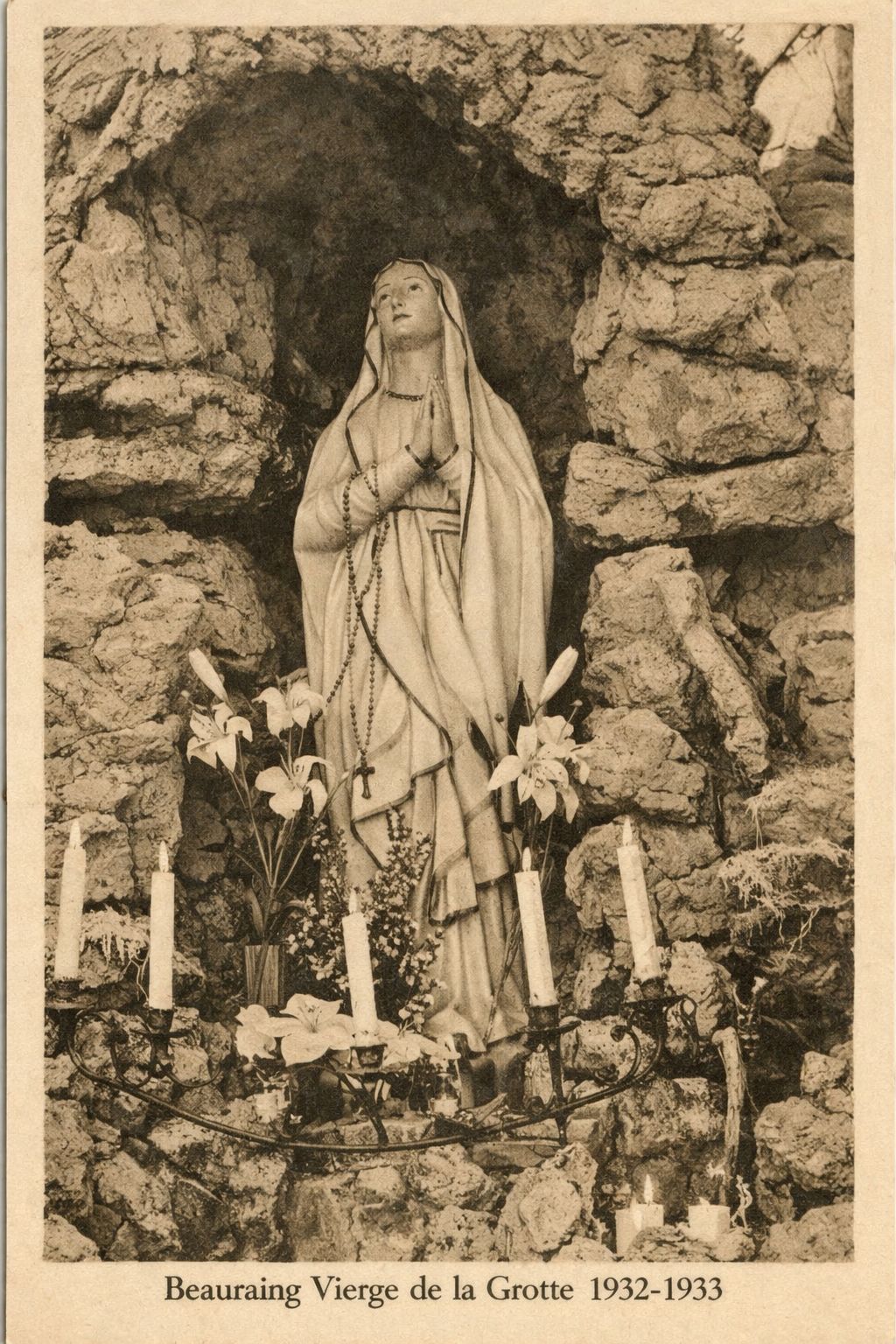
In short, the Beauraing dress is iconographic rather than historical. It reflects the mental template of Mary held by Catholic children in 1932, not the clothing of a woman from Roman‑era Galilee.
3.1.3. The crown
The representation of Mary wearing a crown, stars, or an aura of light evolved in stages from the 12th century through the 17th century, transitioning from a symbol of European royal authority to a cosmic, mystical vision. This imagery developed through distinct artistic eras, rooted heavily in a specific biblical passage and geopolitical events. The concept of Mary as a crowned queen first explicitly exploded in Western European art during the 1100s.
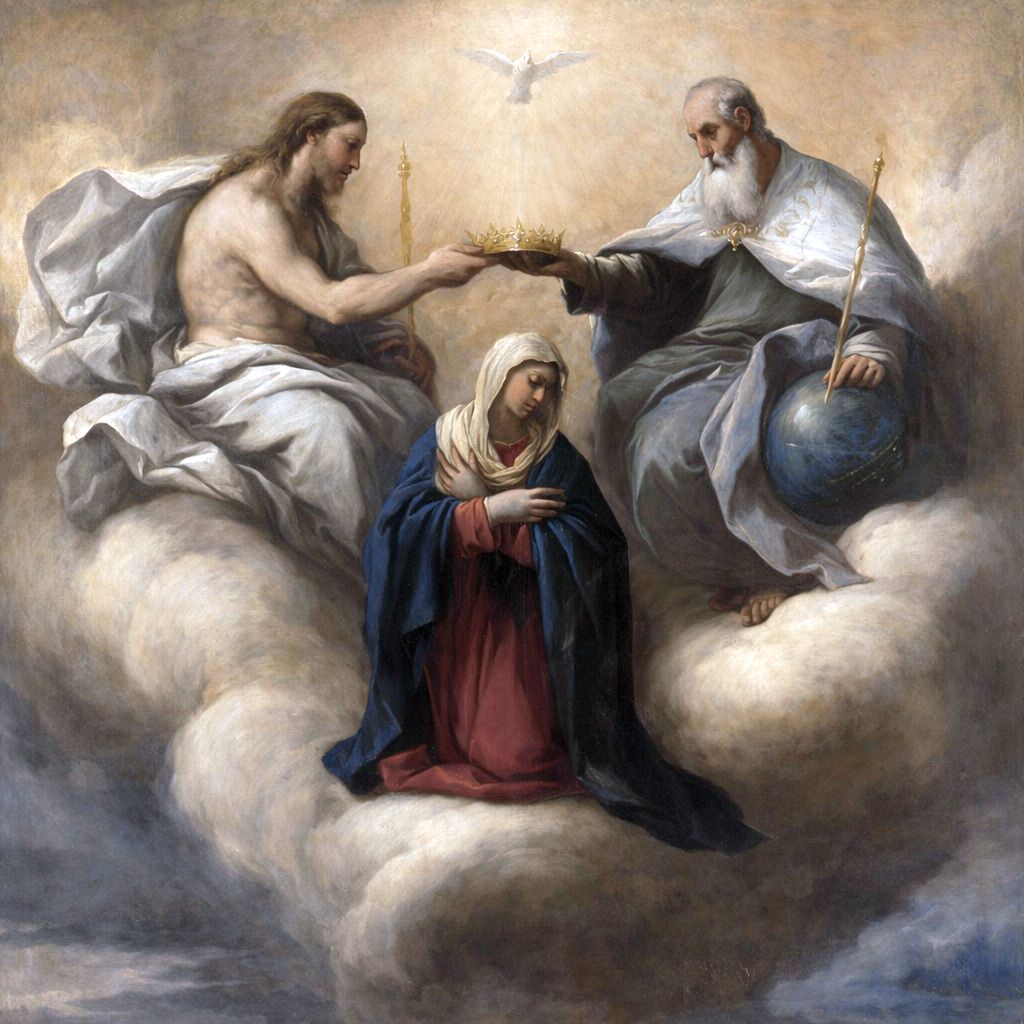
- The “Throne of Wisdom”: Early medieval art usually showed Mary simply as a seat or throne holding the Christ child.
- Influenced by theologians like Saint Bernard of Clairvaux, artists began depicting the “Coronation of the Virgin”. The earliest examples appeared as cathedral stone carvings in France (such as at Notre-Dame de Paris and Chartres Cathedral) and apse mosaics in Rome (at Santa Maria in Trastevere). These works depicted Christ or an angel physically placing a traditional, jewel-encrusted royal crown onto Mary’s head to solidify her title as Regina Caeli (Queen of Heaven).
- The shift from a physical gold crown to a celestial halo of twelve stars became definitive during the Counter-Reformation and the Baroque period (16th–17th Century). This imagery is taken directly from the New Testament’s Book of Revelation 12:1, which describes a cosmic vision: “A great sign appeared in heaven: a woman clothed with the sun, with the moon under her feet and a crown of twelve stars on her head.” Catholic theologians historically interpreted this woman as a symbol for both the Church and Mary.
- The Counter-Reformation Boost: When Protestant reformers rejected Marian devotions in the 1500s, the Catholic Church responded by exalting Mary’s heavenly power even more aggressively. They took the powerful, apocalyptic language of Revelation and instructed artists to paint her with those exact cosmic symbols.
- Artistic Standardization: In 1649, Spanish painter Francisco Pacheco published an influential guide on religious art. He laid down strict rules for depicting the Immaculate Conception: Mary was to be painted hovering in the sky, surrounded by an aura of sunlight, standing on a crescent moon, and wearing a floating circle of exactly twelve stars instead of a heavy metal crown. Masters like Diego Velázquez and Bartolomé Esteban Murillo popularized this look across the globe. The rays of light or glowing aura (often called a mandorla or glory) developed to visually depict the phrase “clothed with the sun.” Instead of a simple circular halo around her face, the light expanded to envelop her entire body.
- Symbolism of the Stars: The twelve stars themselves were interpreted as representing the twelve tribes of Israel (the Old Covenant) and the twelve Apostles (the New Covenant), showing her authority over all of salvation history.
Historically, Mary of Nazareth would not have worn a crown. This is a post‑biblical theological construct. The crown signals theological elevation, not historical realism. It marks the apparition as a religious symbol, not a person.
3.1.4. The rosary
Mary appears holding a rosary – this creates a logical contradiction: Mary is depicted using a devotional object invented over a millennium after her lifetime, designed for prayers addressed to herself.

The rosary has roots in several early Christian prayer traditions. Third-century Christian hermits and monks in Egypt (known as Desert Fathers) used stones and later prayer ropes to keep track when praying the 150 Psalms. Various forms of “the Jesus Prayer” (such as “Lord Jesus Christ, Son of God, have mercy on me.”) became popular. The short prayer was said over and over again in a type of mantra while counting beads. The Our Father was also prayed 150 times, using a string of beads with five decades referred to as a Paternoster (Latin for “Our Father”).
590 AD: The Hail Mary used to only be one line from Luke’s Gospel: “Hail Mary, full of grace, the Lord is with thee.” In 590 AD, Pope Gregory the Great invited Catholics to pray the Hail Mary during the Mass on the Fourth Sunday of Advent. This was the beginning of the prayer’s popularity.
1050 AD: Later, the words of Elizabeth to Mary were added to the Hail Mary prayer: “Blessed art thou among women, and blessed is the fruit of thy womb.”( Luke 1:39-44) At this point, more people started praying the Hail Mary repetitively, using beads to keep track.
Early 1100s AD: Following established medieval patterns of repetitive prayer, devotional communities described penitential forms of reciting large sets of Hail Marys with bodily gestures such as kneeling, genuflection, or prostration.
1214 AD: According to medieval legend, St. Dominic, the founder of the Dominican Order, had a vision of Mary, who told him about the Rosary. Dominic made it his mission to spread the Rosary wherever he went. He encouraged lay Catholics to gather in small groups to pray an early version of the Rosary together.
1261 AD: Pope Urban IV is traditionally credited with adding the name of Jesus to the end of Elizabeth’s words: “Blessed art thou among women and blessed is the fruit of thy womb, Jesus.”
1555 AD: St. Peter Canisius published the Hail Mary in his catechism with almost the entire final petition. His version read: “Hail Mary, full of grace, the Lord is with thee. Blessed art thou among women and blessed is the fruit of thy womb, Jesus. Holy Mary, Mother of God, pray for us sinners.”
1566 AD: Eleven years later, the Catechism of the Council of Trent included, for the first time, the entire petition, concluding with the words “now and at the hour of our death. Amen.”
1568 AD: The Hail Mary was officially approved as the current version.
1917 AD: Mary appeared to three shepherd children in Fátima, Portugal, giving them many messages, including a call to pray the Rosary every single day for world peace. She invited them to add a short prayer to every decade: “O my Jesus, forgive us our sins, save us from the fires of hell, and bring all souls to heaven, especially those in most need of your mercy.” This new update to the Rosary is called “The Fátima Prayer.”
Like the Golden Heart, the appearance of the rosary in the Beauraing visions occurred only after many sessions, and is entirely in line with what Catholic children of 1930 would be expected to see.
3.1.5. The lack of the unexpected and the problem of Divine Restraint
These iconographic details converge on the same conclusion: the Beauraing entity contains nothing visually or verbally unavailable to the children. Its appearance is entirely post-biblical, rooted in European Catholic imagery, symbolically consistent, historically impossible, and reflective of collective religious imagination rather than antiquity. Like UFO encounters, Marian apparitions tend to feature a distinct lack of unexpected elements; the Queen of Heaven never appears riding a Honda Super Cub or wearing a fedora.
Marian apparitions tend to choose marginal witnesses: children, adolescents, shepherds, sickly girls, rural seers, and socially peripheral people least able to document an extraordinary event under rigorous conditions. This is true at Lourdes, Fátima, Beauraing, Medjugorje, and many lesser-known cases. From a devotional point of view, the humility of the witness is meaningful. From an evidentiary point of view, it is puzzling. If the Queen of Heaven wishes to communicate with humanity, why repeatedly choose the demographic least able to verify, articulate, or defend the message?
The messages deepen the problem. They are almost always doctrinally safe, emotionally gentle, and theologically unadventurous: pray, repent, be good, love Jesus, say the rosary. They do not offer verifiable new information, unexpected correction, or practical knowledge unavailable to the witnesses’ culture. They do not say, “Here is the cure for cancer,” “Here is how to prevent the next war,” “Here is a testable sign that will convince the world,” or “Here is something your society could not already have imagined.” The content is pious, but it is also exactly what the local devotional culture already contained.
The usual theological answer is that God respects human freedom and therefore does not intervene in history in coercive ways. But apparition narratives already claim intervention. If Mary can appear in Beauraing, why not Berlin in 1933? If she can speak to children, why not to Stalin? If she can encourage rosaries, why not discourage genocide? If she can request a chapel, why not offer germ theory, famine prevention, or any piece of knowledge that would unambiguously exceed the culture that produced the vision?
That tension does not disprove the phenomenon. It does, however, make the absence of the unexpected central to the analysis. The very features believers cite as signs of authenticity – humble witnesses, simple messages, lack of spectacle, devotional familiarity – are also the features that make apparitions difficult to distinguish from culturally scripted visionary experiences. If the Queen of Heaven is indeed the author of these events, she appears to have adopted a communication strategy that is indistinguishable from human psychology, local iconography, and social reinforcement.
3.2. Characteristics of the Entity’s behavior
3.2.1. Spatial and temporal behavior
Viewed as a reported entity rather than as a theological identity, the Beauraing figure has a specific behavioral profile. It appears localized: one apparition at a time, in one place, never simultaneously elsewhere. It moves through space continuously, “walking in the air” or approaching from the direction of the railway embankment rather than teleporting or simply materializing. It appears at repeated times, remains for minutes, responds to the children’s requests to stay longer, and departs. In the children’s account, the entity behaves as if embedded in ordinary spatial and temporal continuity.
3.2.2. Selective visibility and sparse messages
At the same time, the entity is selectively visible. Adults standing nearby see nothing. The children see and hear the figure, but the environment shows no independent trace: no shadows, no footprints, no physical displacement, no sound audible to others, no temperature change, no damage to plants or ground, no measurable effect on objects or weather. The reported phenomenon interacts powerfully with perception but weakly, if at all, with matter.
The messages are simple and ideologically coherent: be good, pray, build a chapel, come on pilgrimage, love my Son, sacrifice yourself. They are devotional rather than informational. The entity does not reveal unknown facts, correct theological errors, prevent political catastrophe, or offer testable knowledge. It gives the kind of message Belgian Catholic children in 1932 already knew how to receive.
3.2.3. Psychological effects and medical tests
The psychological effects are stronger than the physical ones. The children entered trance-like states marked by fixed gaze, rigidity, synchronized kneeling, reduced ordinary responsiveness, emotional arousal, and allegedly muted pain response. That profile is important, but it points first to altered consciousness rather than external force. The phenomenon changes the witnesses; it does not visibly change the world around them.
The physical effects are correspondingly thin. Claims of reduced pain response during ecstasy are rhetorically powerful but empirically fragile. The tests were crude, inconsistently recorded, and socially inhibited. Nobody in that setting was likely to perform a proper neurological examination, use controlled stimuli, apply chemical irritants, or press a genuinely hot object against a child under the eyes of crowds and clergy. The result is an evidentiary vacuum: no baseline pain response, no controlled comparison between ordinary and ecstatic states, no physiological measurements, and no independent protocol.
The most dramatic devotional formulation says doctors and journalists were trying to “confondre les ‘mensonges’ des petits” – expose the children’s “lies” – and that doctors pinched calves, pushed a knife into Andrée’s skin, and burned Gilberte’s hands with a match:
“les médecins pratiquent des tests, durant l’apparition, en pinçant fort les mollets, en enfonçant un couteau dans la peau d’Andrée, en brûlant les mains de Gilberte d’une allumette. Rien n’y fait, les enfants restent insensibles et ne gardent après coup aucune trace de ces tests douloureux.”
“The doctors carried out tests during the apparition, pinching the calves hard, pushing a knife into Andrée’s skin, and burning Gilberte’s hands with a match. Nothing worked; the children remained insensitive and afterward kept no trace of these painful tests.”
The claim has two parts: no pain reaction during the ecstasy and no trace afterward – “ne gardent après coup aucune trace”. Pinching, penknife pricks, light in the eyes, and a match flame may well have been used. Similar amateur tests – pins, bright lights, matches held near the skin – were reported at other sites in the Belgian wave, including Chênée and Olmen. That wider pattern matters: this was not a unique medical protocol invented for Beauraing, but a common 1932-33 apparition-wave habit of poking, dazzling, and prodding entranced children to see whether they reacted.
The strongest version, a knife driven into skin leaving no mark, undermines itself. Enfoncer un couteau dans la peau means to drive or push a knife into the skin. If the skin was penetrated, there was a wound. If there was no trace, the test did not show what the devotional retelling wants it to show. The contradiction between penetration and absence of injury is not a minor quibble; it is exactly where the apologetic anecdote exceeds the evidence it can support.
The details also shift across retellings. The episode is most often linked to Dr Fernand Maistriaux, Dr Lurquin, and Dr Goethals. One account gives Lurquin as passing a flame under Gilberte Voisin’s hand, pricking the hands of both Gilbertes with a penknife, and shining a bright light into Gilberte Voisin’s eyes. Goethals is described as repeatedly pinching Gilberte Voisin, putting his hand before her eyes, and trying to dazzle her with a flashlight. A contemporary account in the Revue générale says Lurquin found two of the children insensitive to penknife blows, pinching, and a match flame, but his report was dictated to Professor Étienne De Greef on 18 January 1933, more than forty days after the experiment.
That delay matters. Which child was tested (Gilberte and Andrée versus the two Gilbertes in the two accounts quoted above), which stimulus was used, whether the hands or calves were involved, and whether any mark remained all vary between accounts. After the initial experiments, the children reportedly objected to being physically tested. According to Joset’s Dossiers de Beauraing, an agreement followed: only six doctors trusted by the children would be allowed into the apparition area during visions, and even they were not allowed to touch them. The 8 December episode therefore looks less like a continuing medical protocol than a brief, rough, and later embellished test.
A later diocesan medical and psychological examination did occur after the 1935 commission began its work, but that was a different kind of inquiry. Its value lay in judging sincerity, stability, and mental state over time, not in verifying analgesia under controlled injury. Read as a Vallée-style physiological effect, Beauraing’s analgesia claim would need repeatability, measurement, proximity correlation, and independent verification. It has none of these.
There are ordinary psychophysiological mechanisms that can account for muted response without making the children liars. Trance and dissociation can narrow attention so sharply that external stimuli are deprioritized. Stress-induced analgesia can blunt pain during fear, awe, or religious ecstasy. Social expectancy can make a child who has become a “visionary” partly consciously and partly automatically maintain the role. Observer bias can then sharpen ordinary stoicism into total imperviousness: “they did not flinch” becomes “they could not feel pain.” The medical episode is therefore important, but its importance is methodological. It shows how a fragile anecdote became an evidentiary pillar.
3.2.4. Beauraing versus other major Apparitions
| Case | Witness Type | Entity Behavior | Physical Effects | Message Content | Cultural Patterning |
|---|---|---|---|---|---|
| Beauraing (1932–33) | 5 children | Walks in air; stays longer on request; localized | None | Prayer, devotion, “I am the Immaculate Virgin” | Strong Marian iconography; Golden Heart motif |
| Fátima (1917) | 3 children | Appears monthly; consistent form | Sun phenomenon (contested); ground drying | Repentance, prayer, secrets | Apocalyptic tone; Portuguese Catholic imagery |
| Lourdes (1858) | 1 child (Bernadette) | Static figure in grotto | Spring emerges; healings (unverified medically at the time) | Penance, prayer | Local Marian devotion; white dress/blue sash |
| Medjugorje (1981–present) | 6 teens | Appears on schedule; long dialogues | None confirmed | Peace, conversion | Modernized Marian imagery; ongoing messages |
Beauraing is closest to Lourdes in perceptual style: a localized, luminous female figure, no independently verified environmental effects, and a setting already saturated with grotto devotion. It lacks the mass-witness environmental anomaly claimed at Fátima, and it lacks the extended conversational content of Medjugorje. Its distinctiveness lies instead in the compressed, public, highly social sequence through which the narrative stabilized.
3.2.5. Entity behavior summary
From a Vallée-style perspective, Beauraing sits at the intersection of entity encounter, immersive visionary state, and communication event. That does not make UFO occupants and Marian figures the same thing; it shows that human beings repeatedly produce structured reports of anomalous agents whose form, message, and behavior follow the cultural grammar available to the witnesses.
4. Psychological profile of the child witnesses
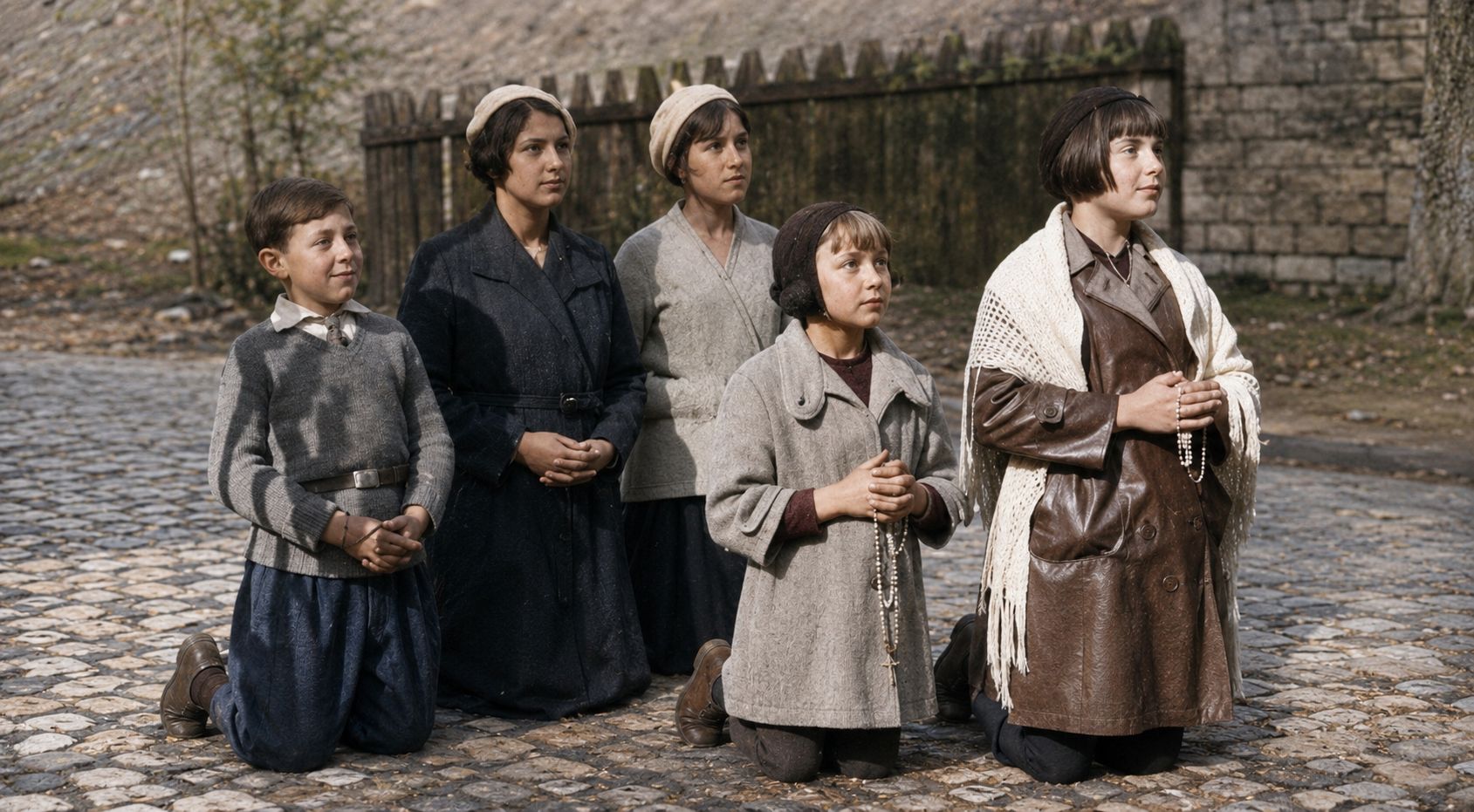
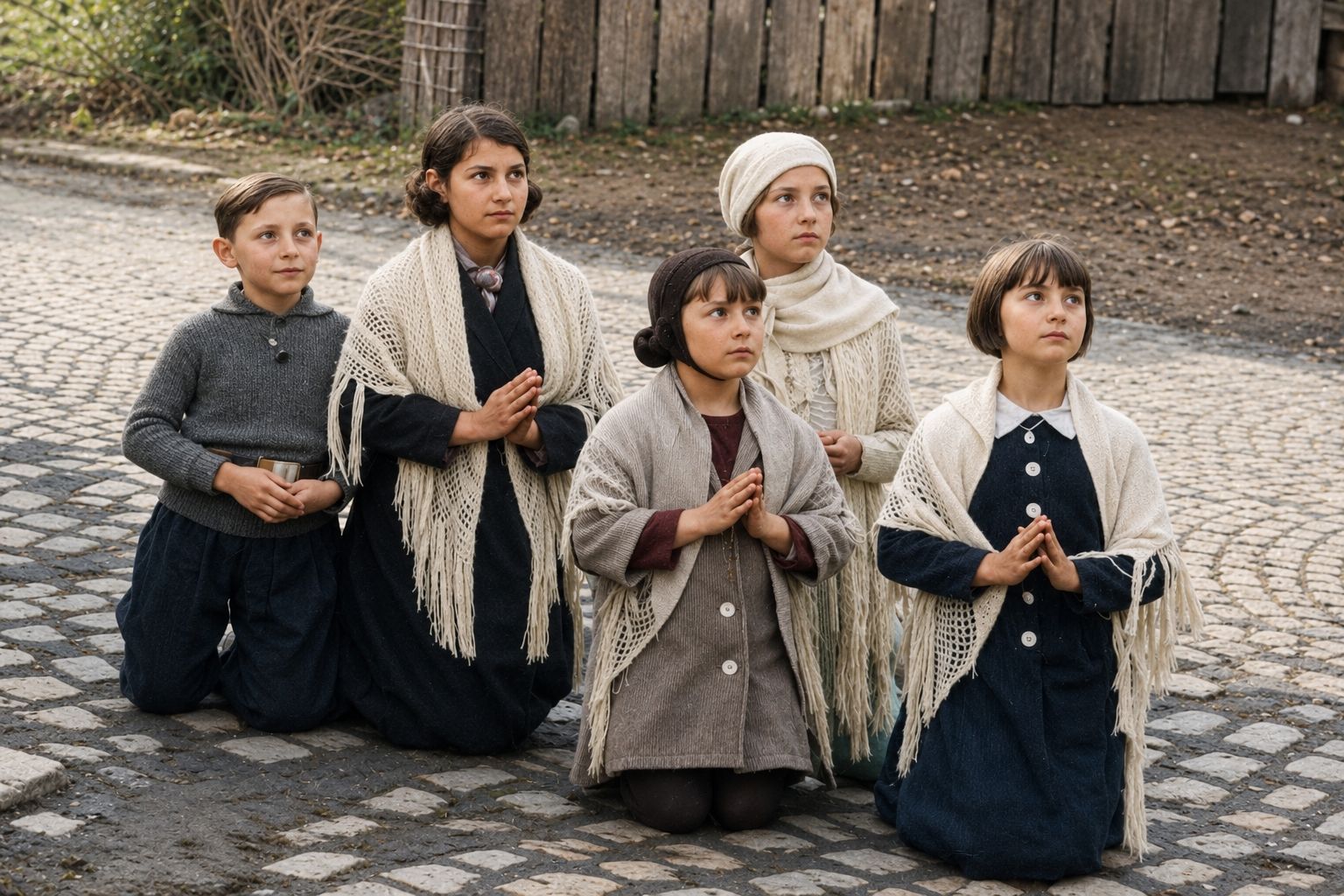
The witnesses were not interchangeable symbolic children. They were five specific children in two close family clusters: Fernande Voisin, about fifteen; Andrée Degeimbre, about fourteen; Gilberte Voisin, about thirteen; Albert Voisin, about eleven; and Gilberte Degeimbre, about nine. That age range matters. It is old enough for social awareness and narrative commitment, young enough for vivid imagination, conformity pressure, and dissociative absorption to remain unusually accessible.
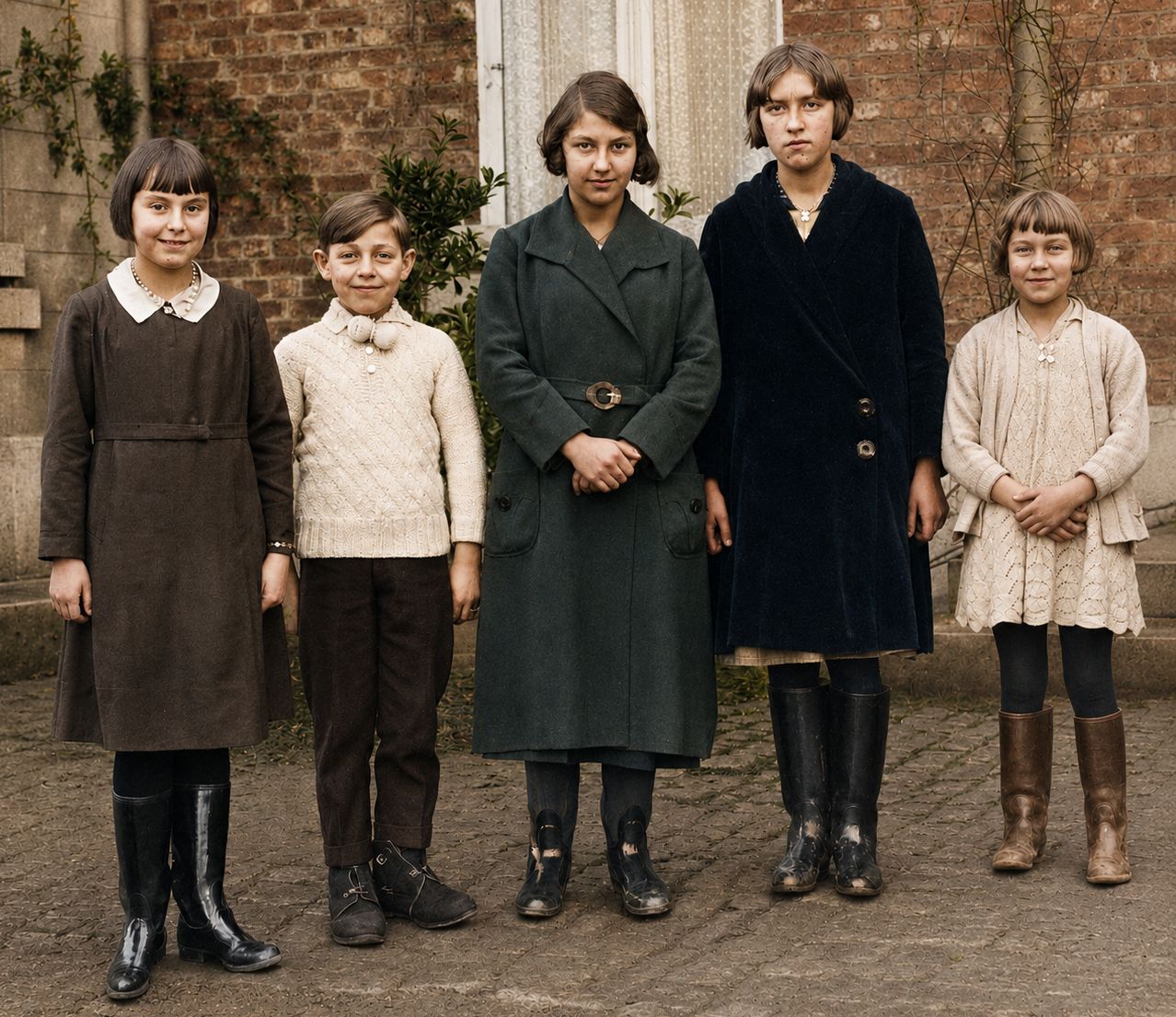
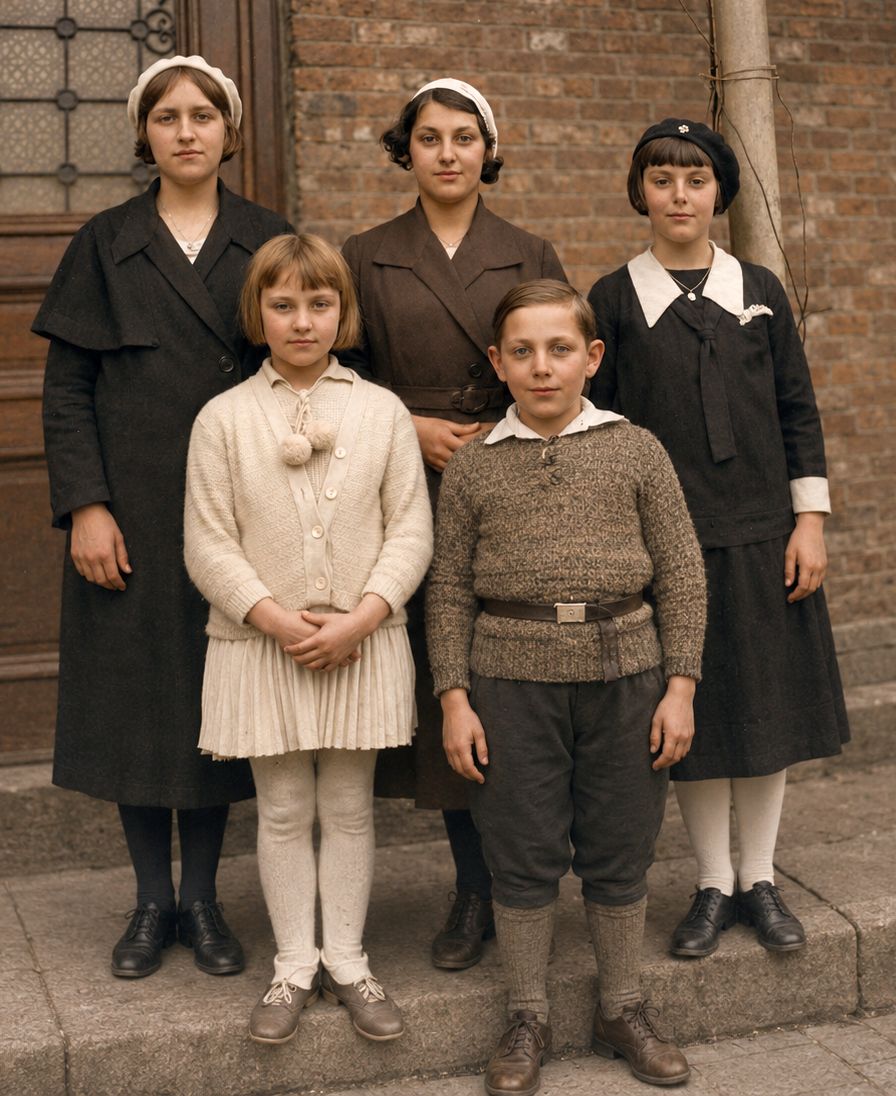
From left to right:
Gilberte Voisin: 13 years old (at the time of the Apparitions)
Albert Voisin: 11 years old, the only boy in the group
Fernande Voisin: 15 years old
Andrée Degeimbre: 14 years old
Gilberte Degeimbre: 9 years old
4.1. A cohesive witness cluster
The five children formed two sibling groups, the Voisins and the Degeimbres, who lived within a few dozen meters of each other. They walked to school together, played together, and were interviewed together. In any investigative field – whether one studies UFO flaps, poltergeist outbreaks, or the more prosaic domain of police eyewitness testimony – such a cluster is immediately recognized as high‑cohesion. High cohesion does not imply collusion; it implies shared interpretation, shared emotional states, and a tendency toward narrative synchronization.
The five children experienced the visions as a group; they famously dropped to their knees “in unison,” recited prayers together, and came out of the ecstasies together. The on-site medical/psychological tests on December 8 (the pin/flame/light tests) were performed on them side by side while they were collectively ecstatic. So the experience itself was thoroughly collective and synchronized.
4.2. Suggestibility without gullibility
Again, the children may well have been sincere. Sincerity is not the same as independence, and suggestibility is not stupidity. It is an openness to emotionally charged interpretation, especially when the interpretive framework is already available. A luminous figure in a convent garden in 1932 Belgium did not require invention from nothing. It required the activation of a familiar Marian template.
Once the first reports were taken seriously by parents, neighbors, clergy, journalists, and doctors, the children were no longer merely reporting an experience. They were becoming the visionaries of Beauraing. That role carried expectations, social rewards, and costs. A child who hesitated, contradicted the group, or failed to see what others saw would have been doing more than changing a detail; she would have been disturbing a public drama that adults had already begun to invest in.
4.3. Consistency as a product of reinforcement
A sincere witness cluster can reinforce itself. One child’s phrasing becomes another’s. One child’s interpretation becomes the group’s interpretation. Repetition makes memory harder, not easier, to separate from narrative. In investigative psychology, consistency is strongest when witnesses have been kept independent and when their agreement includes details they could not easily have acquired from one another or from cultural expectation. Beauraing has the opposite problem: the witnesses were close, the questioning was repeated, the environment was saturated with Marian imagery, and the main details were exactly those the culture already supplied.
4.4 Children steeped in visions, and participating in their production
The children of Beauraing did not enter the apparitions with minds untouched by the idea of supernatural visions. According to the evidence reported by Hallet from the contemporary investigation by Étienne De Greeff, Roland Dalbiez and Gustave Leurquin, Beauraing : notre réponse (1934), subtitle conclusions médico-psychologiques, critique historique, miracle et logique, the children had already been immersed in the imagery and role of the visionary before the apparitions began.
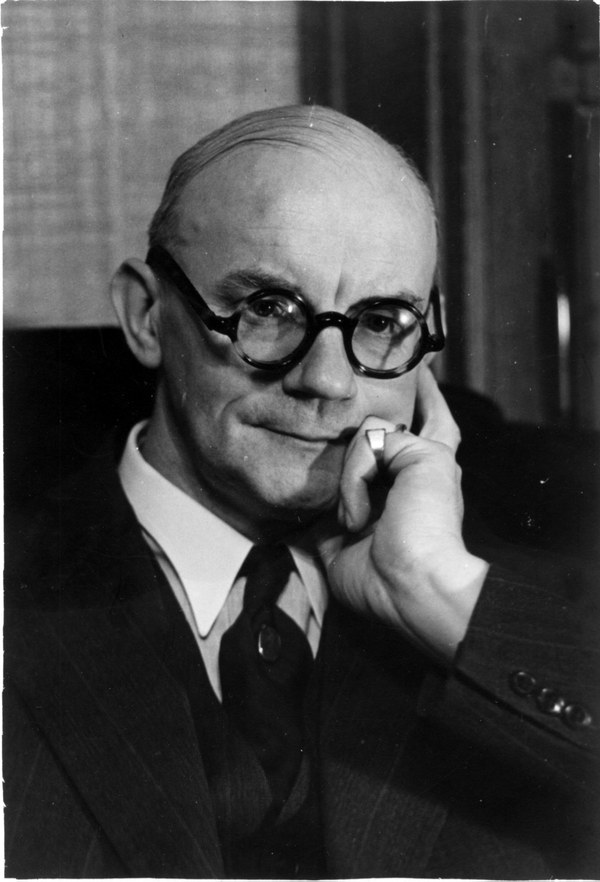
The children had reportedly played at being Joan of Arc having visions, to the extent that other people noticed and later reported the game. The children subsequently denied having done so, even allegedly going so far as to claim that they did not know who Joan of Arc was. The significance is difficult to miss. The children were not merely familiar with stories of saints; they had already experimented with playing the part of someone who received heavenly visions. Their later denials then become noteworthy, because they suggest that the children understood that this previous play could cast doubt on the authenticity of the apparitions.
Their surroundings provided further reinforcement of the same imaginative world: there was the Lourdes grotto associated with the school, while De Greeff observed that Fernande had possessed, since August 1932, a luminous statue of the Virgin in her bedroom. The statue reportedly frightened her so much that she sometimes hid under her covers. Whatever psychological significance one assigns to it, it placed a vivid, luminous image of the Virgin within Fernande’s immediate personal environment only months before the apparitions.
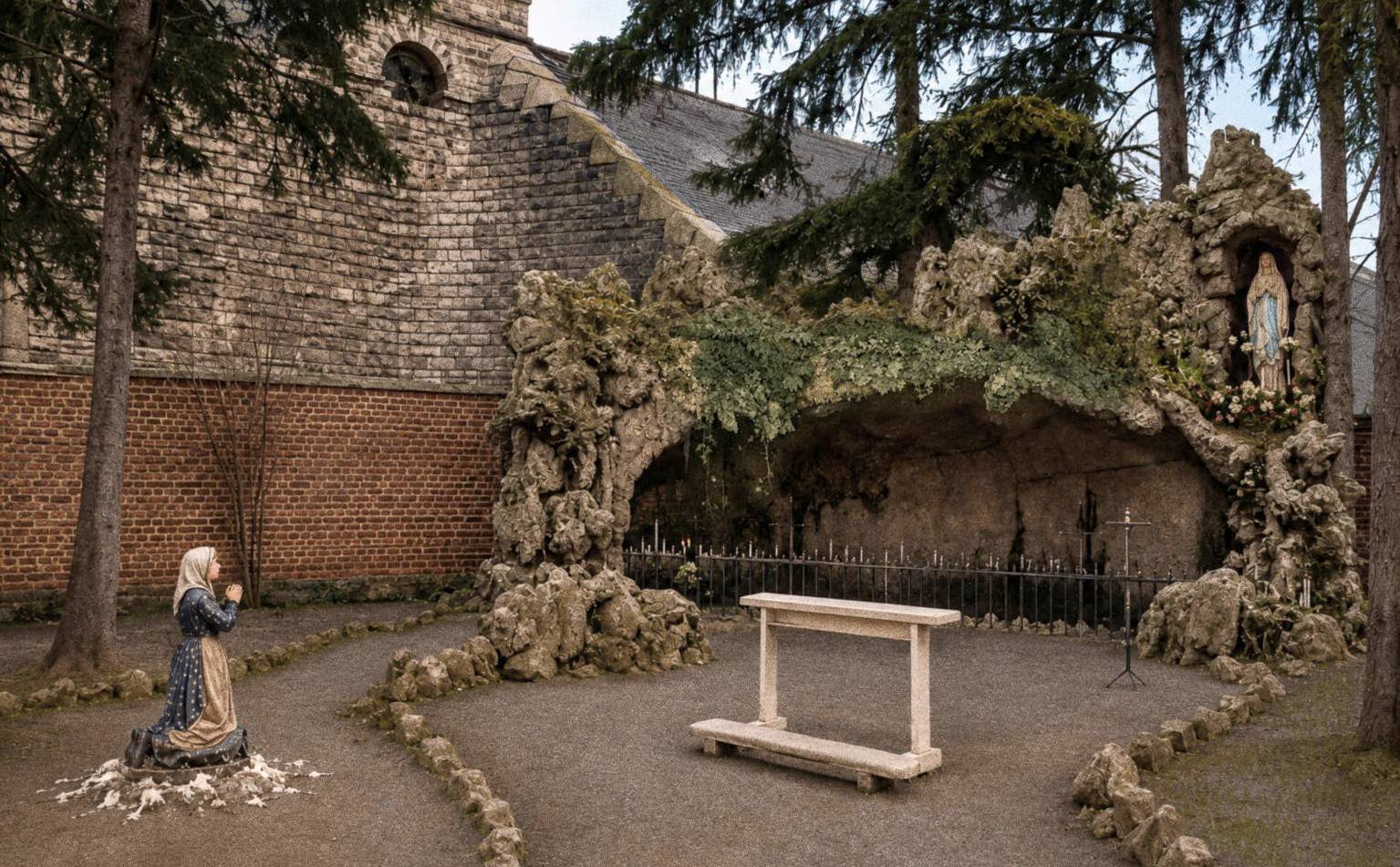
Thus Joan of Arc, Lourdes, the Virgin Mary, luminous religious images and the idea of visionary experience were already present in the children’s world before the phenomenon began. The children had a model for what a visionary was, a setting associated with Marian apparitions, religious imagery, and a social environment in which seeing a supernatural figure was conceivable: one could be a child who saw a heavenly figure.
The subsequent behavior of the children is even more suggestive because they often seem to have treated the apparitions as something dependent upon their own presence and participation.
On one occasion, Albert was unable to attend because of another commitment. The other four children reportedly threatened to return home rather than continue to the grotto “sans plus se préoccuper de l’éventuelle apparition”. If they regarded the Virgin as an autonomous visitor who might appear at the grotto regardless of them, this reaction is difficult to understand. Why should Albert’s absence make the visit pointless? Yet it makes perfect sense if the children had come to regard the apparition as something that occurred when the particular group was assembled.
The children apparently said as much themselves. When people wondered why they were not hurrying to the grotto despite being late, they explained that this did not matter because, according to them, the Virgin only came when they were there: “la Vierge ne venait que lorsqu’ils étaient là.” This is an extraordinarily revealing formulation. The children were not describing themselves merely as witnesses who happened to arrive at the right time. Their presence had become part of the condition under which the Virgin appeared. The apparition had become contingent upon the children. It was like the Entity had become something the children could summon rather than an independent agent that would visit on her own schedule.
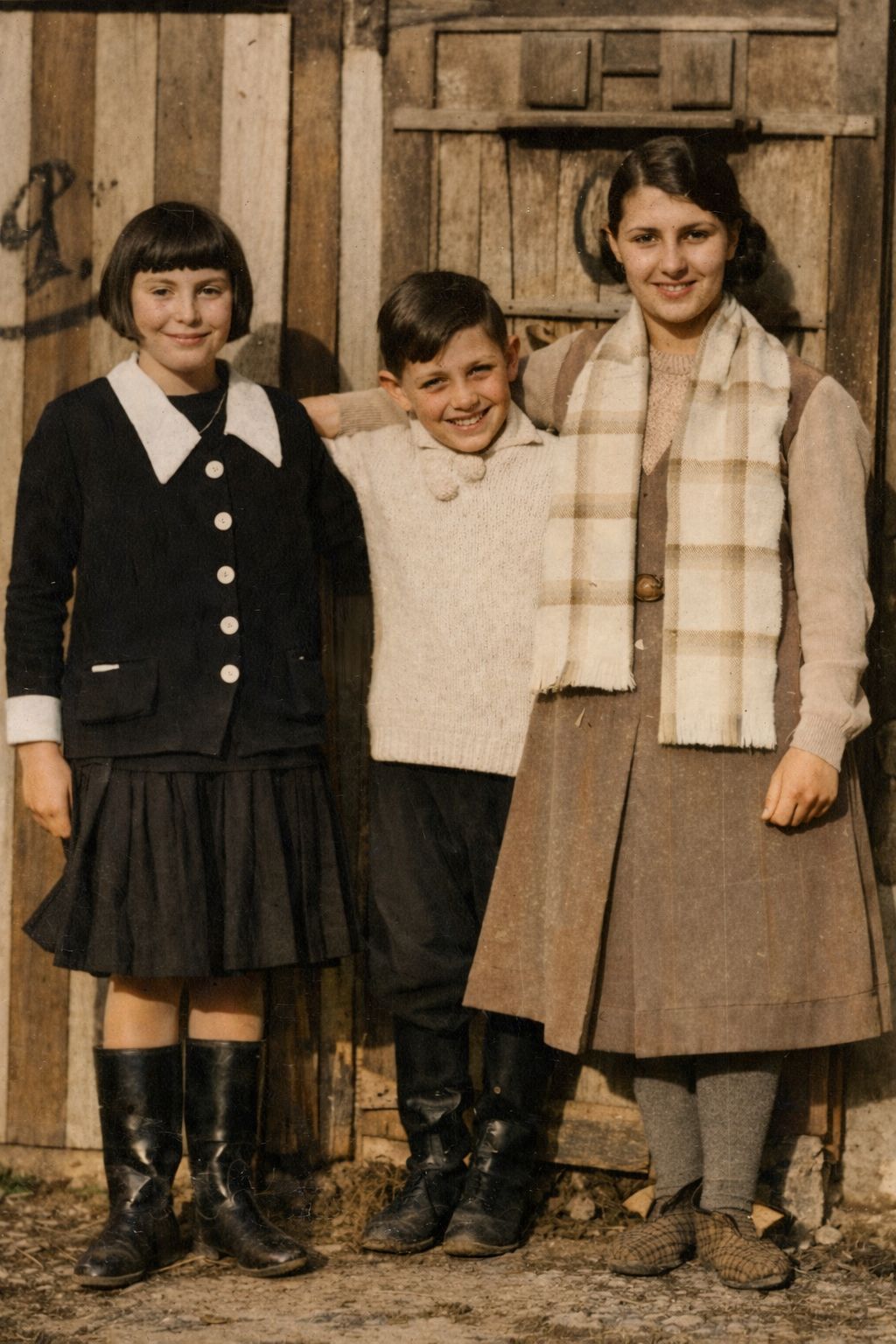
Fernande’s behavior makes this relationship still more explicit. When the crowd impeded her progress, she reportedly exclaimed:
“Allons, laissez-moi passer, je suis la voyante. Si vous continuez comme ça, je n’irai pas à la grotte et les autres non plus et vous serez venus pour des prunes.”
She understood that the crowd wanted her to go to the grotto because without her – and, she added, without the others – the expected event would not occur. She could therefore threaten to withhold the very experience for which hundreds of people had gathered. The voyante had acquired a degree of control over the phenomenon’s social production. This need not mean that Fernande was cynically thinking, “I am pretending and can therefore manipulate these people.” She may simply have believed that Mary would appear when she and the others went to the grotto. But that is precisely what makes the episode interesting: the child’s own participation had become inseparable from the occurrence of the apparition.
The most striking example is the episode (date uncertain, perhaps December 21) involving Albert and two little girls whom he invited to accompany him to the place of the apparitions. Hallet reports that Albert then “agit comme s’il avait une apparition” and said, “Je la vois.” When interviewed by investigators and observers, Albert admitted that this particular mock-apparition with the two young girls was faked. The next night, when the children went again to the site, Albert did not see anything and became worried that “la Dame ne se montre plus parce que je l’ai imitée hier.” But the point is not to declare that Albert was pretending; we have no access to his subjective experience on that occasion, and no less certainty that he was genuinely seeing something than we have regarding any of his other reported visions. What the episode does show is that Albert could apparently enter into the visionary role outside the ordinary group setting and in the presence of an audience he had himself brought there. The outward behavior associated with seeing Mary was therefore not inseparably tied to the other children or to the ordinary circumstances of the apparitions.
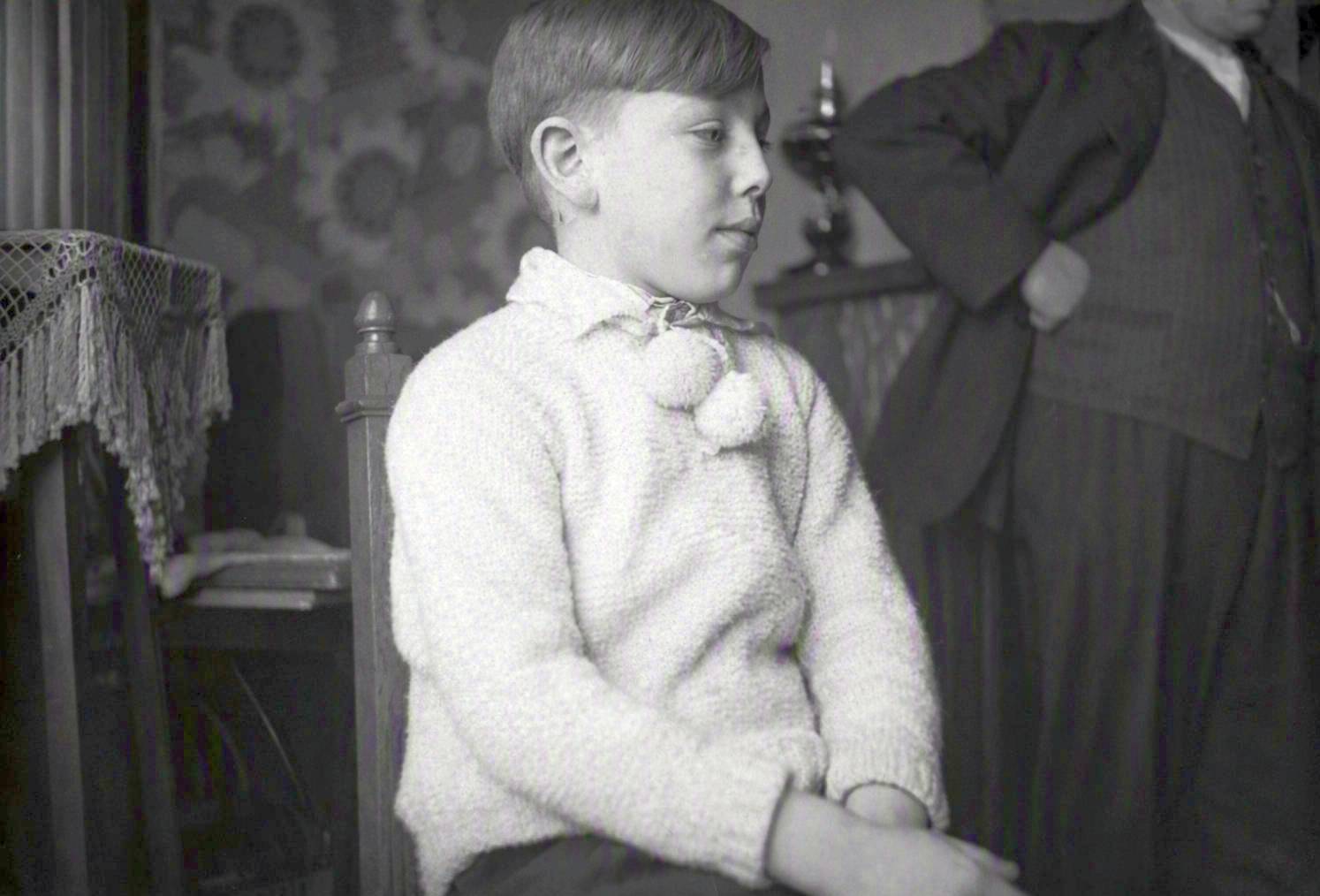
Indeed, the episode becomes particularly interesting when set beside the opposite phenomenon: the girls’ apparent dependence upon Albert. When Albert could not attend on December 30, the other four reportedly did not simply proceed to the grotto and wait to see whether Mary would appear; they threatened to go home. Thus there is a striking asymmetry. The girls apparently regarded Albert’s presence as necessary, while Albert could apparently have an apparition – or at least present himself as having one – without them. This suggests that the children occupied different psychological positions within the visionary phenomenon. Albert may have had an especially important role in generating or sustaining the group’s expectations; the girls may have incorporated his presence into their own expectation of seeing Mary. Conversely, Albert may genuinely have experienced visions independently while the girls’ experiences were more dependent upon the group. What matters is that the children’s own behavior points toward a network of expectations and dependencies, rather than five passive observers of an external Entity.
There’s also an interesting assymetry in deviating perceptions between the children:
| Child | Distinctive individual experiences? | Clearly documented solo visual apparition? |
|---|---|---|
| Albert | numerous | Problematic, including his 2 claimed extra visions and the admitted/famous false vision |
| Fernande | numerous | Dec. 27 -Dec. 29 (uncertain), Jan. 3 |
| Andrée | Some differing perceptions | Not established |
| Gilberte Voisin | Some differing perceptions | Not established |
| Gilberte Degeimbre | particularly differences in hearing | Not established |
The evidence does not look like a simple situation in which five children always experienced exactly the same thing. The accounts preserve numerous discrepancies, particularly concerning what they heard and, later, what they saw in the Golden Heart. And there’s another intriguing asymmetry: Fernande is repeatedly the child who reports something additional, while Albert is repeatedly the child whose testimony becomes problematic. The two younger girls’ testimony seems much more often to consist of partial or differing perception of a common event rather than completely independent visions.
From the standpoint of the devotional interpretation, all of this can of course be accommodated. Mary could have chosen to appear only when the children were together. She could also have chosen to speak to some children separately. She could have told Albert to bring his girlfriends. A supernatural explanation is flexible enough to absorb every one of these observations.
But that flexibility comes at a cost. The more the apparition’s occurrence is explained by reference to Mary’s inscrutable choices, the less the children’s behavior can serve as independent evidence that Mary was actually there. The same observations can be explained more economically by a phenomenon in which the children’s expectations and participation helped generate the experiences in the first place.
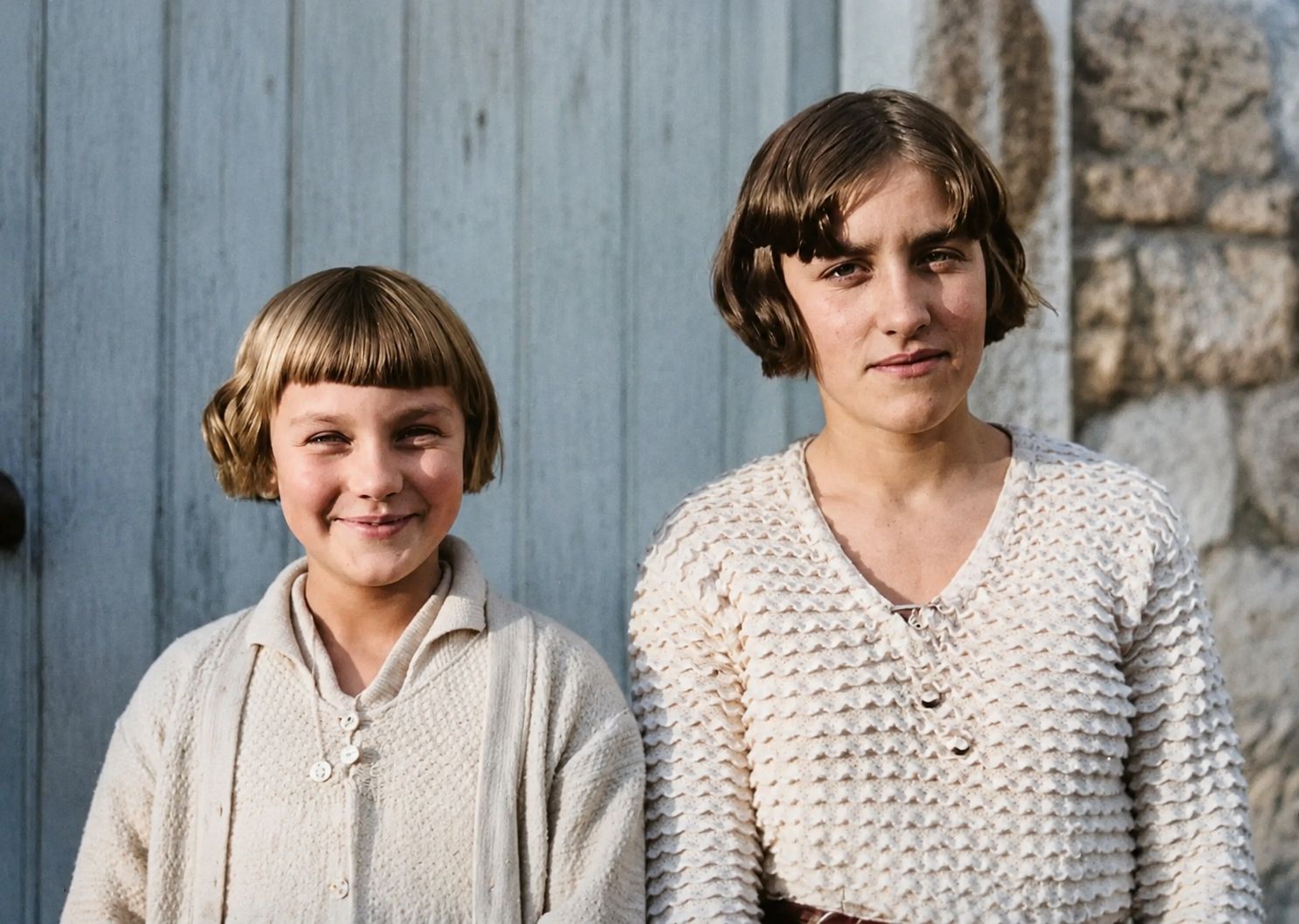
The same pattern appears in the children’s comments about the timing of the apparitions. Their lateness did not seem to trouble them because, as they explained, Mary would not come until they were there. This reverses the expected causal order: that the Virgin decides to appear and the children try to be present in time. In the children’s account, their arrival is effectively what makes the apparition possible.
December 8 was the Feast of the Immaculate Conception, making the date especially significant in a Catholic and Marian context. The children and the growing crowd around them attached considerable expectations to that day, yet the apparition did not produce the spectacular sign or revelation that some had anticipated. Hallet reports that Albert lost all credibility among his peers after a miracle he had promised for that date failed to occur. This is more than a colorful anecdote. It indicates that Albert apparently had sufficient confidence or status to promise a miracle, and when the predicted event did not happen, his standing among the other children suffered. During the first ten days, Albert was the primary actor, spokesperson, and catalyst. He saw her first, asked all the questions, and was the first to bring a rosary. After December 8, Albert moves to the background. In the following apparitions the Entity initially remained silent, then stopped appearing altogether for several days. Until Fernande (the eldest of all five visionaries) emerged as the new emotional core and central figure of the experiences. Thus an expectation was formed, a major expected event failed, and the pattern of the apparitions changed. The phenomenon appears, at least in this respect, to have possibly tracked the children’s emotional state rather than proceeding according to a wholly independent schedule.
This is compatible with a psychological process in which expectation helps determine perception. Once the children had come to expect an apparition at the grotto, under particular circumstances, their attention would have been directed toward the possibility of seeing something. An ambiguous light, shape, sensation or internal image could then be interpreted within the established framework: the Virgin is here. Repeated confirmation by the other children and by the increasingly enormous crowd could reinforce the interpretation. Conversely, a failed prediction could disrupt the expectation and alter the experience. The children’s varying mental states are therefore relevant.
The children did not behave as though they were uniformly entering an irresistible state of religious ecstasy whenever the time for an apparition approached. Sometimes they seem to have been intensely engaged; at other times they were bored, distracted, late, impatient or playful.
Albert reportedly boasted on December 4:
“Je l’ai vue deux fois de plus que les filles !”
Fernande responded by smiling, shrugging and elbowing Gilberte, who was apparently struggling not to laugh. The episode turns the supposedly extraordinary privilege of seeing the Virgin into something resembling a child’s competition over status: who has seen her more?
Critics noted that Albert, being the only boy and the youngest Voisin sibling, felt a strong sense of pride in having “discovered” the Virgin Mary first. They viewed his claim of “extra” visions as a child’s natural desire to maintain his status as the leader and primary visionary of the group.
On December 13, Fernande was occupied untangling her rosary and did not immediately fall to her knees with the others.
Fernande reportedly said On December 28:
“Je me demande comment cela finira; je commence à être fatiguée de cette histoire.”
The statement was made during the period when the apparitions seemed to have stopped. The children were still forced to go out to the cold hawthorn bush every night to pray in front of waiting crowds, only for nothing to happen. Disappointed pilgrims and rising skepticism added to the emotional toll.
On January 1, Albert was apparently so disengaged that he yawned, brushed his clothes with the flat of his hand, chatted with a disabled boy and did not recite the rosary. When subsequently reproached for his behavior, he reportedly explained:
“Je savais bien que la Sainte-Vierge ne reviendrait plus.”
These are not impossible reactions for genuine visionaries. Familiarity can reduce emotional intensity, and children remain children even in extraordinary circumstances. But they are nevertheless difficult to reconcile with the devotional image of children repeatedly overwhelmed by direct encounters with the Queen of Heaven. If the experiences were literal visits from the Mother of God, one might expect at least some enduring sense of awe, anticipation and emotional urgency. Instead, the reports sometimes sound remarkably like children who have become accustomed to a recurring activity: they can be tired of it, late for it, distracted during it, joke about it, or decide that it is no longer going to happen.
Several of the children apparently enjoyed seeing themselves pictured on the covers of newspapers and magazines. Their new public identity as visionaries was not merely a burden; it could also be entertaining and rewarding. Fernande could invoke her status as “la voyante” to force her way through a crowd. Albert could bring girls to the apparition site and apparently enter into the role of someone who sees Mary. As Professor Gustave Cohen wrote in late December:
Ces enfants n’avaient guère l’air d’avoir été transformés psychologiquement par leur apparition céleste.
Pire : ils étaient devenus cabotins et jouaient les vedettes.
Taken together, all these these details seem to point to the possibility that the children were participating in a self-reinforcing visionary process. The process could begin innocently enough. A child experiences an unusual visual, emotional or perceptual event. Because the child is already steeped in stories of Joan of Arc, Lourdes and the Virgin Mary, the experience is interpreted as a vision. The other children confirm the interpretation. The repeated visits to the grotto create expectation. The crowd supplies enormous attention and emotional reinforcement. Predictions are made about what Mary will do. The children learn that their presence matters. Their behavior becomes part of the ritual conditions under which the experience occurs. And the distinction between seeing, expecting to see, and behaving as someone who sees becomes progressively less clear.
On this model, the children could have been sincere participants in an experience that was nevertheless generated or shaped within their own minds. A child can believe that she sees the Virgin while the experience is produced by imagination, expectation, suggestion, perceptual error or some combination of these. The resulting conviction can be genuine even though the perceived figure has no external existence. This model also makes sense of the otherwise puzzling mixture of sincerity and theatricality in the reports. The children could genuinely believe that Mary appeared only when they were present without consciously understanding that their own expectations were helping to produce the experience.
The point is not that these were “bad” children, nor that every reported vision was consciously fabricated. It is that the boundary between experiencing the apparition and producing the conditions for experiencing it appears to have been blurred repeatedly. The children sometimes seem less like witnesses waiting for Mary to decide when to visit, than like participants who knew, at least implicitly, that they were the mechanism by which the phenomenon was brought about, sustained and given its particular form.
5. The pressure of crowds
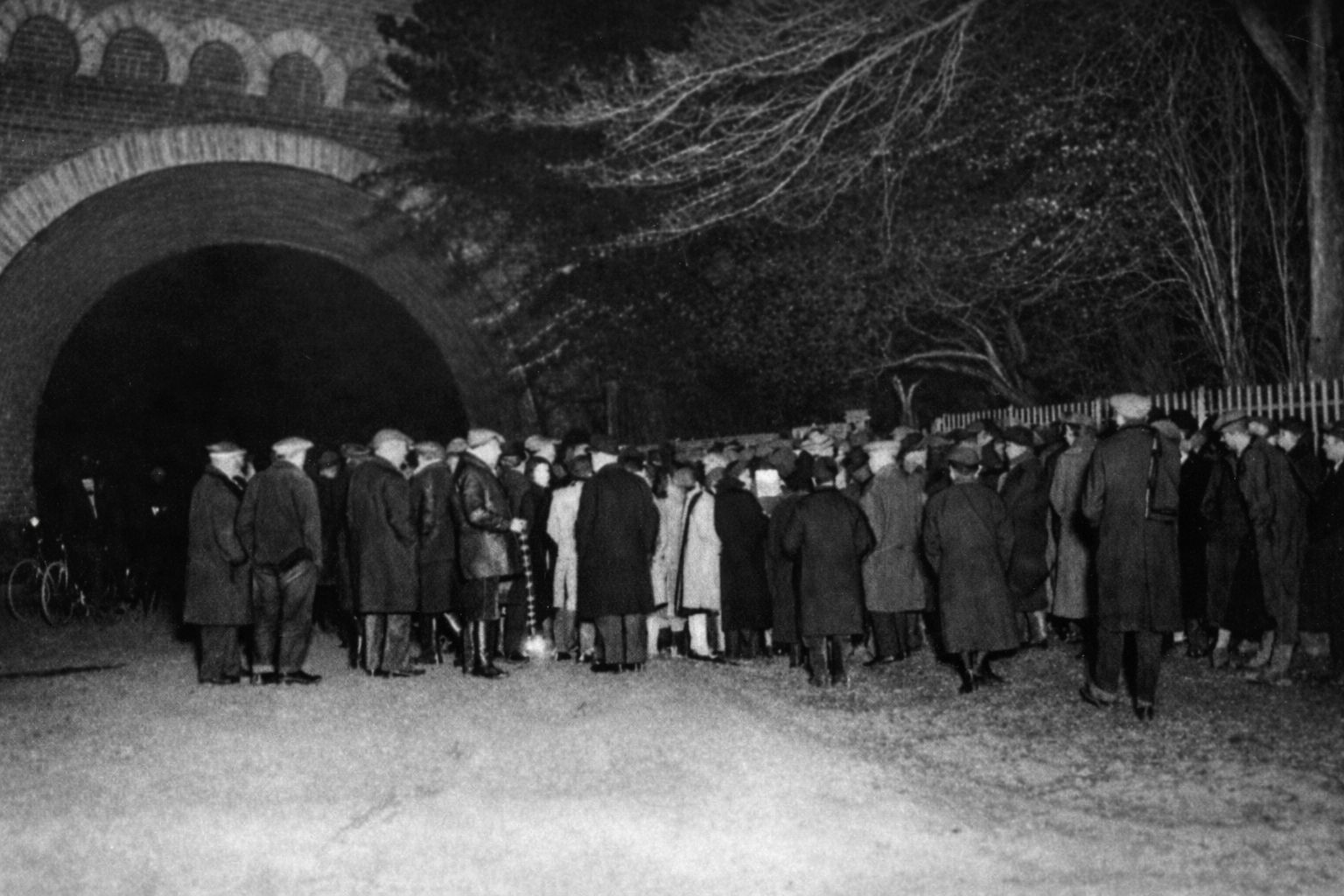
The official narratives of Beauraing tend to treat the crowds as a passive backdrop, as though the visions unfolded in a vacuum and the thousands who gathered merely observed. Yet once the first reports circulated, the social environment changed so rapidly and so dramatically that the apparitions cannot be separated from the conditions under which they were witnessed. The children did not simply experience visions; they experienced them while being watched, while being expected, and eventually while being surrounded by thousands of adults who had come to see them see. In such a setting, the boundary between private perception and public performance becomes porous.
5.1. The sudden emergence of a public stage
Within days of the first vision, the convent garden transformed into a nightly gathering place. Dozens became hundreds; hundreds became thousands. The children found themselves at the center of a space that resembled, in structure if not in intention, a séance circle: a fixed location, a fixed hour, a fixed set of participants, and a shared expectation that something extraordinary would occur again.
The crucial point is simple: the children did not summon the crowds; the crowds imposed themselves on the children. This inversion of agency is characteristic of many apparition waves and revivalist movements. Once a community invests an event with spiritual significance, the individuals at the center lose control of the narrative. They become symbolic actors in a drama they did not write.
5.2. Performance demand and the loss of autonomy
When hundreds or thousands of adults gather in silence, waiting for children to enter a visionary state, the psychological pressure is immense. The children were no longer ordinary schoolmates. They were “the visionaries.” The safest path, socially and emotionally, was to continue seeing what the crowd hoped they would see.
Each successful apparition reinforced the next. The children announced that they saw her; the crowd gasped, prayed, cried, knelt, and waited for more. This response deepened the children’s certainty and the crowd’s belief. The mechanism is social, not mystical; that does not make it weak.
5.3. Ritual repetition and symbolic elaboration
The apparitions occurred repeatedly, often at the same place, at the same hour, with the same witnesses, under the same emotional conditions. This created a ritual frame even if no one planned it as one. Ritual narrows attention, heightens expectation, synchronizes emotion, and makes trance easier. In such settings, visionary content tends to elaborate over time.
The Golden Heart is the clearest example. It appeared only late, after the children were already visionaries, the crowds had grown, clergy and doctors had questioned them, and the narrative had stabilized. More importantly, it did not appear simultaneously to the whole group: Fernande reported it first, and the others only reported it the next day. That staggered emergence is exactly the kind of detail one would expect under contagion and reinforcement, where a striking addition by one witness becomes available to the rest of the group. In visionary psychology, repeated sessions often produce symbolic enrichment. The longer the phenomenon continues, the more culturally familiar detail accretes.
5.4. The social function of anomalies
Vallée’s most provocative idea is the “control system” hypothesis: anomalous events may function less as information delivery than as feedback within a culture. They modulate belief, identity, fear, cohesion, and symbolic order. Whether one takes that literally or metaphorically, the insight is useful. Apparition waves, like UFO flaps, tend to appear during periods of social tension and then reorganize meaning around a vivid, repeatable image.
Beauraing fits that pattern. It did not give Belgium new information. It gave Belgian Catholics a symbolic response to instability: children, innocence, prayer, Marian protection, and a local sacred geography. The phenomenon’s power came from what it stabilized.
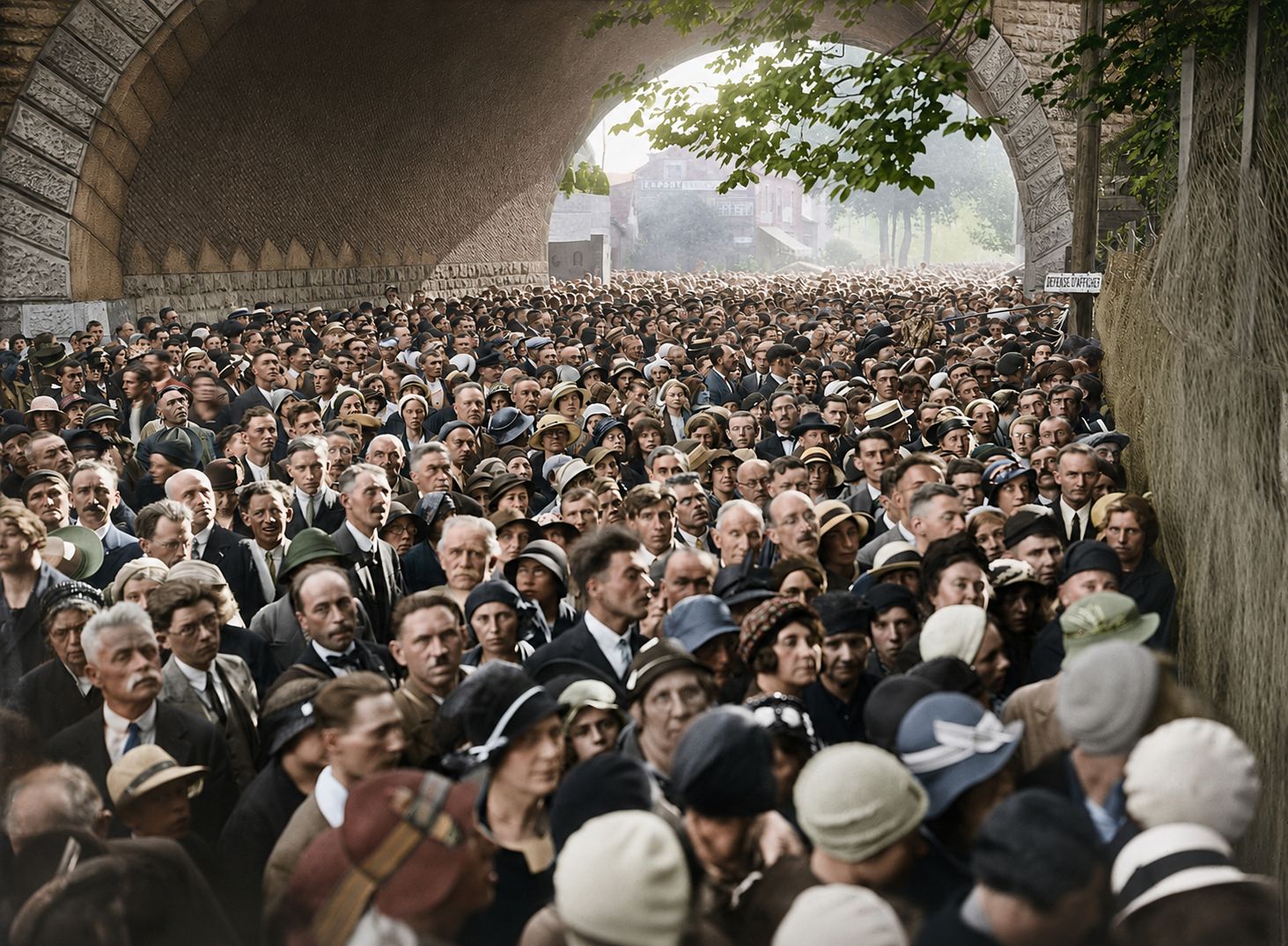
5.5. Why the visions continued
Had the children been alone, the visions might have lasted a single evening. But with thousands watching, the social meaning of the event intensified. The children were locked into a role; the trance states deepened; the symbolic content expanded; the narrative acquired momentum. The apparitions lasted thirty‑six evenings not because the phenomenon required that duration, but because the social environment sustained it.
6. The wider context: Belgium’s apparition wave of 1932–33
The official narrative of Beauraing presents the events as a discrete eruption of grace: a small town, a handful of children, a luminous figure, and a message of prayer. What disappears in that devotional framing is the dense historical atmosphere in which the visions occurred. Belgium in 1932–33 was not a neutral backdrop. It was a country under strain – economic, political, and religious – and these pressures formed the psychological and cultural substrate from which the apparition wave emerged. To understand Beauraing, one must understand the landscape that made such events not only possible but almost predictable.
6.1. Belgium as pressure cooker
Belgium entered the 1930s in a state of quiet instability. The Great Depression struck the country with particular force: industrial contraction in Wallonia, unemployment in mining regions, and a pervasive sense of insecurity. The political climate was equally unsettled. Mussolini had consolidated power in Italy; Hitler was on the cusp of doing the same in Germany; communism had entrenched itself in the USSR. Belgium, still carrying the trauma of German occupation during the First World War, felt squeezed between ideological extremes.
Religious tensions added another layer. Wallonia, including the region around Beauraing, was undergoing rapid secularization. Socialist and anticlerical movements were gaining ground. Catholic elites feared a collapse in religious practice and loyalty. In such a climate, Marian devotion – already a powerful cultural symbol – became a repository for anxieties about identity, continuity, and protection.

The linguistic tensions in Belgium were the product of decades of conflict over language, political power, education, and national identity. By 1930, the issue had become one of the country’s defining political questions. The early 1930s saw a series of landmark language laws that fundamentally changed Belgium. Among the most important:
- 1930: Dutch became the principal language of instruction at Ghent University, the first university in Belgium to teach entirely in Dutch.
- 1932: Belgium adopted major language laws establishing the principle of territorial monolingualism:
- Flanders would be administered primarily in Dutch.
- Wallonia would be administered primarily in French.
- Brussels retained a bilingual status with special rules.
This represented a major victory for the Flemish Movement but also marked a shift away from the earlier ideal that citizens should simply become bilingual. Although these reforms were significant, they did not end the conflict. Dutch had achieved legal equality with French in many domains, but questions about education and civil service appointments remained politically divisive, implementation remained contentious, and nationalist movements on both sides continued to gain influence.
This combination of economic strain, linguistic tensions, political anxiety, and religious insecurity created a fertile environment for visionary phenomena. Apparitions do not arise in a vacuum; they arise where symbolic reassurance is most needed.
6.2. The Belgian apparition wave
Beauraing was not an isolated event. As documented by Tine Van Osselaer in Apparition Fever, Belgium’s 1932–33 apparition wave included more than forty reported sites and hundreds of child and adult visionaries. Reports spread quickly, crowds gathered across many locations, and clergy and medical professionals attempted to evaluate the visionaries as claims proliferated through social contagion. The Church investigated most of these cases and eventually recognized only Beauraing and Banneux. The pattern resembles what sociologists call “collective effervescence”: a moment in which shared emotion and expectation generate new experiences that reinforce the conditions that produced them.
The official story rarely mentions this wider wave. Doing so would place Beauraing within a broader pattern of mass visionary behavior rather than as a singular divine intervention.
6.2.1. The recognized apparitions
- Beauraing (November 1932 – January 1933): The catalyst for the Belgian wave.
- Banneux (January 1933 – March 1933): Occurring shortly after Beauraing, a young girl named Mariette Beco reported visions of the Virgin Mary, who identified herself as the “Virgin of the Poor”.
6.2.2. Notable unrecognized apparitions
6.2.2.1. Onkerzele (1933)
Onkerzele was centered on an adult: Leonie Van den Dijck (often called “Leonieke” or “Nieke”), an uneducated, working-class mother of nine children.
The visions (August – October 1933)
It began on August 4, 1933, while Leonie was praying the rosary near a local chapel and Lourdes grotto. She claimed the Virgin Mary appeared to her standing on a glowing blue-and-silver sphere next to a poplar tree. Over the next few months, Mary allegedly appeared to her 36 times in public. The Virgin reportedly asked for the restoration of local chapels and even traced the blueprint for a new chapel into the ground with her foot.
The “Sun Miracles” and massive crowds
Word spread rapidly, and tens of thousands of pilgrims began descending on the small village. Onkerzele became famous for “Zonnewonderen” (Sun Miracles) in late 1933 and early 1934. Eyewitnesses claimed to see the sun spin, change vibrant colors (pulsing blue, red, and purple), and dance in the sky, phenomena heavily reminiscent of what had happened in Fátima, Portugal, in 1917.
Sensational political prophecies
What truly set Onkerzele apart from other sites – and what deeply troubled both Church and state authorities – was that Leonie began making highly specific, dark political predictions. She correctly foretold:
- The tragic mountain-climbing death of Belgium’s King Albert I in early 1934 (adding a conspiracy theory that he didn’t fall, but was pushed).
- The death of the beloved Queen Astrid in a 1935 car crash.
- The outbreak of World War II.
These prophecies elevated her status from a local mystic to a national celebrity. She suddenly found herself being visited and consulted by members of the high Belgian aristocracy and right-wing political figures.
The Church crackdown and aftermath
The Catholic Church was highly uncomfortable with the political nature of her visions, the mass hysteria, and the commercialization of the site. In 1942 the Diocese of Ghent declared the events non-supernatural and forbade priests from participating in or promoting devotions there.
However, the Onkerzele movement didn’t die out. Leonie passed away in 1949, but right before her death, she left behind one final prediction: she claimed her body would not decompose.
In a bizarre climax to the Onkerzele story, her body was officially exhumed in 1972 (23 years after her death) in front of a national television crew. To the shock of many onlookers, her body was found remarkably intact and well-preserved without ever having been embalmed, fueling a dedicated local cult of followers that persists in the region to this day.
6.2.2.2. Lokeren (October 1933 – 1934)
The events started when a nine-year-old boy, Gustaaf “Stafke” Van Driessche, claimed to see the Virgin Mary appearing in a chestnut tree. True to the “apparition fever” gripping Belgium at the time, the site quickly became highly organized by local supporters. Just like the famous approved apparitions in Beauraing (which featured a hawthorn bush), the chestnut tree in Lokeren became the immediate center of devotion. Locals hung a statue of Mary in its branches and set up rows of devotional candles beneath it. In a second wave, three girls also claimed to see the virgin; Elisabeth Cornelis, Tiny Kool and Maria Van den Plas. Later, they saw Jesus as well. As the phenomenon grew, local organizers constructed large public viewing tribunes.
Rather than issuing a sudden, dramatic condemnation that might anger the locals, the Archdiocese of Malines (under Cardinal Jozef-Ernest Van Roey) systematically dismantled the event through the following steps:
The preemptive Bishops’ statement (October 1933)
The Lokeren events began on October 25, 1933. Recognizing that a massive copycat wave was unfolding across the country, the Belgian bishops moved with extreme speed. On October 30, 1933 – just five days into the Lokeren claims – they circulated a strict pastoral letter warning the clergy and the faithful against jumping to conclusions about “marvelous interventions” and unverified supernatural events.
Targeting the infrastructure (the tribunes)
What made Lokeren unique was its intense commercial and physical infrastructure; local supporters had actually built public wooden tribunes around the chestnut tree so crowds could sit and watch the boy go into his nightly trances.
The Church viewed this not as pious devotion, but as a circus-like, theatrical spectacle that bordered on superstition.
Instead of arguing over theology, local ecclesiastical authorities worked with municipal leaders to crack down on the venue itself, discouraging the public gatherings and ordering the dismantling of unauthorized shrines and commercial setups around the tree.
Silencing the Clergy
A primary tactic highlighted by Van Osselaer is the restriction placed on local priests. Diocesan authorities strictly forbade any Catholic priests from visiting the Lokeren site, blessing the spectators, or participating in the rituals. By completely cutting off the clergy, the Church starved the site of any sacramental legitimacy. If a priest wasn’t there to validate it, the average Catholic pilgrim knew it was unauthorized.
Psychological reframing via investigation
The episcopal commission assigned to look into the 1933 wave subjected the child visionary to rigid scrutiny. Rather than treating the case as a grand spiritual threat, the Church’s experts quietly reframed it as a medical and psychological issue, attributing the visions to childhood imagination, “peer group contagion” (copying the famous approved sites of Beauraing and Banneux), and the high-pressure suggestion of the surrounding adult crowds.
By labeling the event as a product of mass religious suggestion rather than a divine miracle, the Church effectively deflated the hype. Without ecclesiastical backing or priestly presence, the crowds eventually stopped buying tickets for the tribunes, and the Lokeren “fever” faded by 1934.
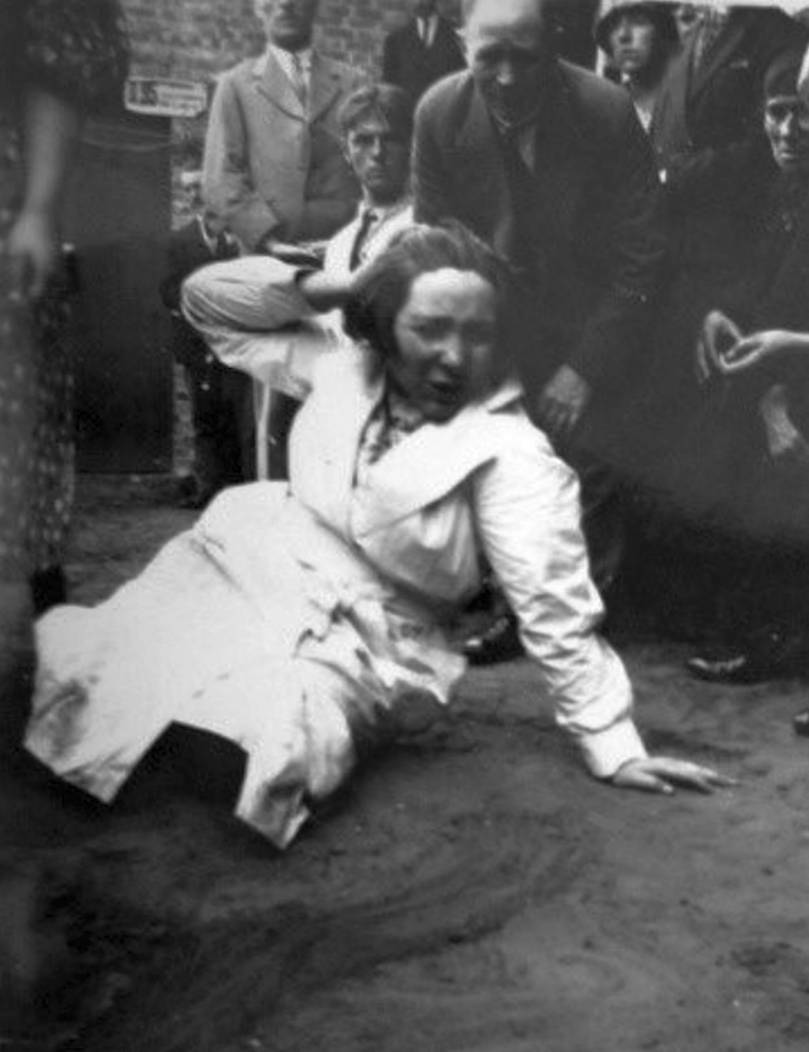
6.2.2.3. Chênée (1933)
Located in the Walloon region near Liège. A group of children claimed to see the Virgin Mary shortly after the Banneux events. It attracted large crowds before being firmly dismissed by the local bishop. The phenomenon unfolded in several quick stages:
The dynamic of the “contagion”
Chênée was geographically very close to Banneux, where the officially approved apparitions of Mariette Beco were taking place between January and March 1933. Driven by the massive media coverage of Banneux and nearby Beauraing, a group of local children in Chênée claimed that the Virgin Mary had begun appearing to them as well.
Unlike Onkerzele, which centered on a single adult woman making grand political prophecies, Chênée was a collective child apparition. A handful of neighborhood children began going into synchronized “ecstatic trances” together, claiming they could see the Virgin Mary.

The backyard spectacle
Word spread like wildfire through the working-class community. Thousands of local citizens and pilgrims began crowding into a suburban backyard to witness the children pray and experience their reported visions.
In her book, Van Osselaer uses Chênée to illustrate how bystanders and the public actively shaped these events. The onlookers weren’t just passive spectators; they documented the children’s physical reactions, tested them for sensitivity to pain while in “trance” (a common practice at the time, like sticking pins in them or holding matches near their skin), and created a highly charged atmosphere of local piety.
The Episcopal intervention
The local Bishop of Liège, Louis-Joseph Kerkhofs, was in a very delicate position. He was already closely investigating the Banneux apparitions (which he would eventually support). He and his diocesan commission recognized that if every neighborhood in Liège started claiming its own copycat Virgin Mary, it would completely undermine the credibility of Banneux.
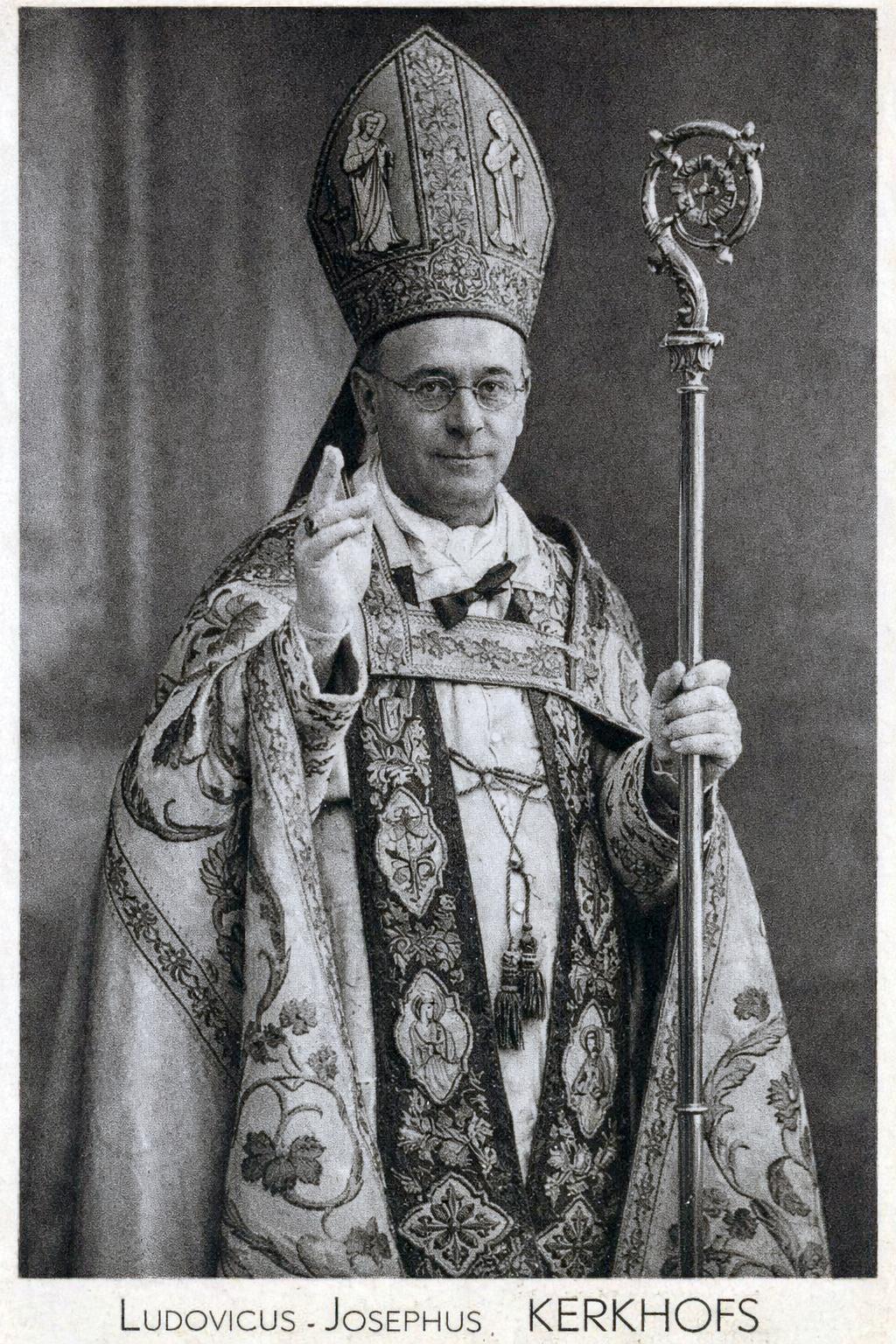
Church authorities moved swiftly in Chênée. Priests were instructed to keep the faithful away from the backyard, and the children were intensely interrogated by clerical and medical experts. The commission concluded that the Chênée visions were a product of psychological suggestion, childhood imagination, and the surrounding religious excitement.
6.2.2.4. Havelange (1933)
Another Walloon site where multiple visionaries reported ecstasies. It served as a prime example of how “contagion” spread from village to village.
Multiple visionaries
Unlike sites that featured a single, distinct seer, Havelange quickly developed into a collective phenomenon. Multiple locals, primarily children and young adolescents, simultaneously claimed that they were experiencing visions of the Virgin Mary.
Simultaneous ecstasies
The visionaries began falling into synchronized “ecstatic trances” in front of growing crowds of neighbors and pilgrims. Bystanders watched the seers pray fiercely and stare blankly into the air, creating a powerful loop of reinforcement: the larger the crowd grew, the more intense and frequent the children’s visions became.
The Church’s dismissal
Because Havelange was characterized by rapid collective suggestion rather than unique or theological depth, Church investigators quickly deemed it a product of psychological mirroring and local hysteria. It was dismissed as non-supernatural, and without Church backing, the local gatherings eventually dissolved.
6.2.2.5. Herzele (1933)
A Flemish site that experienced significant local momentum, closely tied to the regional fervor sparked by Onkerzele. The core of what happened in Herzele centers on a young man named Maurice De Vuyst.
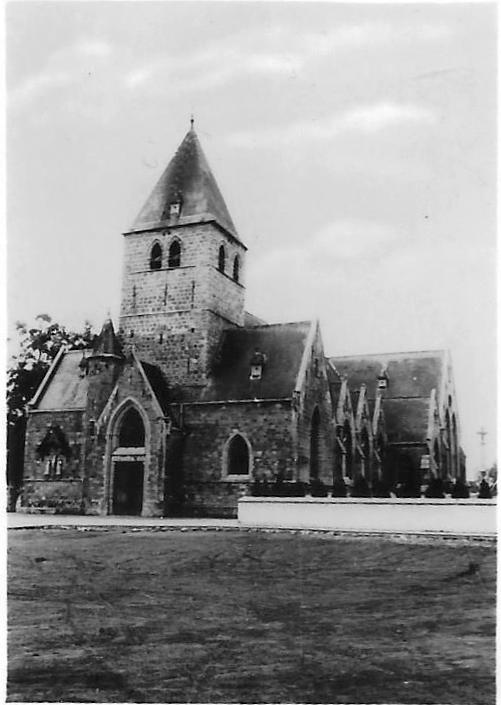
The visions in the woods
In late October 1933, 21-year-old Maurice claimed that while walking near a local poplar tree, a bright, celestial light appeared. Within that light, he reported seeing the Virgin Mary floating slightly above the ground.
- The Iconography: Maurice described Mary as wearing a stunning light-blue dress covered in golden stars, a golden crown, and holding a branch of boxwood (buxus).
- The Repetition: The apparition reportedly repeated over consecutive nights. By early November, the public became highly aware of his claims.
The rapid mobilization
Because the region was already highly sensitized by Leonie Van den Dijck’s ongoing apparitions in Onkerzele, Herzele caught the “fever” almost instantly. Within a week of Maurice’s first reported vision, local police records estimated that over 4,000 to 5,000 pilgrims and onlookers were descending on the small village night after night to witness Maurice pray and fall into his reported trances. Local excitement peaked when a child born deaf and mute was alleged to have been miraculously cured at the site.
The grand “prophecies”
What makes Herzele a standout chapter in Van Osselaer’s study, and what ultimately sealed its doom with Church authorities, was that Maurice, like Leonie in Onkerzele, did not restrict his visions to simple messages of prayer. He began delivering grand, highly controversial political and apocalyptic prophecies.
Maurice famously prophesied about the arrival of a mystical “Great Monarch” (a recurring figure in right-wing French and Belgian Catholic apocalyptic thought) who would supposedly arise to rule over France, defeat the forces of secular modernism, and restore a holy Catholic empire.
Church condemnation
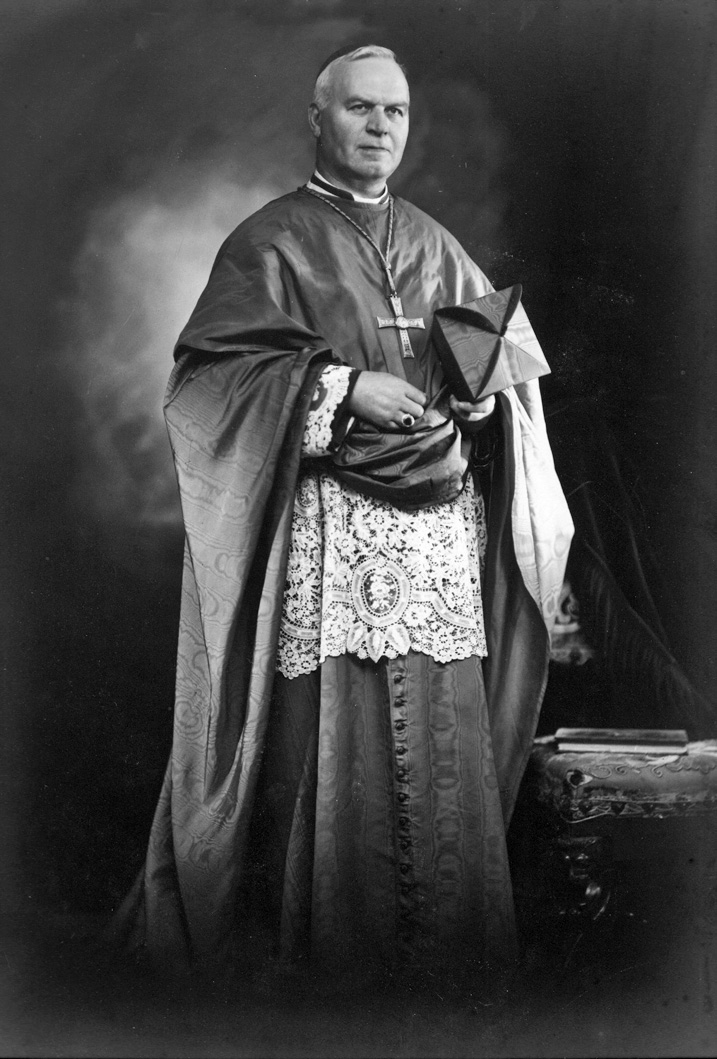
The combination of chaotic nightly “circus-like” crowds, unauthorized miracle claims, and highly charged political rhetoric forced a swift response from the hierarchy. Cardinal Van Roey and the ecclesiastical commissions firmly rejected Maurice De Vuyst’s claims, classing Herzele alongside the rest of the unrecognized wave as a product of mass suggestion and religious over-excitement. Deprived of official legitimacy, the mass pilgrimages to Herzele faded, though the site remained a footnote in the intense spiritual gridlock of 1930s Flanders.
6.2.2.6. Berchem (Antwerp) & Borgerhout
In late 1933, following the intense media coverage of the rural apparitions, urban working-class neighborhoods in Antwerp began reporting their own visions. Several independent visionaries, primarily young girls and working-class women, claimed they were receiving private and public visits from the Virgin Mary inside their homes, backyards, and neighborhood streets.
The clash with modern urban infrastructure
In rural locations, massive crowds of thousands could gather in open fields or around a tree with relatively few disruptions to daily infrastructure. In Berchem and Borgerhout, the sudden influx of thousands of pilgrims, curiosity-seekers, and secular onlookers created total chaos:
- Gridlock: Narrow neighborhood streets quickly choked with people trying to catch a glimpse of the visionaries during their reported ecstasies.
- The Secular Gaze: Because these events happened in major urban centers, they attracted a much higher concentration of secular journalists, skeptics, and medical students from nearby cities. The visionaries were subjected to intense public scrutiny and aggressive psychological testing by onlookers right in the middle of crowded suburban blocks.
Rapid mobilization and the “miracle” economy
The urban proximity allowed for a much faster commercial and devotional mobilization. Souvenir stands, printed pamphlets detailing the visions, and spontaneous shrines popped up almost overnight. The speed at which these urban neighborhoods transformed into impromptu pilgrimage hubs deeply alarmed Church authorities.
The swift institutional suppression
While a rural bishop might take months to investigate a distant village, the ecclesiastical hierarchy in Antwerp and the Archdiocese of Malines-Brussels moved with swift, aggressive efficiency in Berchem and Borgerhout.
Cardinal Van Roey was deeply concerned about urban “contagion” – the idea that mass religious hysteria could ripple through the packed working-class districts of Belgium’s major cities. Local parish priests were strictly ordered to dismantle street shrines immediately, forbid public gatherings around the visionaries’ homes, and firmly instruct the faithful that these suburban visions were strictly a product of psychological suggestion and over-stimulated imaginations.
Berchem and Borgerhout are the ultimate proof that the 1933 wave wasn’t just a rural, peasant phenomenon; it was a pervasive cultural obsession capable of capturing the minds of modern, urbanized populations.
6.2.2.7. Tubize (1933)
A site of reported miracles and visions that sparked brief but intense press coverage and local pilgrimages before fading under ecclesiastical discouragement. While many other unrecognized local apparitions fizzled out quickly within a neighborhood backyard, Tubize became a massive, short-lived media sensation.
The dynamic of the visionaries
In the summer of 1933, following the massive media coverage surrounding the recognized events of Beauraing and Banneux, a small group of children in Tubize claimed that they were being visited by the Virgin Mary. The children began falling into public “ecstatic trances,” staring fixedly into space and praying out loud, claiming they could see the Virgin Mary floating before them.
The spontaneous “miracle” economy
Because Tubize was relatively accessible, the news spread like wildfire. What set Tubize apart was the sheer speed of its commercialization. Spontaneously, and without any authorization from the Catholic Church, a mini-economy boomed around the kids’ backyard:
- Impromptu shrines: Locals set up complex street altars and decorated the apparition site with candles, flowers, and holy statues.
- Media and Merchandise: Local printers and entrepreneurs rushed to publish booklets tracking the children’s daily messages. Souvenir stands selling rosaries, medals, and postcards popped up overnight to cater to the influx of visitors.
The pilgrimage influx and public scrutiny
For a brief window in 1933, thousands of pilgrims and curiosity-seekers flooded into Tubize, creating a major public spectacle. This rapid mobilization caught the attention of secular Belgian newspapers, which frequently mocked the “apparition fever” sweeping the country, as well as medical professionals who showed up to analyze the children for signs of hysteria or mental suggestion.
The Church disavowal
Just as they did at other copycat sites, Church authorities in the Archdiocese moved swiftly to contain the situation. Fearing that uncontrolled, commercialized local cults would make the Catholic Church look superstitious and undermine the credibility of truly verified sites, the local clergy strictly forbade Catholics from promoting the Tubize events.
Priests actively discouraged the pilgrimages and refused to bless the spontaneous shrines. Starved of ecclesiastical legitimacy and under heavy pressure from investigators, the children’s visions stopped, the crowds dissipated, and the booming souvenir stands packed up, leaving Tubize as one of the most explosive, fast-fading footnotes of the 1930s craze.
6.2.2.8. Olmen (1933)
A Campine village in Flanders where children reported seeing the Virgin Mary, drawing thousands of weekend onlookers.
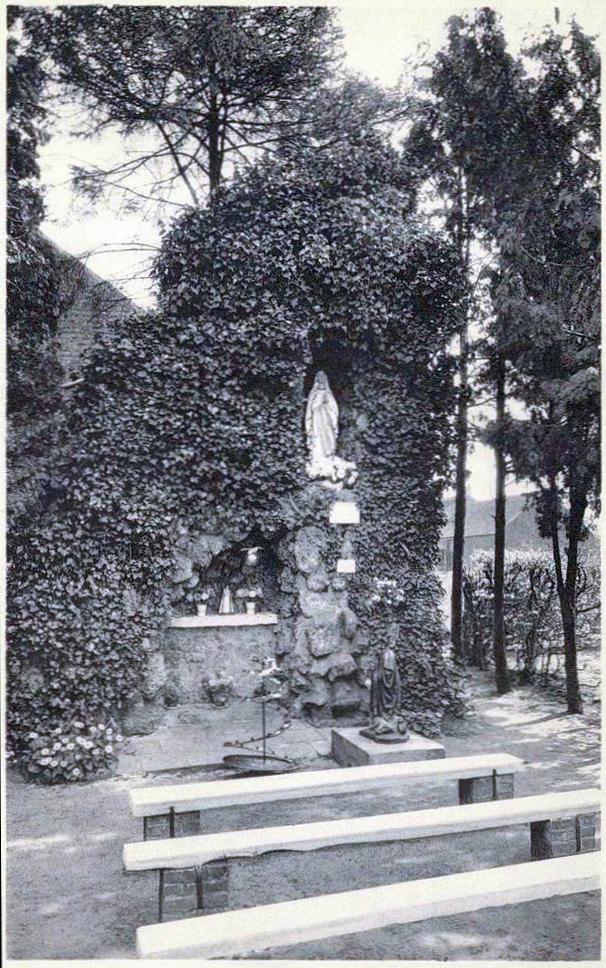
The dynamic of the visionaries
Mirroring the famous events in Beauraing, the Olmen phenomenon began with local school children. A few children reported seeing a glowing, beautiful lady – whom they identified as the Virgin Mary – appearing to them in the village outskirts. Like the seers at other sites, the children began falling into public “ecstatic trances,” during which they claimed to converse with the Virgin, completely oblivious to their surroundings.
The weekend pilgrimage phenomenon
Because Olmen was a relatively quiet, rural Campine village, the sudden arrival of thousands of outsiders deeply disrupted local life. Olmen became a massive hub for weekend religious tourism.
Every Saturday and Sunday, special buses and cycling groups from surrounding regions would flood the village.
Onlookers packed into the fields surrounding the apparition site to watch the children pray, desperately hoping to witness a personal miracle, a healing, or a “sun miracle” like those rumored in Onkerzele.
Testing the children’s ecstasies
Because it became a high-profile local spectacle, the Olmen visionaries were heavily scrutinized by the crowd. Bystanders and self-appointed investigators performed amateur “tests” on the children while they were in their ecstatic states – such as shining bright lights in their eyes or touching them to see if they reacted to pain – to prove to skeptics that the trances were genuine and not faked.
Suppression by Church authorities
The frenzy in Olmen was short-lived due to aggressive intervention by the Archdiocese of Malines (under Cardinal Van Roey). The Church was terrified of the rapid multiplication of these unverified rural shrines, believing they bordered on superstition and distracted from officially sanctioned church devotions.
Local clergy strictly forbade the building of permanent structures at the site, discouraged public press coverage, and actively steered parishioners away from the field. Deprived of official ecclesiastical oxygen and heavily pressured by local authorities, the children’s visions ceased, and the massive weekend crowds quickly vanished by the end of 1933.
6.2.3. Why only Beauraing and Banneux “succeeded”
The Church’s approval of Beauraing and Banneux was not arbitrary. It reflected criteria ecclesiastical commissions had long applied: consistency and stability, observability, doctrinal simplicity, devotional fruit, and institutional process. Both sites involved small and relatively stable visionary groups whose testimonies could be presented as coherent over time. Both occurred in manageable settings – a convent garden at Beauraing, a rural path at Banneux – where clergy could observe the visionaries repeatedly. Their messages were devotional rather than apocalyptic or political. Both developed into pilgrimage destinations with claims of healing and sustained prayer activity. Both underwent formal episcopal investigation, culminating in approval in 1949.
At the same time, it is not always clear why Beauraing and Banneux succeeded while other sites faded. Many rejected cases had sincere visionaries, trance states, reported healings, and orthodox messages. None of those factors alone explains recognition. Beauraing and Banneux had advantages: they came early, they were narratively manageable, they avoided overt political prophecy, and they developed into durable pilgrimage sites without major scandal around the seers.
The majority of the forty-plus rejected apparition claims failed one of these points: political or apocalyptic messages, visionaries whose behavior seemed hysterical or scandalous, disorderly crowds, commercialization, or obvious copycat dynamics. Beauraing and Banneux also had the advantage of being first, while later apparitions in the wave carried the appearance of contagion. More prosaically, the Church could not recognize everything. A miracle that happens everywhere every day ceases to be miraculous. The absolute peak of the wave was reportedly the evening of 29 October 1933, when Mary appeared in Onkerzele, Lokeren, Etikhove, Herzele, and Melen. After that, the epidemic slowly faded away.
6.2.4. Apparition waves in comparative perspective
The Belgian wave fits a broader historical pattern: Marian apparitions tend to erupt during periods of intense social, political, or religious stress. A brief comparison illustrates the point.
| Case | Historical Context | Visionary Pattern | Interpretive Parallel |
|---|---|---|---|
| Lourdes (1858, France) | Post‑Revolution anticlericalism; social upheaval | Poor child visionary; local tensions | Apparition as counter‑symbol to secularization |
| Fátima (1917, Portugal) | Anti‑clerical regime; WWI trauma | Child visionaries; apocalyptic overtones | Apparition as response to war and ideological fear |
| Medjugorje (1981–, Yugoslavia) | Communist repression; ethnic tension | Teen visionaries; long‑running messages | Apparition as spiritual counter‑narrative |
| Belgium (1932–33) | Depression; rising fascism/communism; Catholic anxiety | Many sites; many visionaries; two approved | Apparition as response to ideological and religious instability |
The common thread is not theological content but sociological function. Apparitions emerge where communities feel threatened, where identity is contested, and where symbolic reassurance becomes psychologically valuable.
6.2.5. A parallel case: the Belgian UFO wave of the 1990s

The structural similarity between the 1932–33 apparition wave and the Belgian UFO wave of 1989–1992 is difficult to ignore. The content differs – luminous triangles instead of luminous ladies – but the underlying dynamics are remarkably consistent.
| Feature | 1932–33 Marian Wave | 1990s UFO Wave |
|---|---|---|
| Social tension | Economic depression; ideological fear | Cold War end; NATO tensions; media anxiety |
| Cultural imagery | Marian iconography | Black triangles, aviation motifs |
| Crowd formation | Thousands gathering nightly | Mass sightings; public vigils |
| Institutional response | Ecclesiastical commissions | Military and scientific investigation |
| Narrative evolution | Golden Heart motif emerges | Triangular craft becomes dominant form |
The comparison is not meant to equate the two phenomena but to highlight a shared structure: collective expectation, ambiguous stimuli, cultural templates, and reinforcement loops. Vallée’s insight – that visionary and UFO waves follow similar psychological and sociological patterns – finds a clear illustration in Belgium’s two major flaps, separated by sixty years but united by structure and geography.
The parallels are especially strong. In both cases, a sudden wave of sightings occurs, reports multiply rapidly, media coverage amplifies the phenomenon, and witnesses influence each other’s descriptions. The most famous photograph of the Belgian UFO flap – the Petit‑Rechain image – was later revealed to be a hoax, yet it shaped public perception for decades. Both phenomena are real as social events, but not necessarily as external entities.
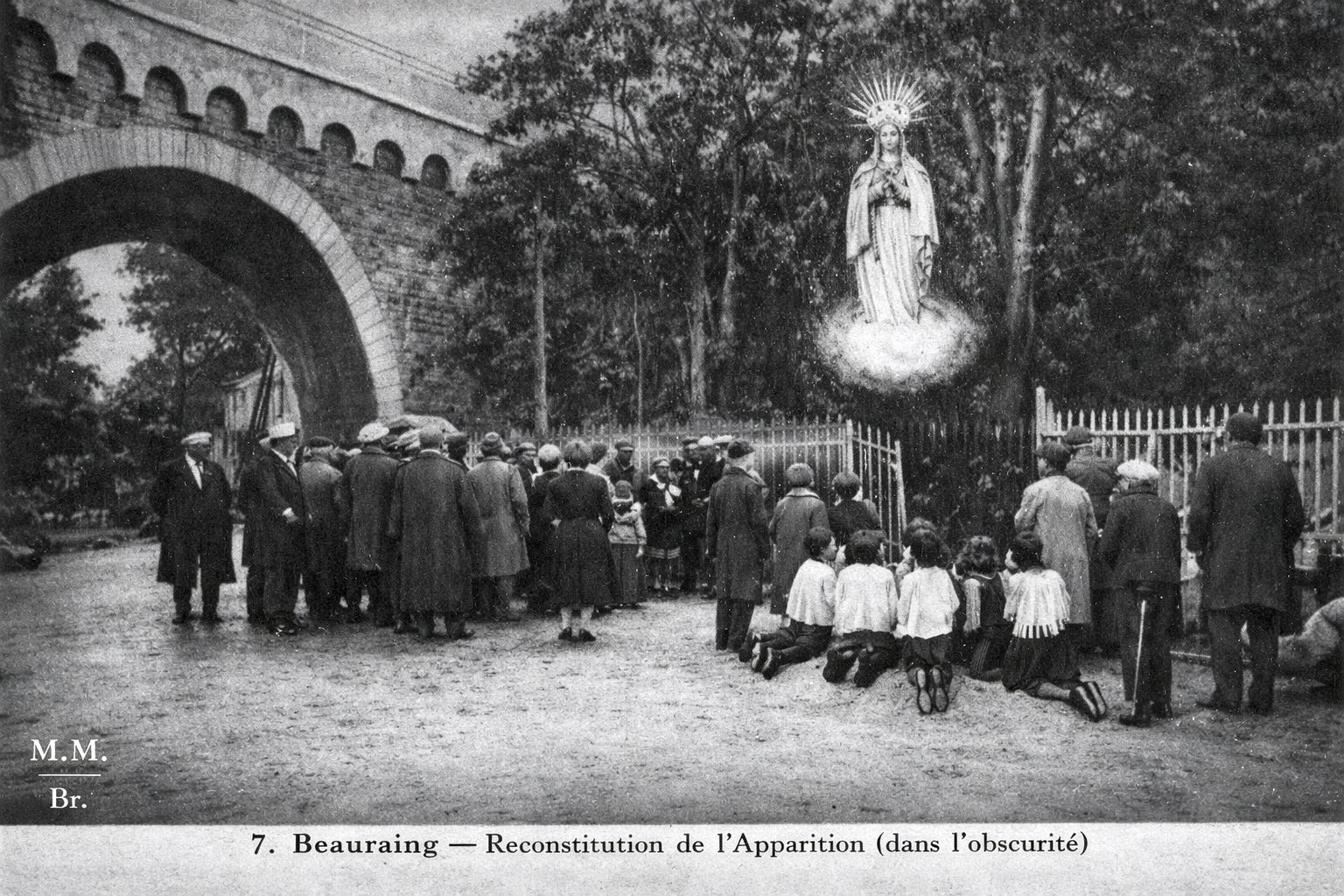
6.3 The Catholic Activist connection
Beauraing entered the publishing network surrounding Catholic Action at almost exactly the moment when Léon Degrelle was transforming that network into a mass-media operation. There are three layers worth separating: Dr Fernand Maistriaux, Éditions Rex, and the ACJB (Association Catholique de la Jeunesse Belge).

6.3.1. Dr Fernand Maistriaux and the mishandled investigation
Fernand Maistriaux was a doctor in Beauraing and a local president of the Association Catholique de la Jeunesse Belge (ACJB). He became involved with the alleged apparitions very early. A scholarly study by Tine Van Osselaer notes that he was one of the first doctors at the site and that he wrote the first book about the apparitions at the request of Rex, explicitly describing Rex as the publishing house of the Catholic Action youth movement.
According to research in “Les apparitions de la Vierge et la critique historique” by Marc Hallet, Dr Maistriaux took it upon himself to organize the initial interrogations of the children. This was a lay initiative, completely independent of the later Church investigation, conducted primarily by medical doctors invited by Maistriaux. But his methods were heavily criticized as unscientific, such that even supporters considered the investigation badly conducted.
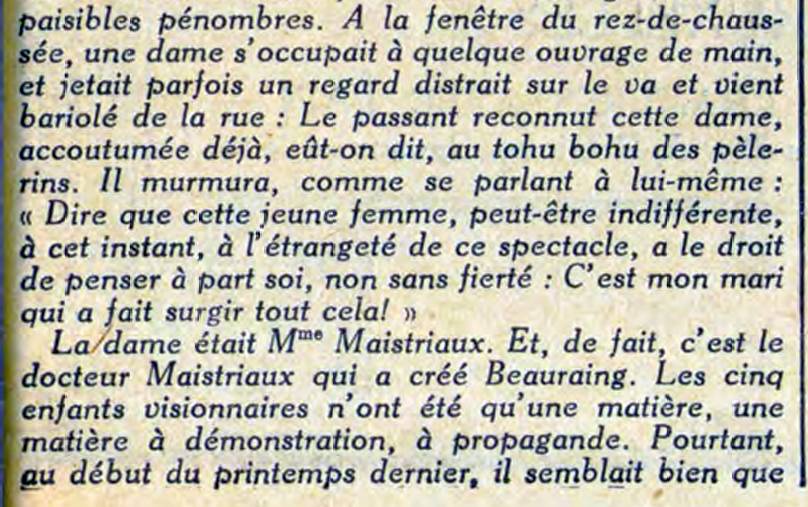
6.3.1.1. The investigators were not appropriately qualified
The first criticism is that Maistriaux was a very young general practitioner, not a specialist in psychiatry, psychology, psychopathology, or psychoanalysis.
Hallet quotes the earlier critic:
“La cause initiale fut l’incompétence manifeste des dirigeants de l’enquête.”
and asks why Maistriaux had not sought the assistance of:
“psychiatres, de psychologues, d’aliénistes, de maîtres éprouvés et de toutes croyances”
and specifically people with established international authority in psychopathology and psychoanalysis.
The point isn’t simply “Maistriaux was young.” It is that he was effectively trying to adjudicate an extraordinary psychological phenomenon without bringing in the specialists whose disciplines were most relevant to distinguishing hallucination, suggestion, hysteria, group influence, fabrication, etc.
6.3.1.2. Maistriaux appears to have controlled access to the investigation
This is perhaps the most striking criticism.
Gaston Robert, who himself believed Beauraing was authentic, described Maistriaux as a forceful personality:
“Le médecin catholique de Beauraing, qui préside à l’organisation de la séance, est un caractère. Il possède toutes les aptitudes requises pour le commandement. Il parle sur un ton qui ne souffre pas de réplique. Aux premiers mots qu’on lui dit, sa tête et le haut de son buste se reculent d’un geste brusque et son regard, à l’arrêt, s’exerçant au travers de grosses lunettes d’écaille, indique la solidité des positions. On saisit sur-le-champ
qu’aucun argument n’aura raison de ses décisions de principe. Ses jugements sont souverains.”
and, even more pointedly:
“Ses énoncés dominent la preuve.”
In other words, Robert’s criticism is that Maistriaux’s conclusions were effectively being treated as the starting point from which the evidence was interpreted, rather than allowing the evidence to determine the conclusion.
Even more important is Robert’s description of who was permitted into the examination room:
“N’avaient donc accès dans la salle que les médecins et les amis de bon ton.”
Robert adds that magistrates, civil servants, professors and senators were turned away at the door.
That’s a major methodological problem. An investigation claiming to establish the objective truth of an extraordinary event should ideally be open to independent observers, especially people capable of challenging the investigators’ assumptions.
6.3.1.3. There was effectively no independent cross-examination
The previous point leads to a larger issue: Maistriaux’s group was investigating itself.
According to the account quoted by Hallet, Maistriaux:
“avait accaparé l’enquête ‘scientifique’ pour lui seul et ses confrères”
and was quite willing to speak on behalf of the group as a whole.
This creates what we’d now call a confirmation-bias problem. If the investigators are already convinced that the children are genuine, and skeptics are excluded from observing the questioning, there is little opportunity for an adversarial examination of the evidence.
6.3.1.4. The children were not isolated from one another
The examination record contains at least one instance in which Gilberte Degeimbre, having forgotten a detail, turned to her sister for the answer. This demonstrates that the questioning procedure did not consistently preserve the independence of the children’s testimony. Consequently, similarities between their accounts cannot automatically be treated as independent corroboration.
Sometimes one child would be asked a leading question already containing the testimony of another:
Certaines étaient ce qu’on appelle des questions fermées, c’est à-dire contenant, en elles, la réponse toute faite ou souhaitée. Exemple de question fermée : “Quand vous la voyez, est-elle fort claire, fort lumineuse ?” Réponse : “Oui”. Evidemment !
We should also distinguish communication during the investigators’ examination from communication before the examination. The latter is much harder to reconstruct, but it is arguably even more important because the children could have discussed the apparitions extensively before being questioned. The fact that the investigators apparently did not rigorously isolate them during questioning makes it harder to use later concordance as proof of independent perception. Hallet quotes Gaston Robert:
“La concordance des témoignages en faveur de l’apparition ne fournit pas la preuve de la réalité de celle-ci puisqu’ils disposaient de toute la journée pour s’en entretenir.”
In other words:
“The concordance of the testimonies in favor of the apparition does not provide proof of its reality, since they had the whole day in which to discuss it.”
And Robert adds that the children had “traîné dans un couloir avant d’être interrogés”—they had been hanging around/waiting in a corridor before being questioned—and therefore had been able to communicate with one another.
6.3.1.5. The interviewers didn’t keep contemporaneous records
Hallet cites the fact that three children separately used essentially the same unusual expression, saying that the apparition had something like:
“des lampes électriques dans la tête”
Robert and F. Dorola were struck by the fact that such an unusual expression supposedly emerged independently from three children. That could potentially have been powerful corroboration – if the children’s testimony had actually been independent and contemporaneously recorded.
But then the investigation itself undermines that interpretation. Hallet reports that the expression was Maistriaux’s recollection, and that:
“à cet interrogatoire du mardi cinq décembre personne ne prit vraiment des notes, chacun se fiant sur sa mémoire !”
So, essentially, nobody really took notes at the December 5 interrogation; everyone relied on memory.
6.3.1.6. The children were not necessarily interviewed in a way that preserved their original testimony
This is another recurring criticism in Hallet’s treatment of Beauraing. Later accounts contain contradictions concerning what the children said at the time versus what was reconstructed afterward.
The problem is particularly acute with questions such as:
- Did a child report something immediately after an apparition?
- Was it recorded verbatim?
- Were all the children questioned separately?
- Were they subsequently brought together?
- Did adults tell them what the others had said or pose leading questions?
- Were later accounts allowed to overwrite the original ones?
Hallet argues that the surviving documentation does not permit us to reconstruct the original testimony with the confidence that the apologetic literature sometimes implies.
One doctor explicitly noticed the problem:
“J’ai constaté que j’étais le seul prendre des notes, parmi les médecins”
—“I observed that I was the only one taking notes among the doctors.”
The doctor then adds:
“les enfants ne m’ont pas répondu comme vous…”
—“the children did not answer me as they did you…”
That second statement is potentially very significant. It suggests that the accounts were not simply uniform across different interrogations, despite the later presentation of a concordant testimony.
It also raises an obvious methodological question: what exactly did Maistriaux and the other doctors remember the children saying, and how much of the apparent agreement was reconstructed afterward? Since no proper record was kept of the interrogations, were contradictions simply omitted and forgotten?
6.3.1.7. The investigation did not sufficiently exploit the obvious psychological questions
This is perhaps the broadest methodological criticism.
A genuinely neutral investigation would have needed to consider multiple competing hypotheses. Instead, the early investigation appears to have concentrated heavily on establishing that the children were sincere and that their experiences were extraordinary.
But sincerity is not the same as accuracy.
A child can sincerely report seeing something that wasn’t objectively present. And several children can arrive at similar reports through suggestion or interaction. Those possibilities required specialist investigation.
The critic quoted by Hallet therefore asks why Maistriaux did not bring in experienced authorities in psychopathology and related fields.
6.3.1.8. The early testimony was in fact far from consistent
The later claim that the Beauraing children gave remarkably consistent accounts from the outset is difficult to reconcile with the earliest witness accounts, preserved outside of Dr Maistriaux’s narrative. The evidence instead suggests that the children’s descriptions developed considerably over time, moving from uncertainty about a light or moving object toward an increasingly definite identification with the Virgin.
The reports also contain indications that the children’s descriptions could shift in response to their surroundings. On December 11 Fernande was asked where she saw the Virgin and answered: “Dans l’espace, sur le remblai de chemin de fer.” An observer then pointed out that from her usual position during the apparitions the railway embankment could not be seen because branches obstructed it. Fernande immediately changed her indication and pointed to another location, about thirty degrees away. Her account was apparently capable of changing when confronted with information supplied by an observer.
Similarly, the claim that the children did not blink during the apparitions – attributed to Albert – is difficult to reconcile with the actual situation since he could not directly observe the others’ eyes while supposedly seeing the Virgin himself. Yet this kind of statement is revealing because it shows how readily details could become part of the story regardless of whether the children had actually observed them.
6.3.1.9. The investigation was entangled with promotion of Beauraing
Maistriaux wasn’t merely an investigator. He was also one of the early promoters/documenters of Beauraing, publishing material about the events almost immediately.
And the later Un Lourdes belge ? framing is significant because it places the phenomenon within a pre-existing Catholic apparition template: Beauraing as a potential Belgian Lourdes.
That doesn’t prove bad faith. But it creates a potential role conflict. An investigator ideally needs room to conclude “nothing happened,” “the evidence is inconclusive,” or “the children were mistaken.”
The more publicly committed the investigator becomes to the proposition that Beauraing is authentic, the harder it becomes to maintain that neutrality.
6.3.1.10. The investigation left permanent gaps in the historical record
This is actually more important than any individual criticism. The investigation utterly failed to preserve the children’s testimony, let alone preserve witness independence.
Hallet ultimately argues that the investigation was:
“très mal conduite”
and that numerous pieces of the evidentiary “puzzle” would be lost forever.
The most revealing quotation is “Ses énoncés dominent la preuve” – his assertions dominate the evidence.
That gets to the heart of the problem: the criticism isn’t merely that Maistriaux reached the wrong conclusion; it’s that the structure of the investigation made it difficult for the evidence to challenge his preconceived conclusion.
And the fact that this same person was simultaneously an early investigator, organizer, Catholic activist and promoter of the “Belgian Lourdes” interpretation deserves very close scrutiny.
In retrospect, it was a huge mistake that the bishop tolerated these amateur, non-clerical “investigations” to permanently muddle the record. The fundamental problem with the early Beauraing investigation is not merely that the children’s testimony contained contradictions. It is that the investigation was conducted in such a manner that the extent of those contradictions can no longer be reliably determined. The surviving record consists disproportionately of retrospective summaries and recollections rather than independently recorded contemporaneous statements. Consequently, later assertions of unanimity cannot be independently tested against a complete primary record.
6.3.2 The involvement of Éditions Rex
Maistriaux’s first book covered the apparitions from 29 November through 20 December, included portraits of the children, and gave information about the Voisin and Degeimbre families.

Dr Fernand Maistriaux, Que se passe-t-il à Beauraing?
Louvain: Éditions Rex, 1932, 44 pages with photogravure illustrations.
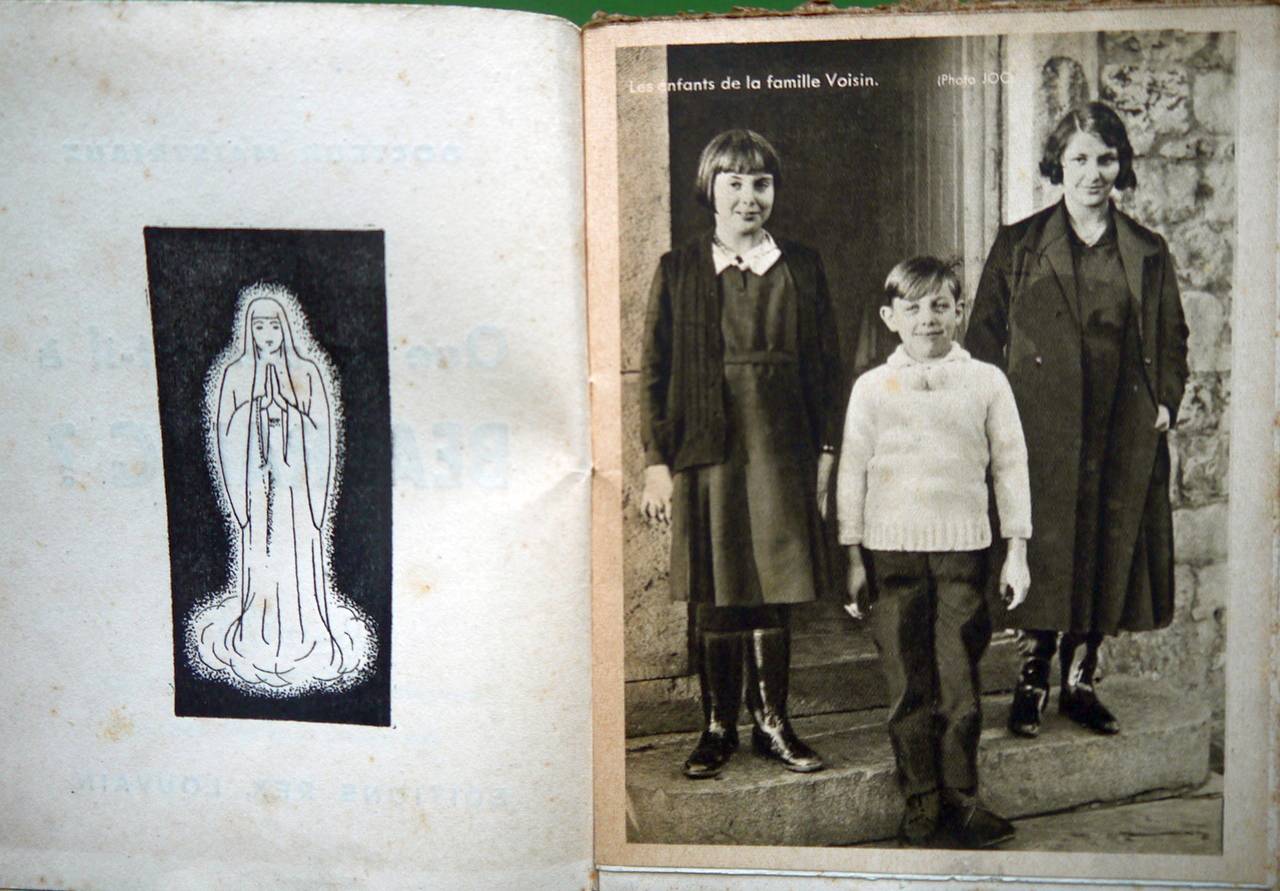
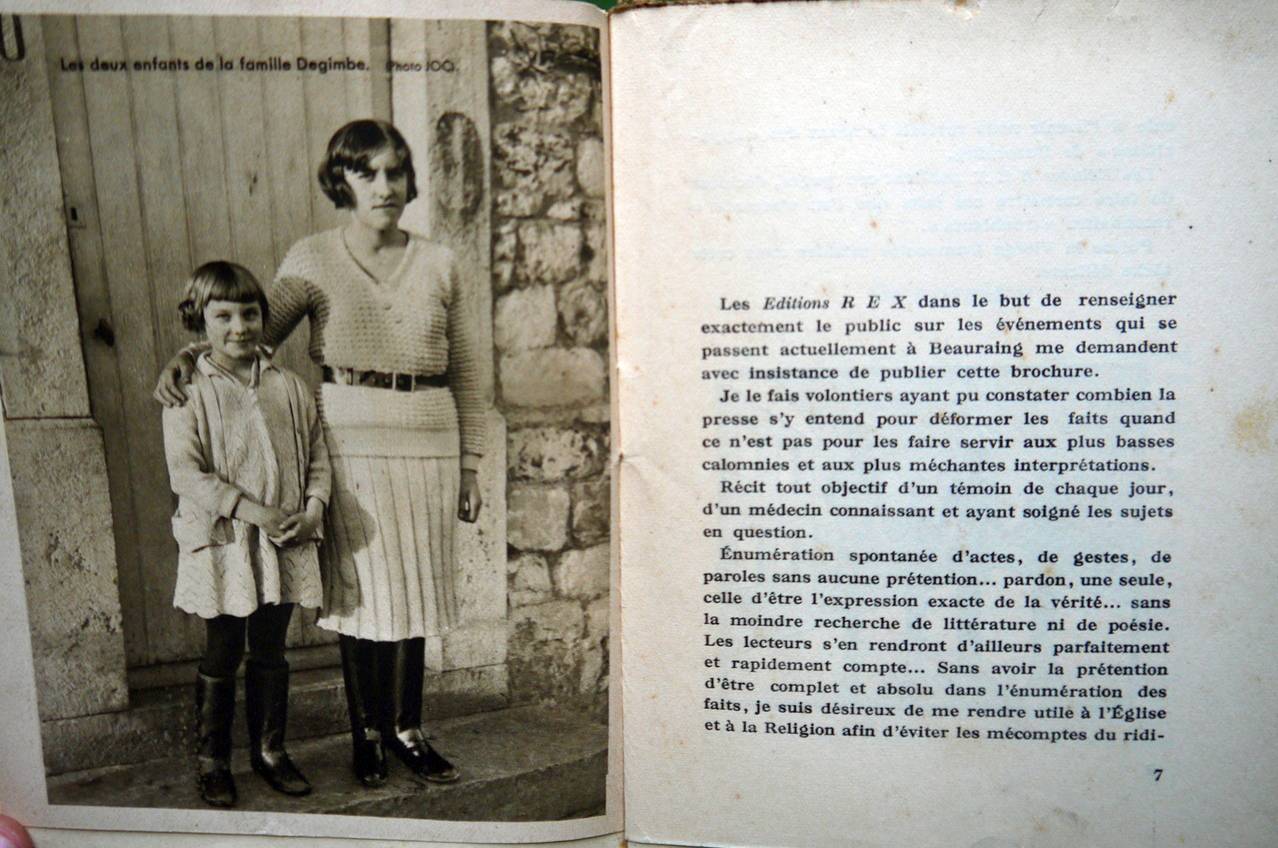
This wasn’t a retrospective book written months later. It was near-contemporary reportage produced while the apparition sequence was still underway. And the inclusion of photos means the Rex publication was already doing more than simply circulating an argument. It was visually documenting the phenomenon.
Rex immediately followed it up with a second Beauraing publication in 1933, covering the events through the final apparition of 3 January.

Maistriaux, Les dernières apparitions de Beauraing
Louvain: Éditions Rex, 1933, 61 pp.
This second brochure included views of the grotto and the tree where the Virgin was said to have appeared, as well as a portrait of Maistriaux.
A larger book, largely repeating the previous two, followed the same year:

Fernand Maistriaux, Un Lourdes belge ? Les apparitions de Beauraing
Louvain: Éditions Rex, 1933, 99 pp.
So Rex’s Beauraing publishing activity wasn’t a single pamphlet. It developed into a small publishing program.
The early timing matters. Rex was not retrospectively documenting a settled event. It was publishing while the evidence was still forming, while the children’s accounts were still being questioned, and before the Church’s formal investigation had begun. The publications visually and narratively standardized Beauraing for the Belgian public.
Éditions Rex had originally been established as a Catholic publishing house associated with the Action Catholique, and its purpose was to publish Catholic material. A historical study of the origins of Rexism describes the company as having been founded in Louvain to publish brochures of Catholic Action, and says that when Degrelle took over its management in October 1930, it was still a relatively small operation.
The ACJB was one of the important Catholic youth organizations within that broader Catholic Action world. And this is where Maistriaux’s position becomes important. He wasn’t simply some random doctor whom Degrelle discovered. He was a Catholic activist already embedded in the same organizational ecosystem. Van Osselaer’s research specifically describes Maistriaux as a local ACJB president and says his Beauraing books were written at Rex’s request.
6.3.3. Degrelle’s creation of a mass-media phenomenon
The Rex publishing house was financially weak when Degrelle took it over in 1930. A contemporary historical study of Rexism describes how Degrelle deliberately moved away from the rather dry theological/Catholic pamphlet market and began producing cheap, topical brochures intended for mass circulation. The same study says that he would react to events of interest to Catholics by rapidly producing inexpensive pamphlets. Beauraing was almost the perfect subject for that strategy:
- dramatic religious claims
- children as visionaries
- enormous crowds
- controversy
- Catholic interest
- and, crucially, a story that was developing day by day.
Degrelle’s publishing operation could therefore turn a local religious event into something that could be read about, photographed, discussed, bought, and circulated throughout Belgium.
A historical biography of Degrelle puts the point quite bluntly: he did not invent the Beauraing and Banneux apparitions, but he did significantly promote them through his press.
6.3.4. The financial incentive
Tine Van Osselaer’s research on the Rex/Banneux publishing campaign says that Degrelle saw the commercial potential of the apparition publications and that the comparable Beauraing publications had quickly brought financial health to the struggling publishing company. There was undoubtedly genuine Catholic enthusiasm involved, but Degrelle also recognized that apparitions were commercially powerful news events.
And the sequence at Banneux shows the mechanism very clearly. After Beauraing had proven successful, Degrelle used the same publishing machinery to promote Banneux. Van Osselaer describes him commissioning Amand Géradin and arranging a translated publication to stimulate interest among Flemish readers. Beauraing appears to have been the proof of concept.
And there is a particularly useful bibliographical lead: the first Maistriaux booklet survives in multiple editions, including a 135th-thousand edition, which tells us that the initial publication wasn’t some obscure little pamphlet; it was being reprinted in very substantial numbers.
That is probably the most important thing established so far: Rex didn’t merely mention Beauraing. It appears to have turned the apparition into a successful mass-market publishing campaign, using an ACJB-connected local doctor as an early authoritative witness and distributing illustrated material while the events were still unfolding.
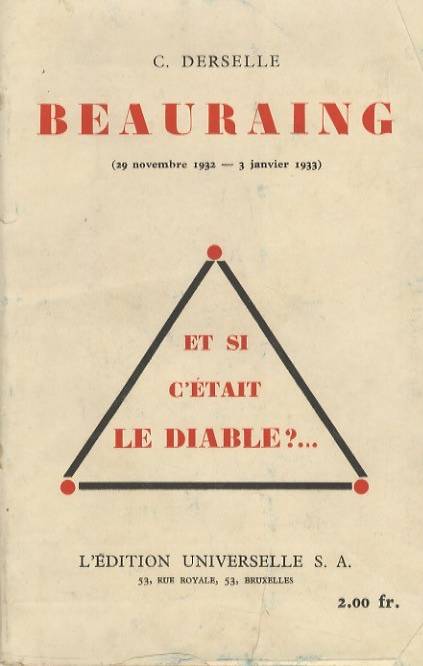
Éditions Rex continued its involvement in the debates around Beauraing, arguing in favor of the apparitions in publications like Le scandale de Beauraing : réponse à “Si c’était le diable?“, a 1933 pro-Beauraing polemical booklet, written by Roger Saussus in response to Clément Derselle’s “attack” on the apparitions, Et si c’était le Diable? – “What if it were the Devil?”
Derselle’s quite orthodox point was that Catholics shouldn’t so readily accept extraordinary events before the Church has evaluated them, since ecstasies, seemingly miraculous healings, devotional-sounding messages, and popularity are not sufficient proof of divine origin, since the devil is quite capable of any and all of these. Doctrinally, in the absence of Church approval, this prudence is the proper stance for Catholics to take, so the vehement reaction from Éditions Rex to Derselle was rather telling.
How much did Rex’s commercial and ideological interests shape the way the ambiguous early events were selected, interpreted, standardized, and presented to the Belgian public? The significance of the Rex intervention lies in the rapid construction and dissemination of a particular interpretation of the events. At a stage when the children’s accounts were still ambiguous and divergent, Rex-associated publications presented the testimony as remarkably consistent, emphasized its apparent medical corroboration, and increasingly framed Beauraing as a potential “Belgian Lourdes.” In doing so, this early promotional campaign may have transformed a heterogeneous body of primary testimony into a coherent Marian narrative before the Church’s formal investigation had even begun.
6.3.5. Tension with the Church
The official Church hierarchy was initially cautious. The bishop of Namur, Mgr. Thomas-Louis Heylen, actually instructed clergy to stay away from the crowds in December 1932. He didn’t immediately endorse the apparitions. His later position became much more favorable, but the official ecclesiastical investigation developed gradually. Meanwhile, lay Catholic activists were already publicizing the events.
The Rex/ACJB activity was entirely separate from the official Church approval.
In fact, the scholarship points to episcopal concern about lay organizations operating outside direct ecclesiastical control. The same study says Heylen was wary of the power of Catholic organizations and later established an ecclesiastical group to oversee development of the Beauraing shrine, despite the existence of a lay Pro Maria organization.
6.3.6. Was the record botched on purpose?
In the sense of media strategy and narrative construction, Degrelle appears to have understood the value of Beauraing very quickly. The particularly striking combination is:
- very early intervention while the events were still unfolding
- rapid publication through Rex
- presentation of Maistriaux’s favorable interpretation as authoritative
- emphasis on consistency and corroboration
- the highly effective “Belgian Lourdes” framing
- and exploitation of the enormous publicity and commercial potential of the pilgrimage.
Degrelle was an experienced propagandist and publisher. He understood that controlling the framing of an event early can matter almost as much as the event itself. Once the public had been given a coherent narrative—five children, independently consistent, medically examined, apparently unaffected by painful stimuli, seeing the Virgin—the later Church investigators were operating in an environment where that narrative was already deeply established.
If the original interviews and medical observations had been meticulously recorded, later publicity could be checked against the primary record. But if the primary record is fragmentary, retrospective, or based on investigators’ memories, the first published narrative can itself become the de facto historical record.
Whether the absence of contemporaneous records resulted from incompetence, enthusiasm, or deliberate choice can no longer be established with certainty. What is clear is that the investigation was conducted in a manner that failed to preserve the independent primary evidence necessary to test its central claim of concordance. The resulting evidentiary situation was unusually advantageous to the pro-apparition narrative: the primary testimony was inadequately preserved, while the investigators’ retrospective consensus was preserved and published. That is difficult to dismiss as merely an accident.
The contemporary criticism doesn’t merely say that the doctors happened to be amateurs. It says that Maistriaux controlled the investigation and failed to bring in precisely the kinds of specialists who would have made the investigation genuinely rigorous. F. Dorola’s 1933 criticism, reproduced by Hallet, is remarkably explicit. He asks why Maistriaux had not sought the assistance of “maîtres éprouvés” and asks whether he had sufficiently wanted to do so. This wasn’t a retrospective critic saying, decades later, “They should have used better experts.” A contemporary supporter of the apparitions was already criticizing the investigation in 1933.
And Dorola’s criticism goes further. He says that the large numbers of doctors who came to Beauraing were mostly inappropriate:
“la plupart étaient incompétents en la matière, dont presque tous étaient de simples curieux.”
If Maistriaux merely happened to have an incompetent team, you could explain it as enthusiasm, inexperience, or the chaotic circumstances. But the evidence shows:
- he strictly controlled access
- qualified outsiders were excluded
- he did not recruit the appropriate psychological/psychiatric expertise
- other doctors complained about the quality of the investigation
- he nevertheless presented the resulting investigation as authoritative
- his interpretations were rapidly published through Rex
Thus the hypothesis of deliberate control of the evidentiary environment becomes much more reasonable. Pourquoi Pas?, independently and contemporaneously, says Maistriaux had “jalousement” taken charge of the affair and even refused another Catholic physician, Dr Dimanche, permission to observe the children for three days. After that refusal, Dimanche – described as Catholic but “moins porté au surnaturel” – decided to cease involvement.
Thus the absence of competent independent investigators was not merely an unfortunate accident of circumstance; it occurred within an investigative structure in which Maistriaux exercised considerable control.
It is hard to escape the suspicion that Dr Maistriaux understood that verbatim independent records might expose discrepancies, and therefore preferred an investigation in which doctors would compare memories and produce a consensus account. The resulting absence of primary records would then make that consensus difficult to challenge retrospectively. We do have surviving notes and later reports, as some physicians were taking personal notes. The problem is that the documentation was fragmentary and methodologically inadequate. Meanwhile Maistriaux’s published material explicitly presented the investigation as rigorous and persuasive, described the children’s story as “jamais … en conflit” and presented as though they had been questioned separately, with great care, and by the most competent people.

To quote Tine Van Osselaer:
Interestingly, most of the records [of miraculous cures] that have been preserved in Beauraing are linked to the apparitions of 5 August 1933; that is, the apparitions of Tilman Côme, the adult visionary of Beauraing who was never officially recognized.
In other words, preserving records was apparently not necessarily conducive to recognition. The records surrounding the inconvenient adult visionary survived unusually well; the children’s early testimony, which mattered most to official approval, remained far less secure.
By the time later ecclesiastical investigators arrived, they were not encountering an uncontaminated evidentiary field. They were encountering an event already shaped by repeated questioning, child-to-child communication, retrospective reconstruction, medical interpretation, devotional enthusiasm, and organized publicity.
7. A landscape of manufactured memory
7.1. Designed to forget the chaos
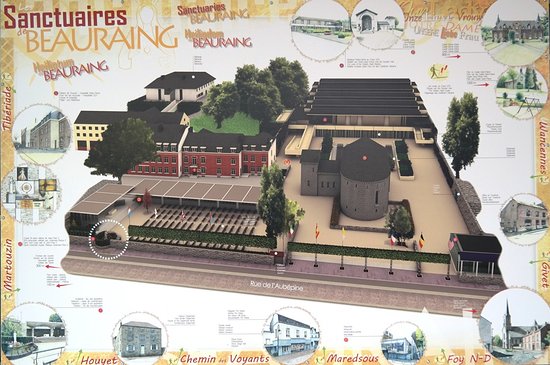
The modern sanctuary at Beauraing presents itself as a place of seamless continuity, as if the present had grown organically out of the winter evenings of 1932–33. Manicured lawns, controlled sightlines, and a carefully choreographed devotional itinerary create the impression of a site that has always known what it is. This impression is misleading. The Beauraing of today is not the Beauraing of the apparitions; it is the Beauraing that has been constructed, stabilized, and ritualized through decades of institutional memory‑work.
The sanctuary’s spatial logic reinforces selective memory. Visitors are guided along a linear devotional path – hawthorn tree, Golden Heart statue, Chapel of the Apparitions, Rosary Way, basilica – each step reinforcing a distilled narrative: Mary appeared here; she revealed her heart; she asked for prayer; pilgrims responded. The path is not descriptive but prescriptive. It tells the visitor what matters and, by omission, what does not.
What is absent from this script is as telling as what is included. There is no trace of the Belgian apparition epidemic, no hint of the crowd pressure, no acknowledgment of trance states or narrative synchronization, no reference to the social tensions of Depression‑era Wallonia. The sanctuary presents a distilled memory, not a historical reconstruction.
The hawthorn tree – once an ordinary garden tree surrounded by mud and crowds – is now fenced, elevated, and framed as a sacred relic. The tree is no longer a witness to a messy social event; it is a curated object, a controlled node of devotion.
The Golden Heart motif, which emerged only late in the sequence of visions after repeated sessions and escalating crowd pressure, is now omnipresent. Symbolic consolidation replaces historical sequence.
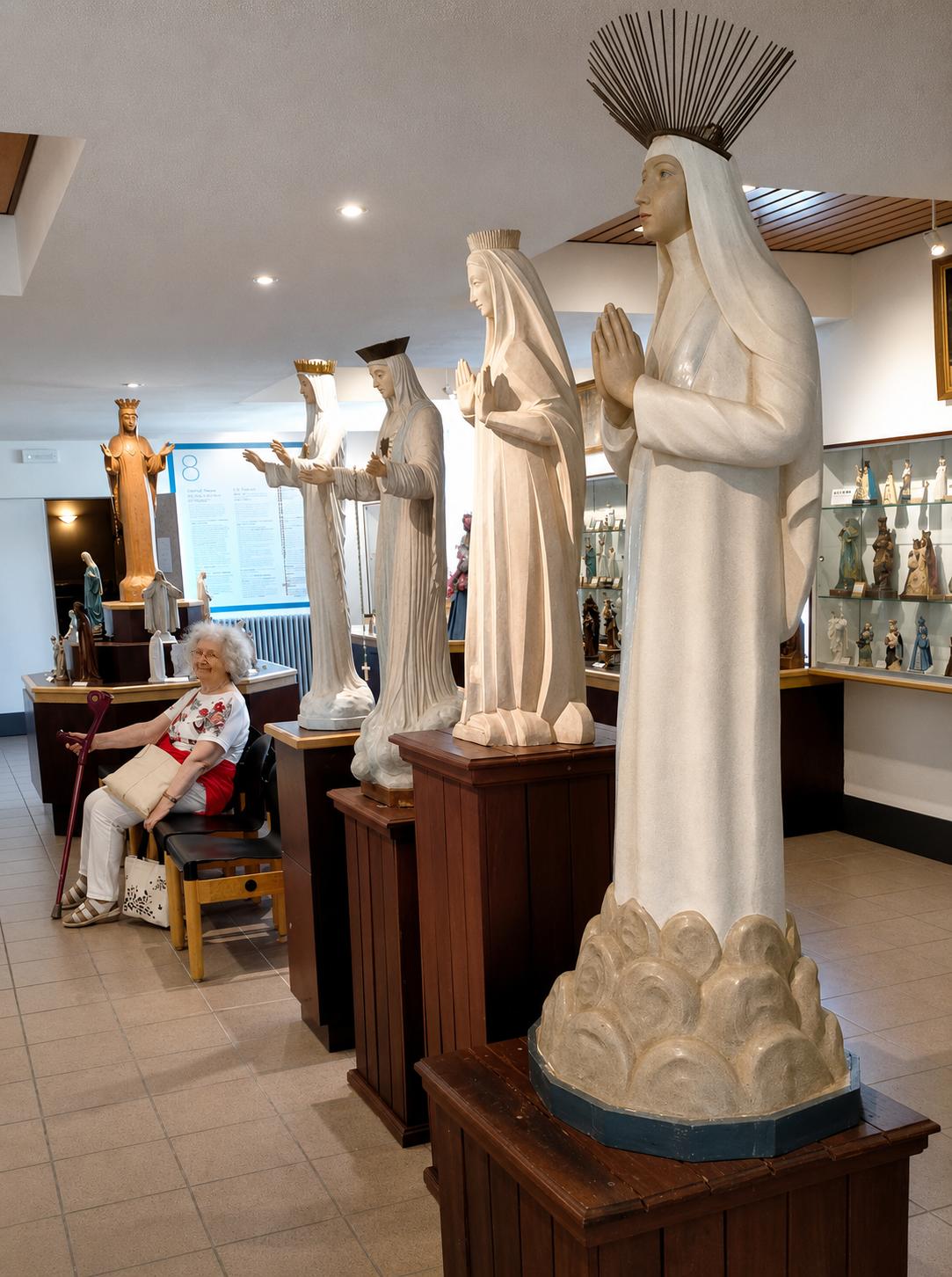
The Chapel of the Apparitions replaces intensity with tranquility: soft lighting, devotional art, and quiet circulation reframe what had been noisy, crowded, and volatile as private contemplation.
The basilica performs a different function: institutional monumentalization. Its architecture communicates legitimacy and stability. It is the Church’s way of saying, without words, This happened. This matters. This is part of our story.
The architecture itself becomes a theological argument. The chapel says: this was peaceful. The basilica says: this was approved. The statue says: this was always about the Golden Heart. The path says: move through the story in this order. None of these claims has to be written on a sign to shape the visitor’s understanding. The site teaches by arrangement.
The gift shop and information center complete the memory‑machine. Books, holy cards, statues, and pamphlets present a harmonized version of the children’s testimonies. None mention the apparition epidemic, the rejected sites, the psychological dynamics, or the social contagion. The narrative is filtered until only the devotional core remains. What was once a complex social event becomes a simple spiritual story.
7.2. The archaeology of a vanished Grotto
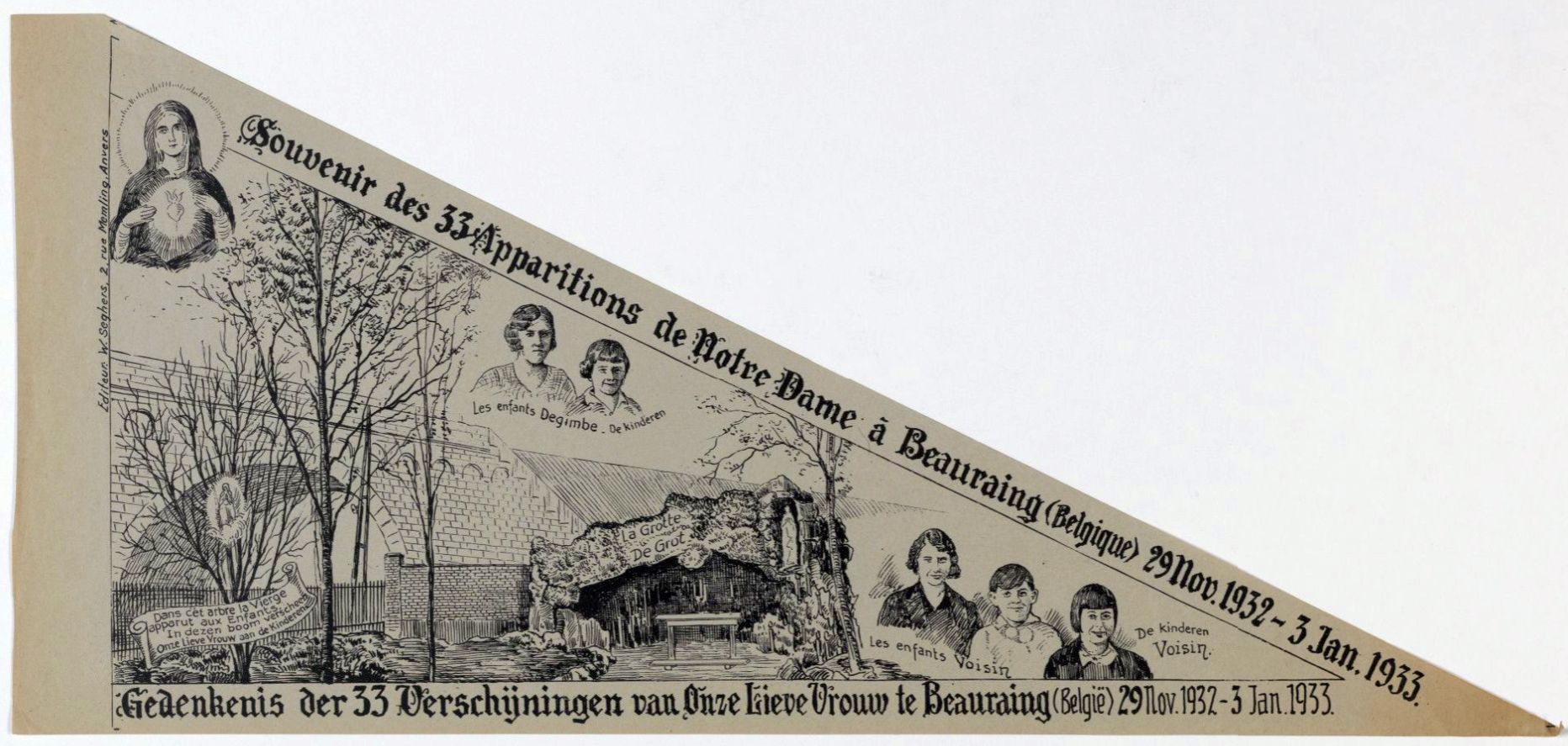
exemplifying that it initially was an integral part of the narrative
The most revealing feature of the sanctuary is not what stands at its center, but what has quietly disappeared from its periphery. In 1932, the convent garden contained a substantial Lourdes grotto, positioned only a few meters from the hawthorn tree where the children fixed their gaze. It was an ordinary devotional structure, neither ancient nor miraculous, but it was undeniably part of the physical environment in which the apparitions unfolded. Contemporary photographs show it clearly; postcards and newspaper articles referred to it; the children passed it each evening; the crowds stood beside it. It was the prominent devotional center of the convent garden. (lourdesgrotten.com)
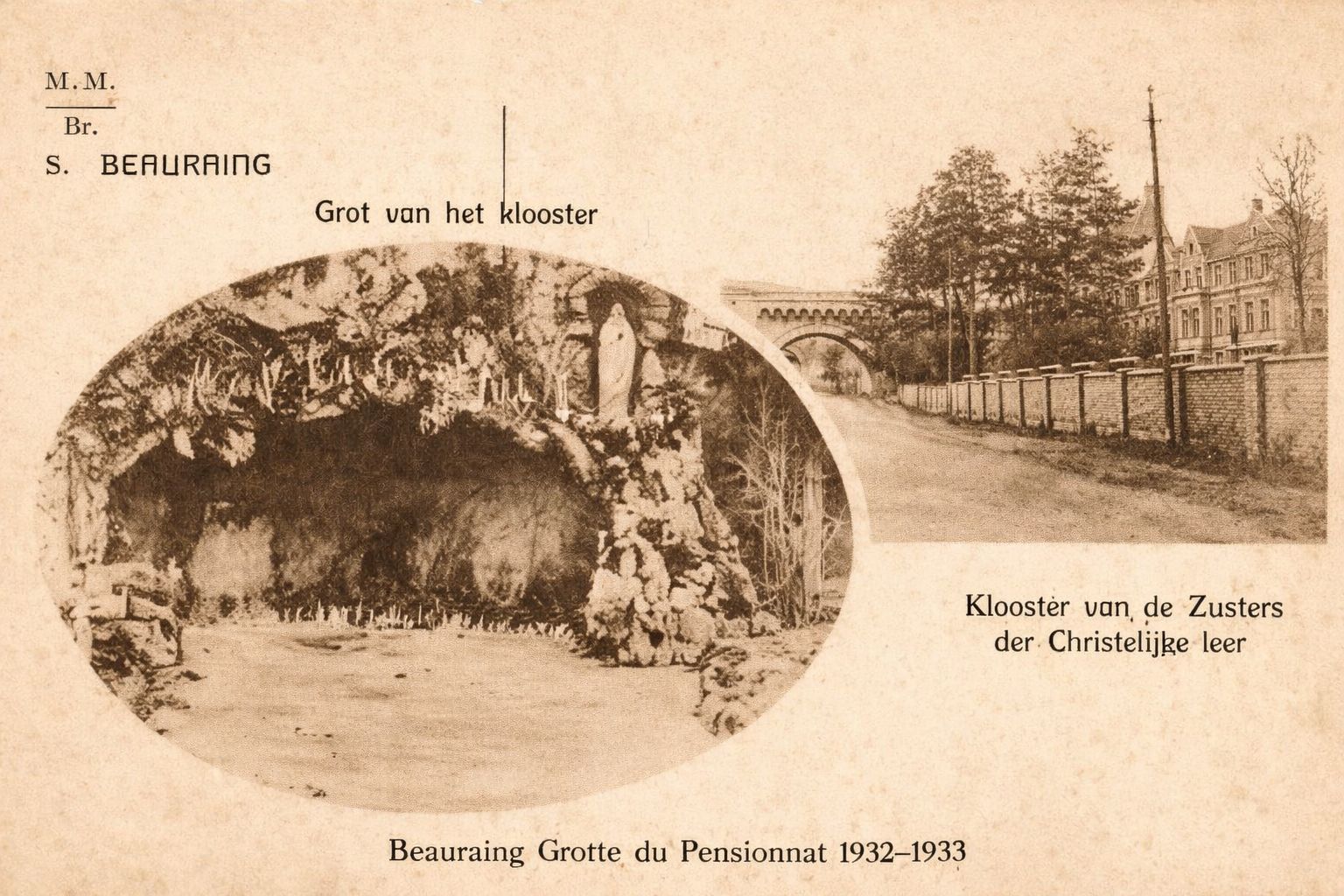
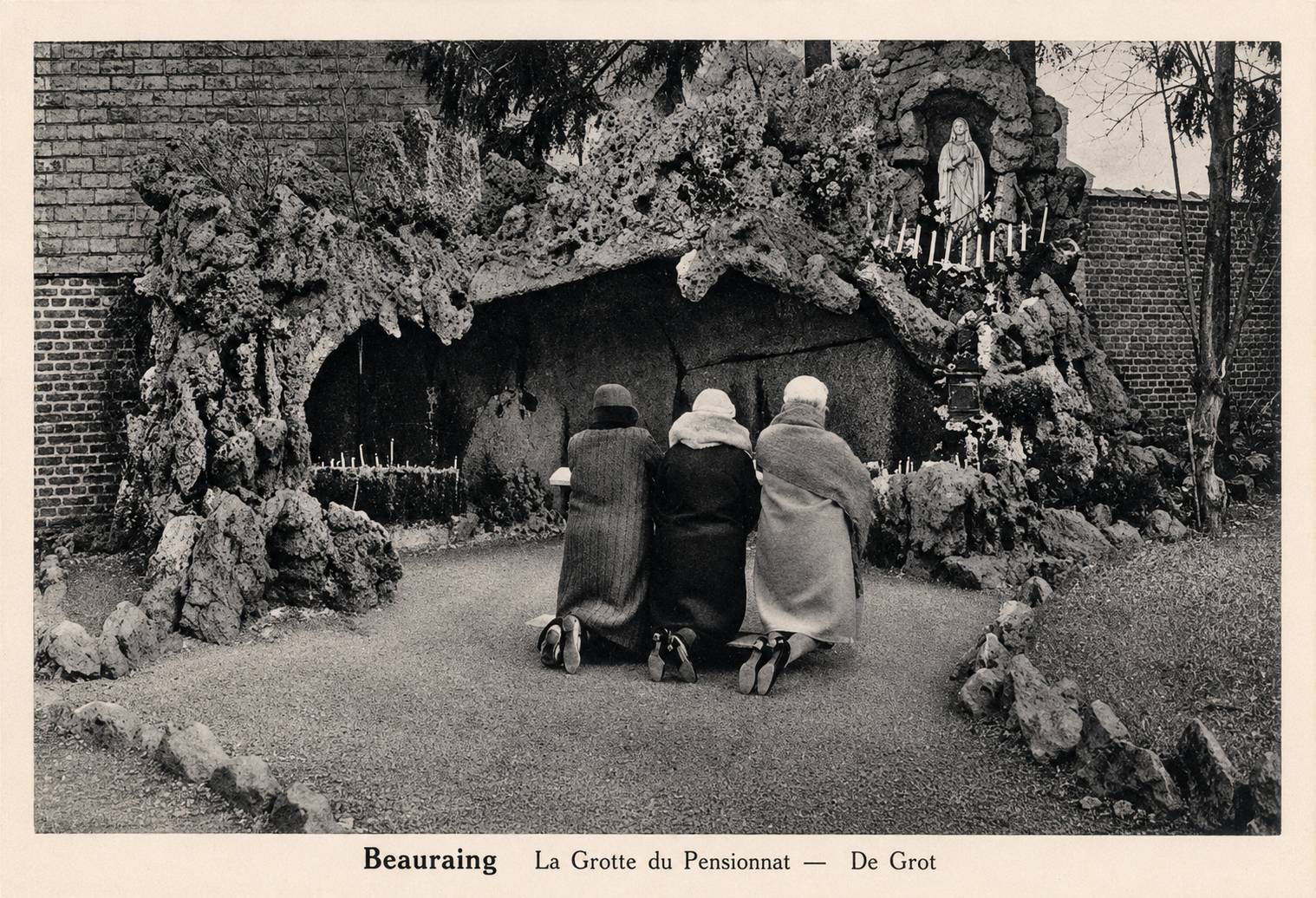
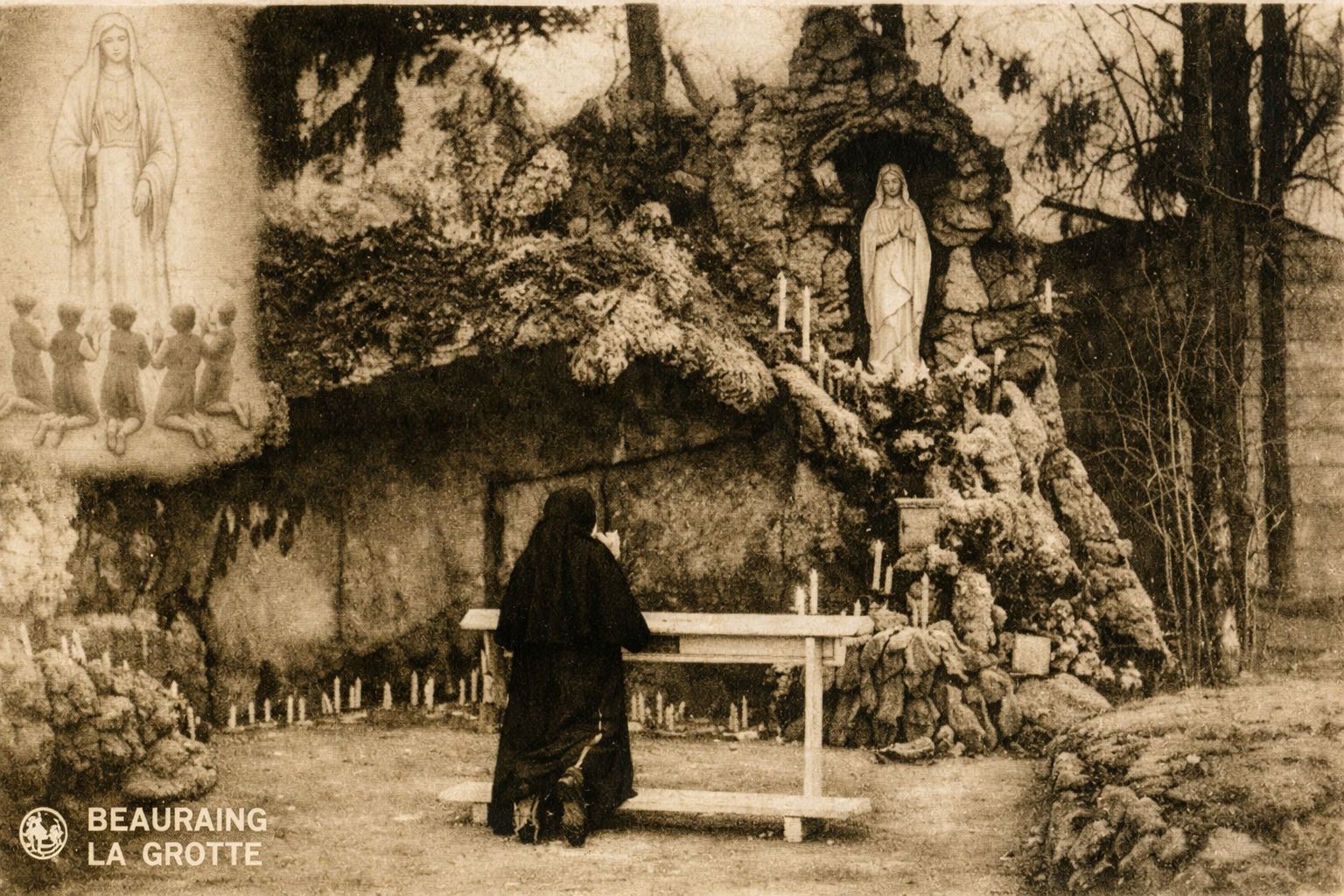
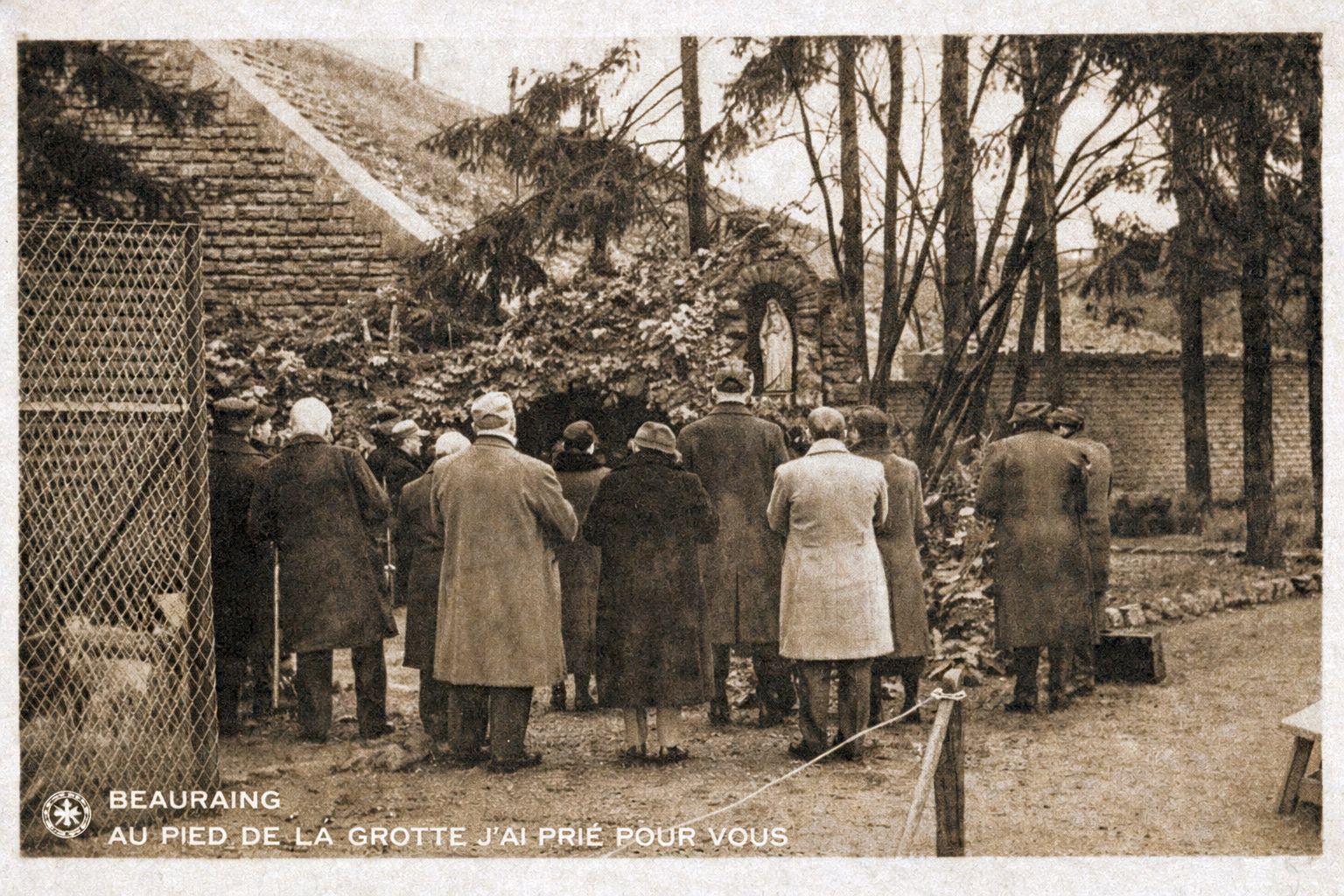
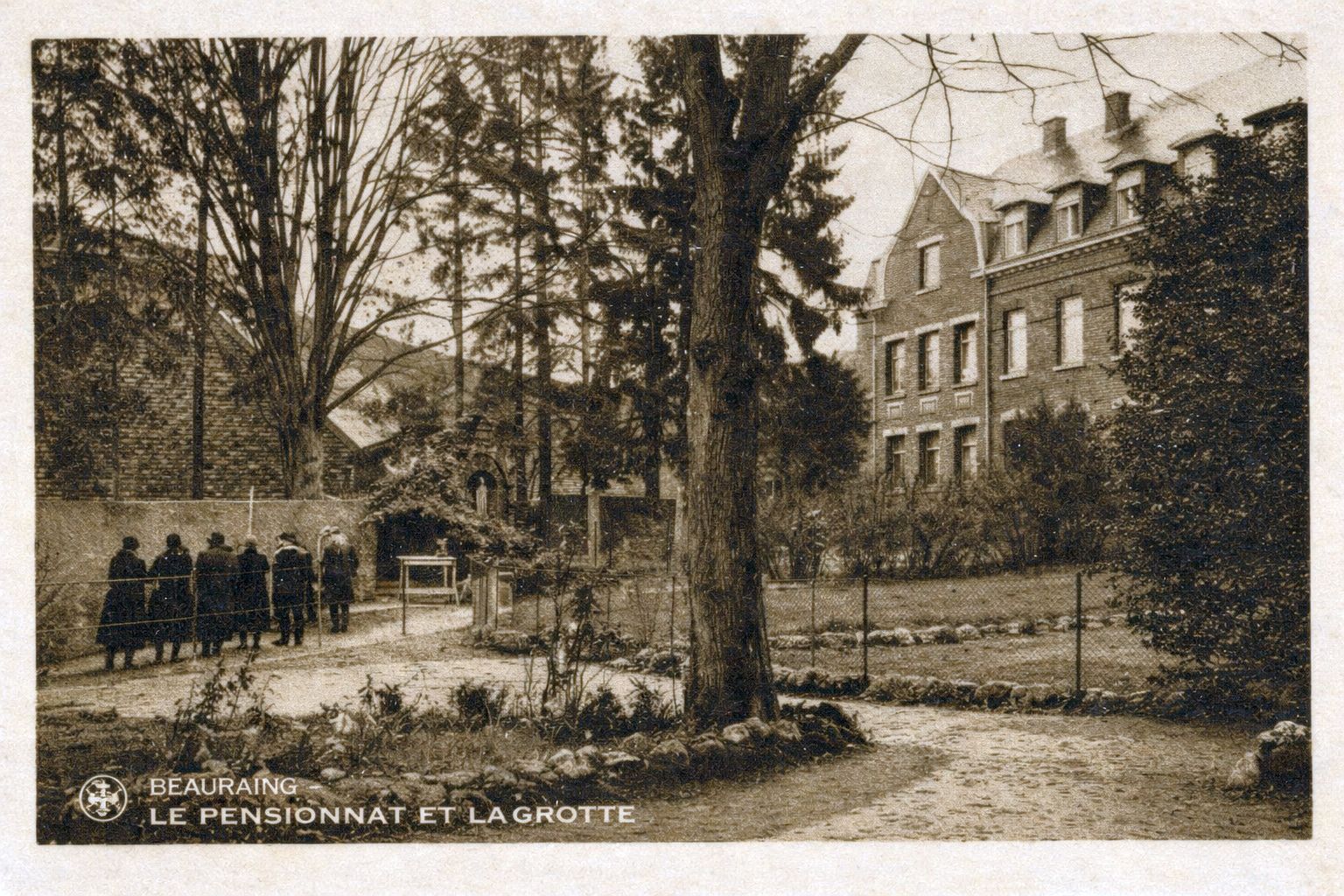
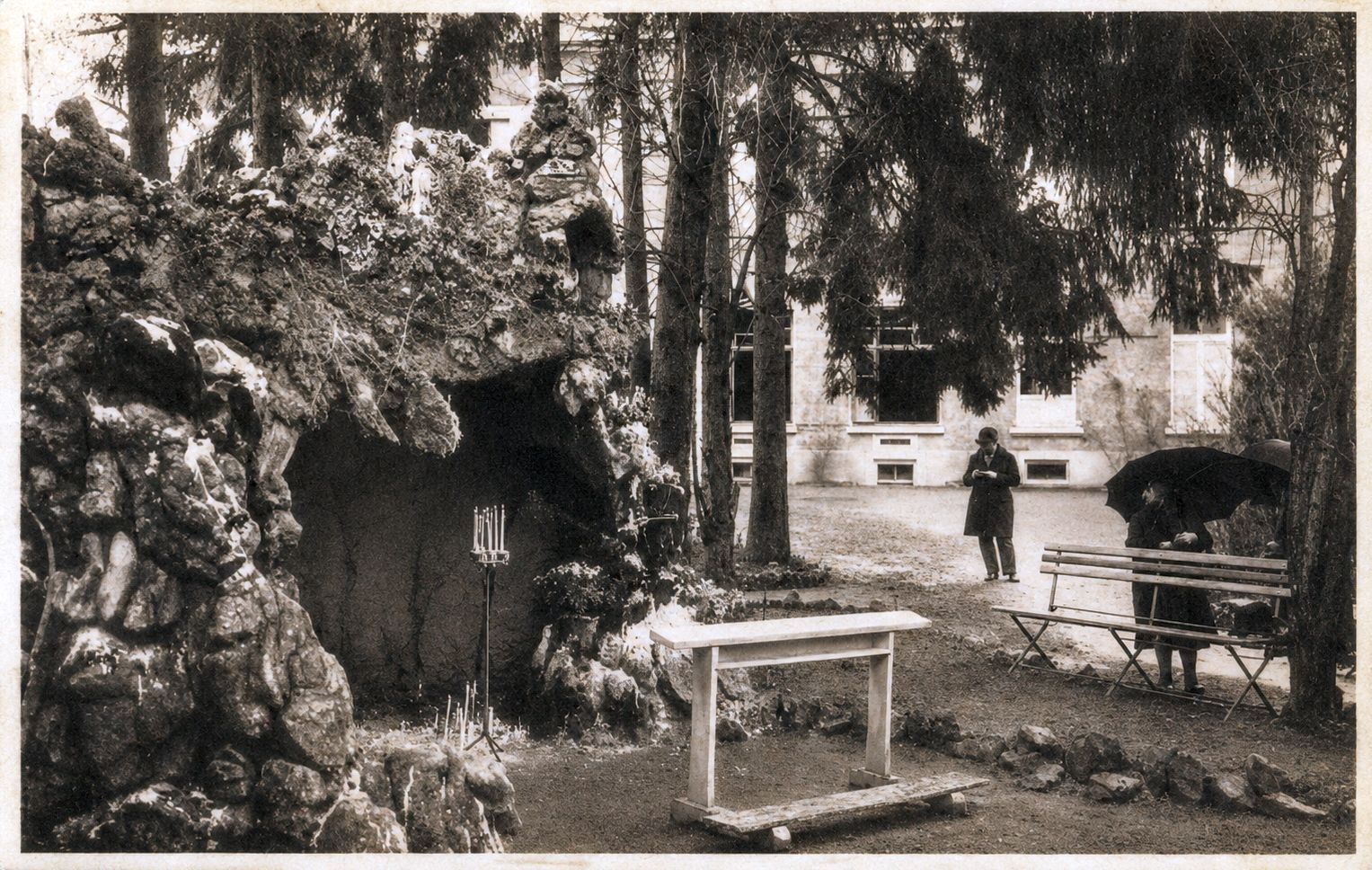
Today, the grotto is gone. I found no public acknowledgement or justification for the removal, but based on the sanctuary’s reconstruction phases, the most likely scenario is that it was dismantled during the major landscaping works of the 1950s–1960s, perhaps as early as 1946 when the big marble statue was installed, although I found postcards sent in 1947 and 1950 that still refer to the grotto.
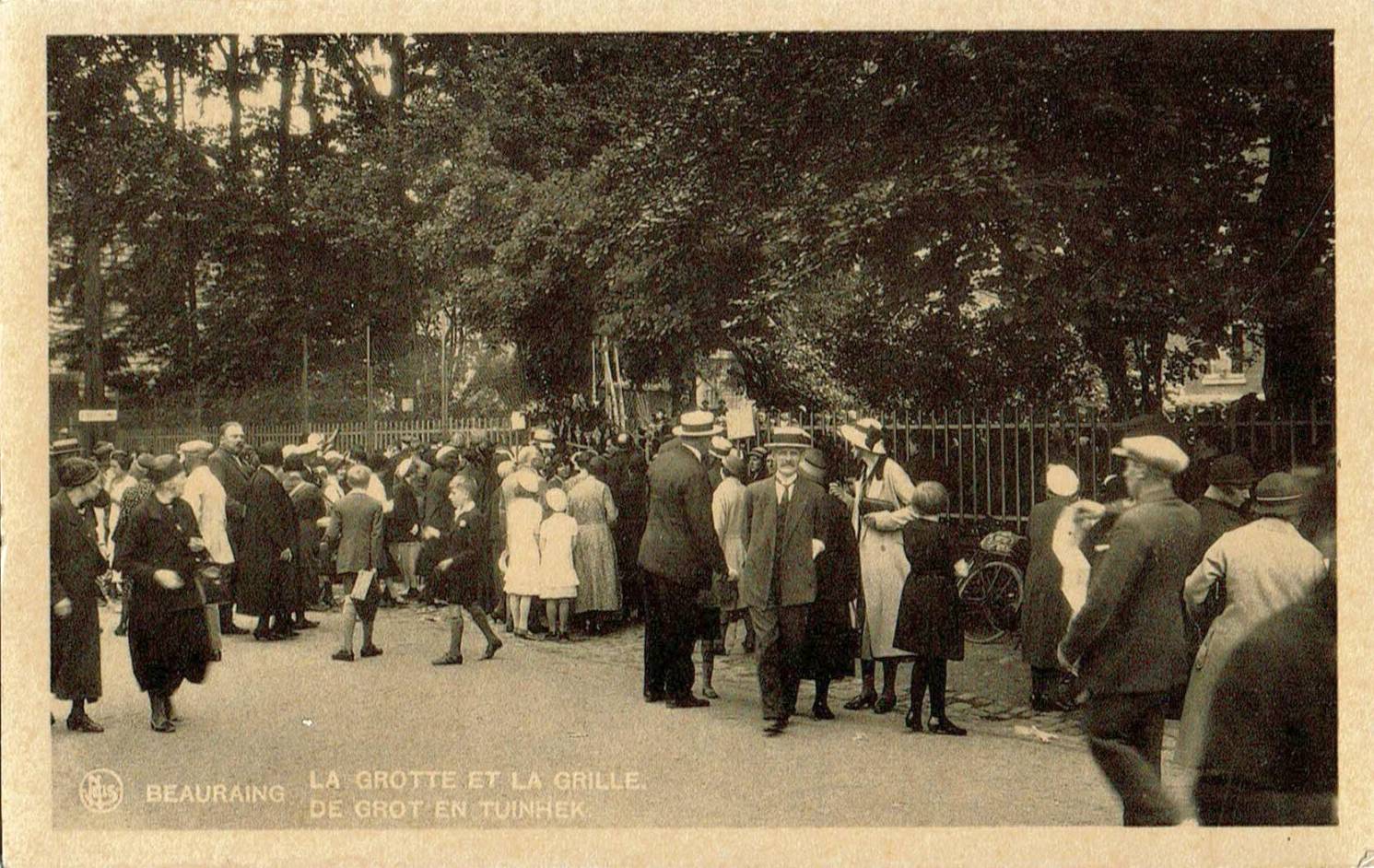
The grotto appears removed at the time of this “circa 1960” photo:
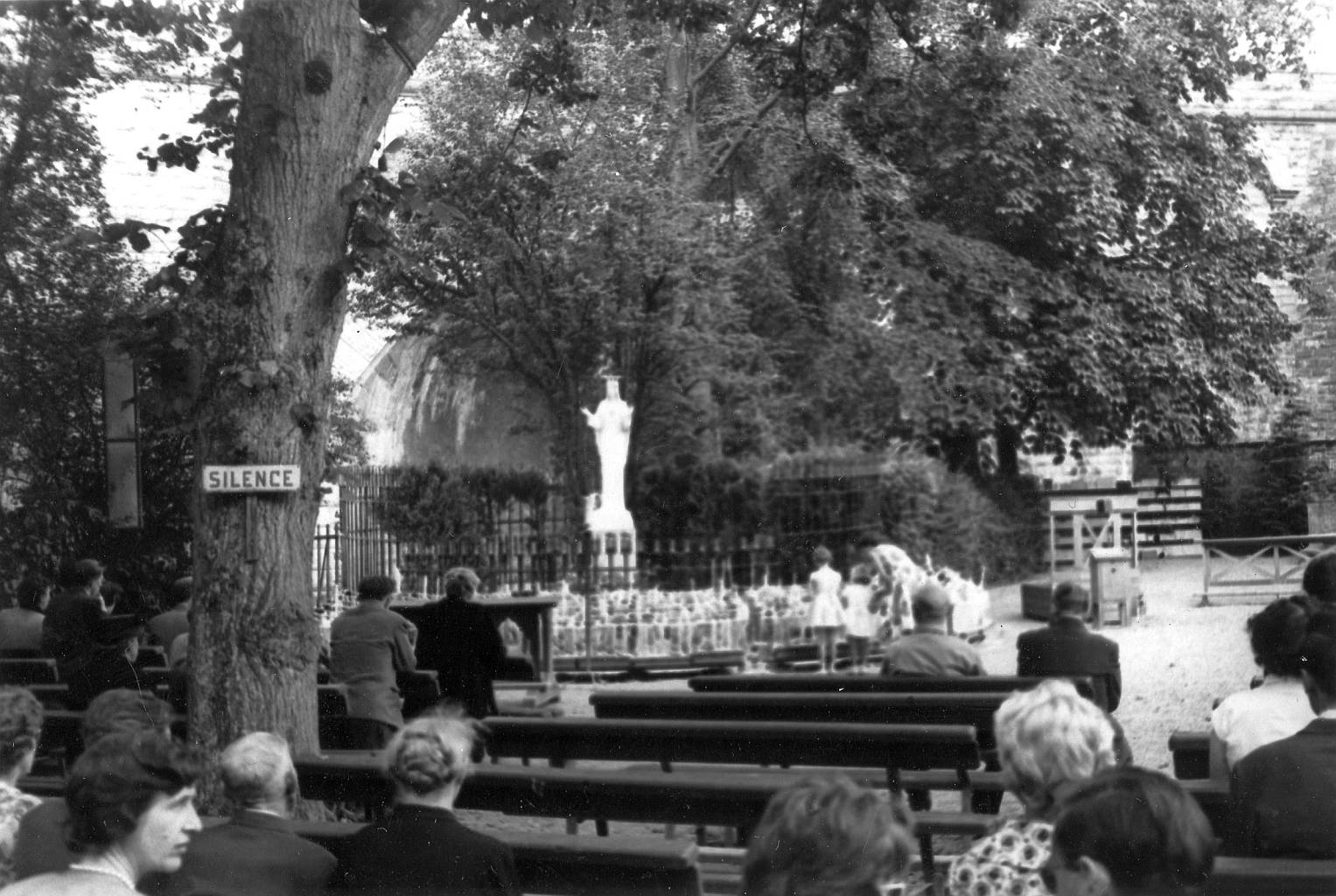
What matters is that the grotto has been rendered invisible – not merely physically absent but narratively erased. The sanctuary offers no marker, no plaque, no architectural trace acknowledging that a Marian shrine once stood beside the site of a Marian apparition. As far as I could find, the removal was never announced, explained, or defended.
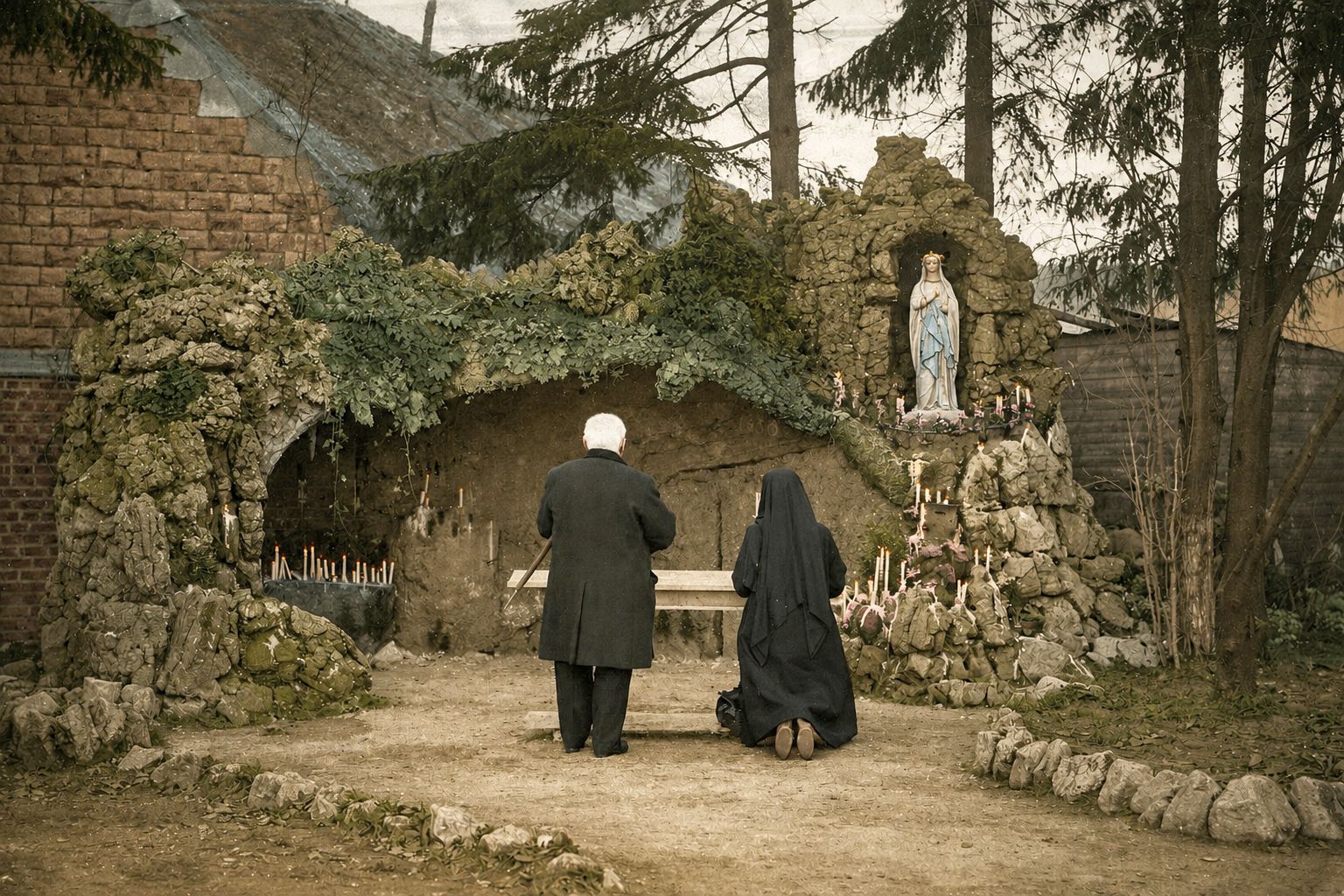
This absence functions as a kind of negative space, a hole in the historical landscape. Once noticed, it becomes difficult to unsee. The hawthorn tree has been elevated into the uncontested focal point of the apparitions, while the grotto – an inconvenient reminder of the garden’s pre‑apparition devotional life – has been removed from both sight and story.
The erasure of every trace is harder to read as neutral housekeeping than as a decision to let the grotto be forgotten. A grotto beside the apparition site introduces interpretive noise: it raises the possibility of visual confusion, devotional influence, or narrative ambiguity. Removing it simplifies the story. The tree becomes the place; the grotto becomes a footnote that no longer exists.
The grotto was where the first apparition occurred, and the statue reportedly figured in the first exchange between the children and Sister Valéria. According to the account discussed in Les apparitions de la Vierge et la critique historique, the children initially said that the statue of the Virgin moved, rather than immediately reporting that a living apparition had appeared independently of the statue. The later interpretation – that they were seeing the Virgin herself, with the statue merely being the physical location/background – appears to have developed subsequently. This makes the grotto arguably apparition-originating, which is the one category a curated origin-story can’t drop innocently.
A Lourdes grotto with a Madonna statue, in the convent-school garden the children attended daily, is the single strongest naturalistic explanation for the visions. Children steeped in a Marian shrine “see” a walking Virgin; and the “a statue doesn’t move” exchange is the obvious debunk surfacing in real time: an adult reaches for the statue as the mundane explanation, and the children insist they see the Lady walking. That is the naturalistic hypothesis and its rebuttal, compressed into one sentence. A devotional narrative has a specific, strong reason to drop the best natural explanation of the whole phenomenon.
The older Sharkey/Debergh and Toussaint & Joset accounts describe the first apparition, 29 Nov 1932, this way:
they saw the figure of a beautiful Lady in white walking above the bridge and the grotto by the convent with clouds covering her feet.
The current (2023) account from the Sanctuary reframes the first sighting to above the railway bridge (“la Vierge qui se promène au-dessus du pont”) and doesn’t mention either grotto or statue. The narrative never lies about the location, it just foregrounds the railway and drops the shrine, and in doing so deletes the one object (the grotto’s Madonna statue) that supplies the naturalistic seed and the “a statue doesn’t move” exchange.
If the modern narrative were merely streamlining to one landmark per phase, a devotional narrative would be expected to keep the grotto (a Marian shrine, theologically resonant) and drop the railway bridge (mundane infrastructure). The opposite happened: they kept the railway and deleted the shrine. That is the unnatural choice, and it’s unnatural in precisely the direction that removes the priming object: a Lourdes-style grotto is the obvious naturalistic seed for a Marian vision.
Specifically a grotto with a Madonna and an adjacent kneeling Bernadette statue primes something far more specific: a child kneeling before an apparition of the Virgin, which is exactly the reported behavior (the children “thrown to their knees” before the Lady). The tableau doesn’t just seed that a Virgin might appear; it models the entire scene, seer included.
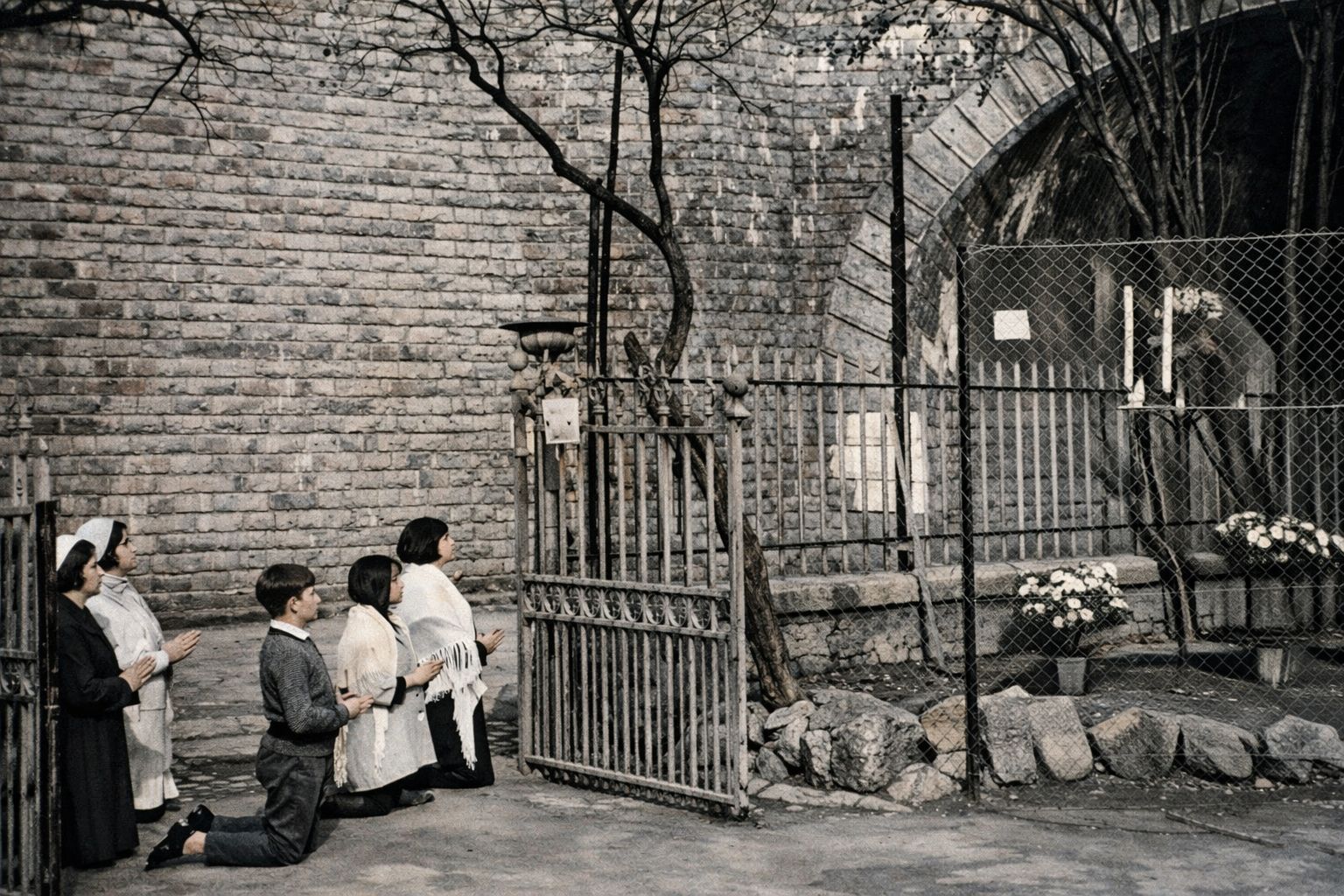
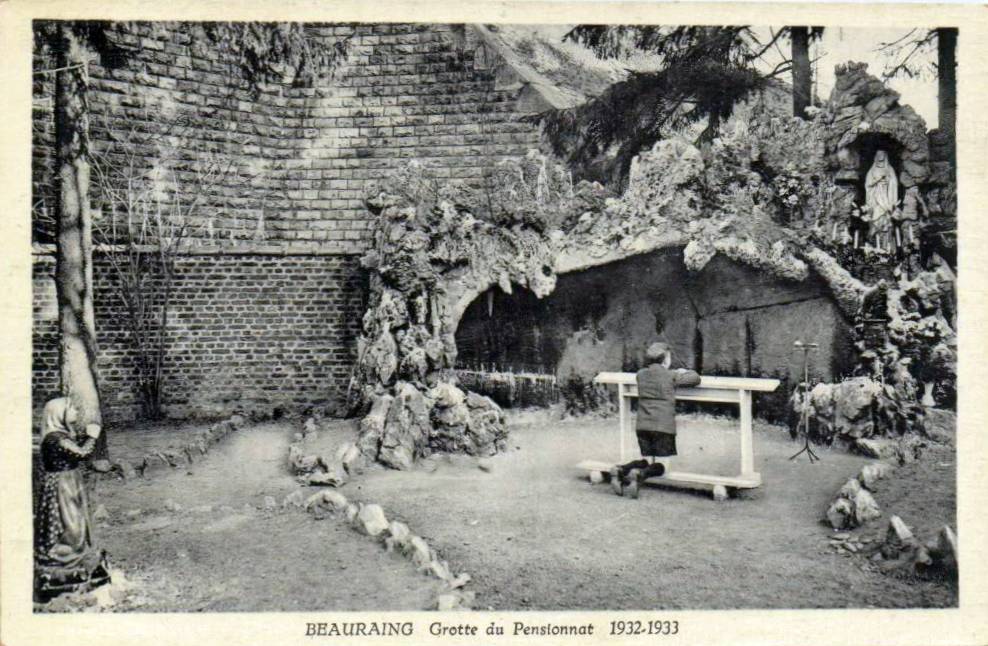
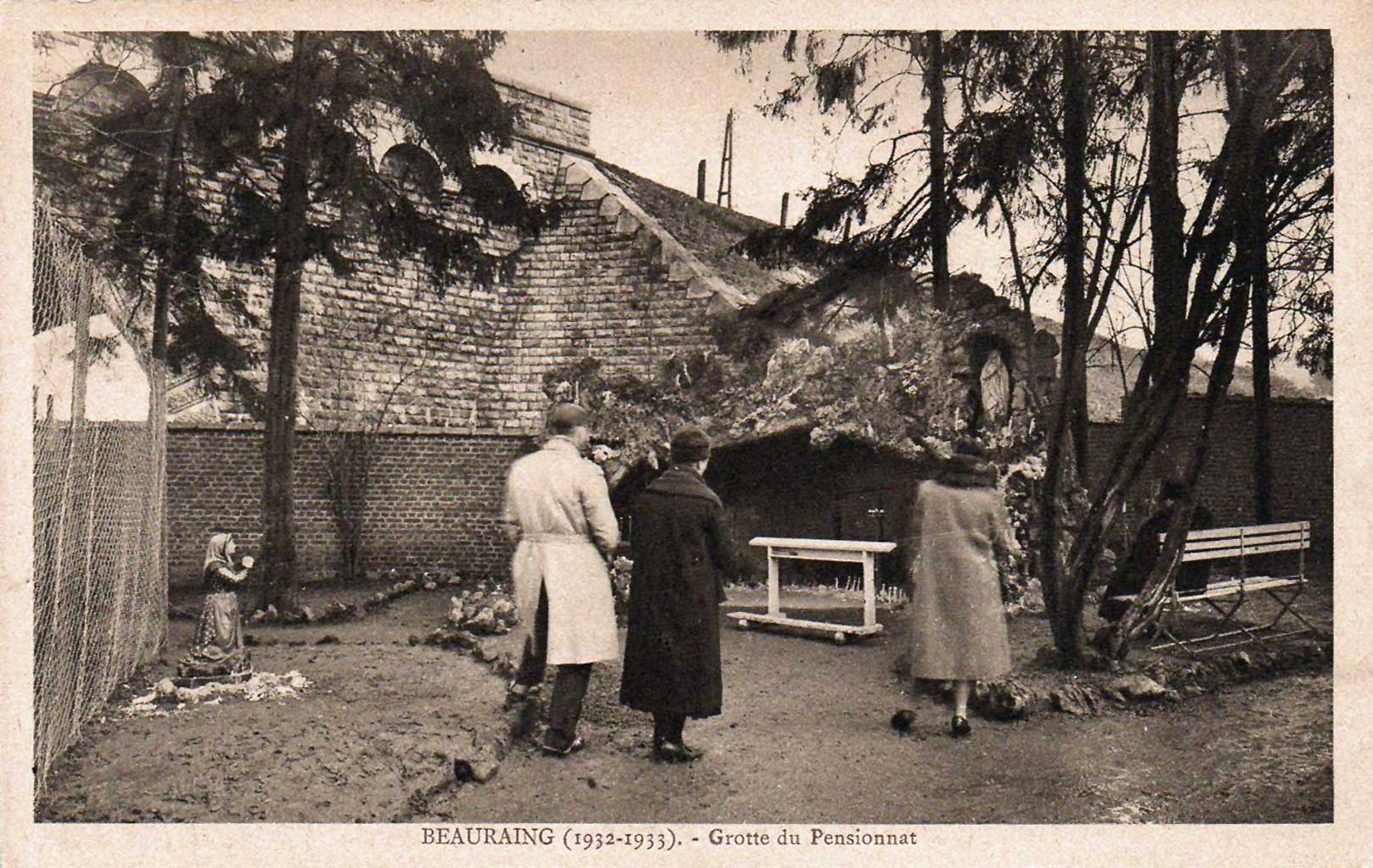
“Que soy era Immaculada Councepciou” was how the Lourdes apparition reportedly identified itself to Bernadette Soubirous in 1858, using the Bigurdán dialect. The Catholic doctrine that Mary was conceived without original sin, had only recently been formally defined as dogma by Pope Pius IX in 1854. On December 2, the night of the fourth apparition, Albert asked the figure, “Êtes-vous la Vierge immaculée?” She smiled and nodded. The children came back to this repeatedly, as reported on December 24:
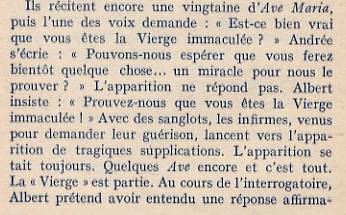
This is potentially invoking one of the most distinctive markers of Lourdes in Beauraing.
In fairness, the Lourdes signature phrase is the unusual identification as “l’Immaculée Conception” which refers to the doctrine and is not quite the same as “la Vierge immaculée”, a proper reference to a person. But for a Belgian Catholic child, the reflexive first guess in early-1930s French is almost certainly the plain devotional name: “la Sainte Vierge” or Notre-Dame or la Vierge Marie. That’s the everyday name children actually used. “Vierge immaculée” is considerably more formal and theological. This could have been prompted by the liturgical season; on December 2, with the Feast of the Immaculate Conception only days away, catechism and liturgy in a convent school would be foregrounding exactly that vocabulary. So it wasn’t necessarily inspired by the Lourdes grotto replica only a few meters away.
Nevertheless, the distinction is quite theological, in plain French Immaculate Virgin and Immaculate Conception are treated as nearly synonymous, to the point that many accounts translate Vierge immaculée as Immaculate Conception. Newspaper articles at the time explicitly described the visionaries of Beauraing as “new Bernadettes” (“De wonderbare verschijningen te Beauraing”, in De Standaard, 30 December 1932, p. 1)
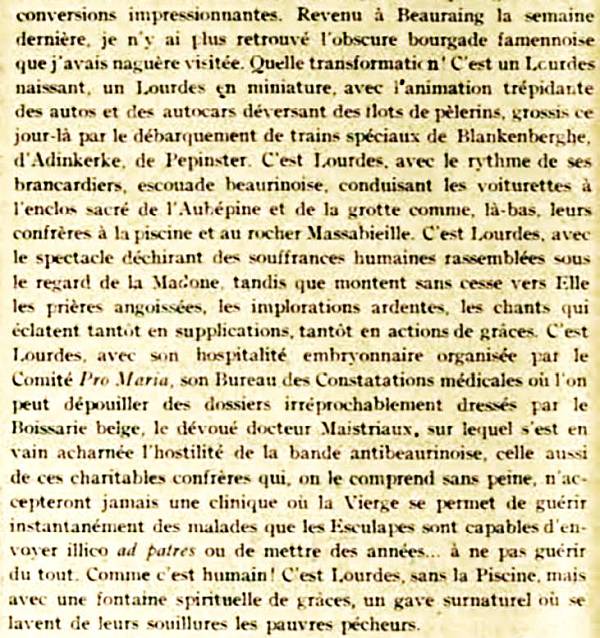
Mgr. Joseph Schyrgens explicitly equates Beauraing with Lourdes, and its hawthorn tree and grotto with Lourdes’ pool and rock
With the grotto, one of the most conspicuous elements linking Beauraing to the established Lourdes tradition was removed. Similarly, the apparition’s reported self-identification as the “Immaculate Virgin” was replaced with the “Golden Heart” – a title the entity never claimed. Meanwhile, the hawthorn tree, which had no intrinsic Marian significance before the events and was just a tree that happened to be nearby, has become the principal relic. Whether intentional or not, the result is that the visitor encounters a narrative emphasizing the uniqueness of Beauraing rather than its continuity with Lourdes.
In this sense, the disappearance of the grotto is not merely an architectural decision but a curatorial act, shaping how the past is remembered. Or, more precisely, how it is allowed to be remembered.
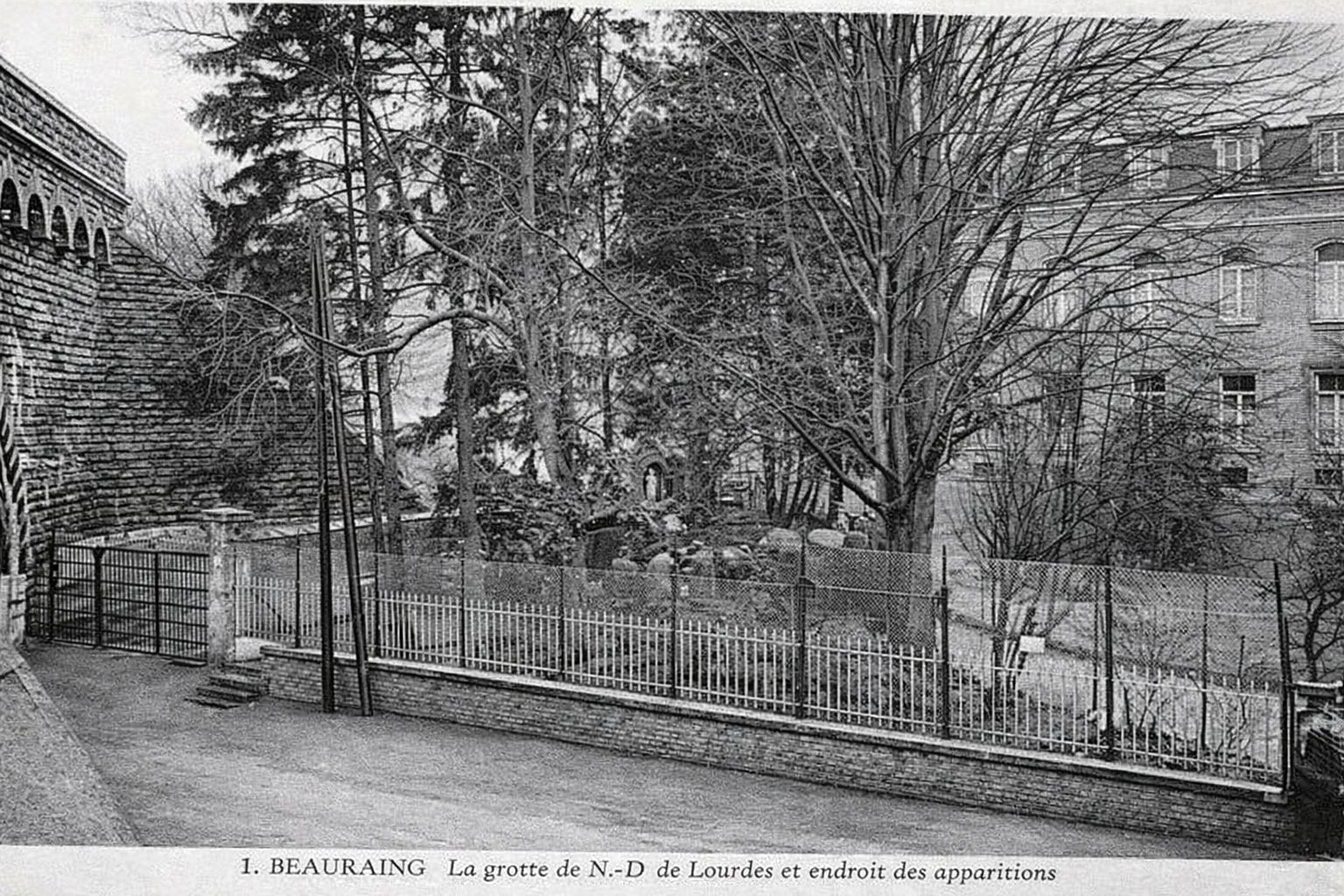
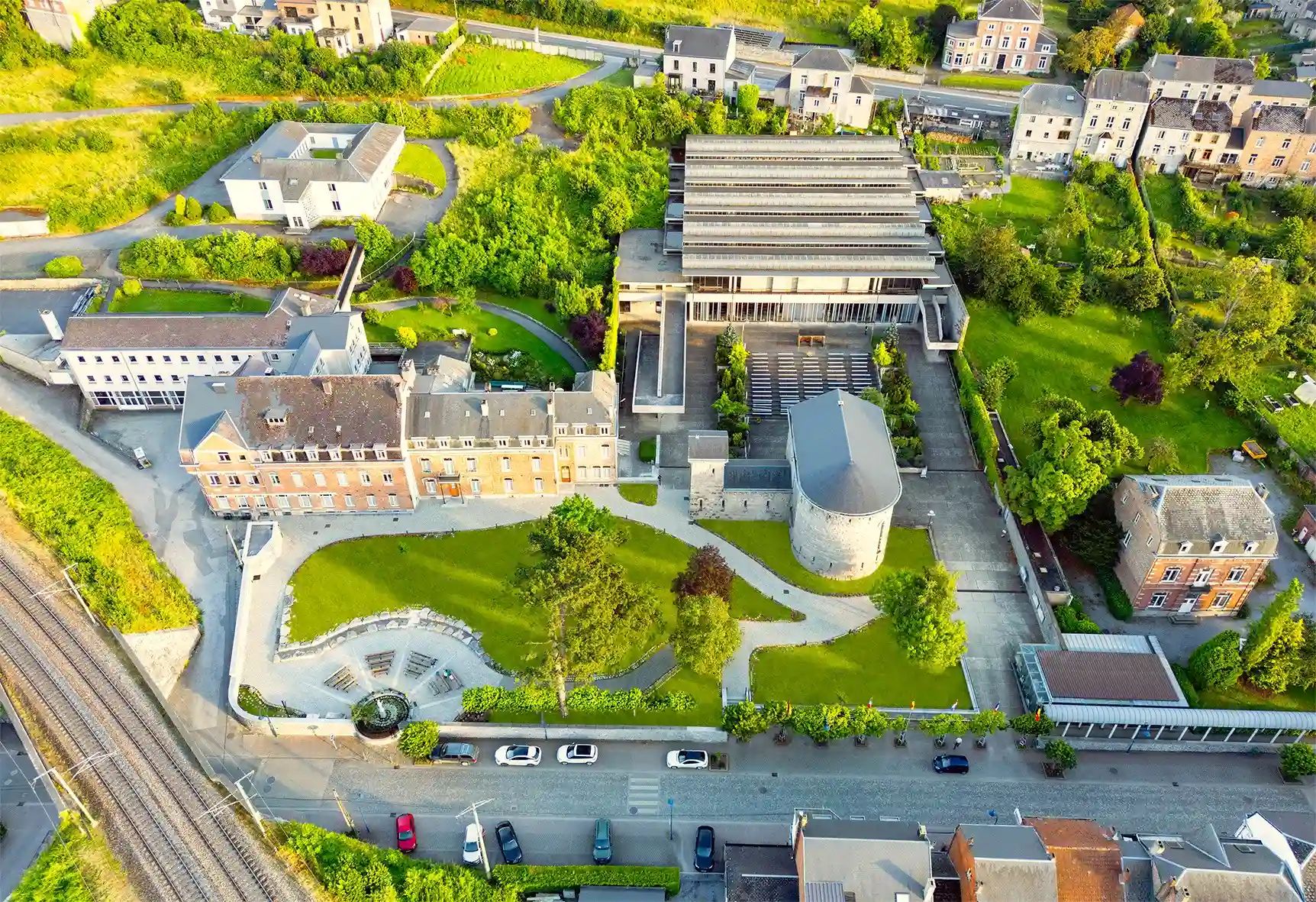
There is something unsettling about erasing a Marian shrine next to a Marian apparition site. Even if the grotto wasn’t central, it was still a place of prayer, built by the Sisters, and part of the children’s visual world. So why was it removed anyway? Shrines don’t preserve history neutrally. They preserve meaning, and meaning is curated. The grotto was most likely removed because it didn’t fit the meaning the sanctuary wanted to emphasize.
The site has been edited so that the tree appears to have stood alone, uncontested, awaiting the apparition that would define it.
This is not unusual in the archaeology of sacred landscapes. Sites that become centers of pilgrimage often undergo a process of symbolic pruning, in which elements that do not support the emerging narrative are quietly removed. The result is a landscape that appears coherent, even inevitable, but only because the traces of its earlier complexity have been erased. Beauraing’s vanished grotto is a small example of this broader pattern: a devotional structure removed not because it was unimportant, but because it was too important in the wrong way.
When Muhammadﷺ cleared the Kaaba of its idols, he wasn’t simply destroying objects; he was reframing the meaning of the structure itself. By erasing the pre‑existing Marian shrine, the sanctuary likewise reset the symbolic field. The parallel exposes a tension common to all sacred sites: the impulse to purify history in order to preserve faith.
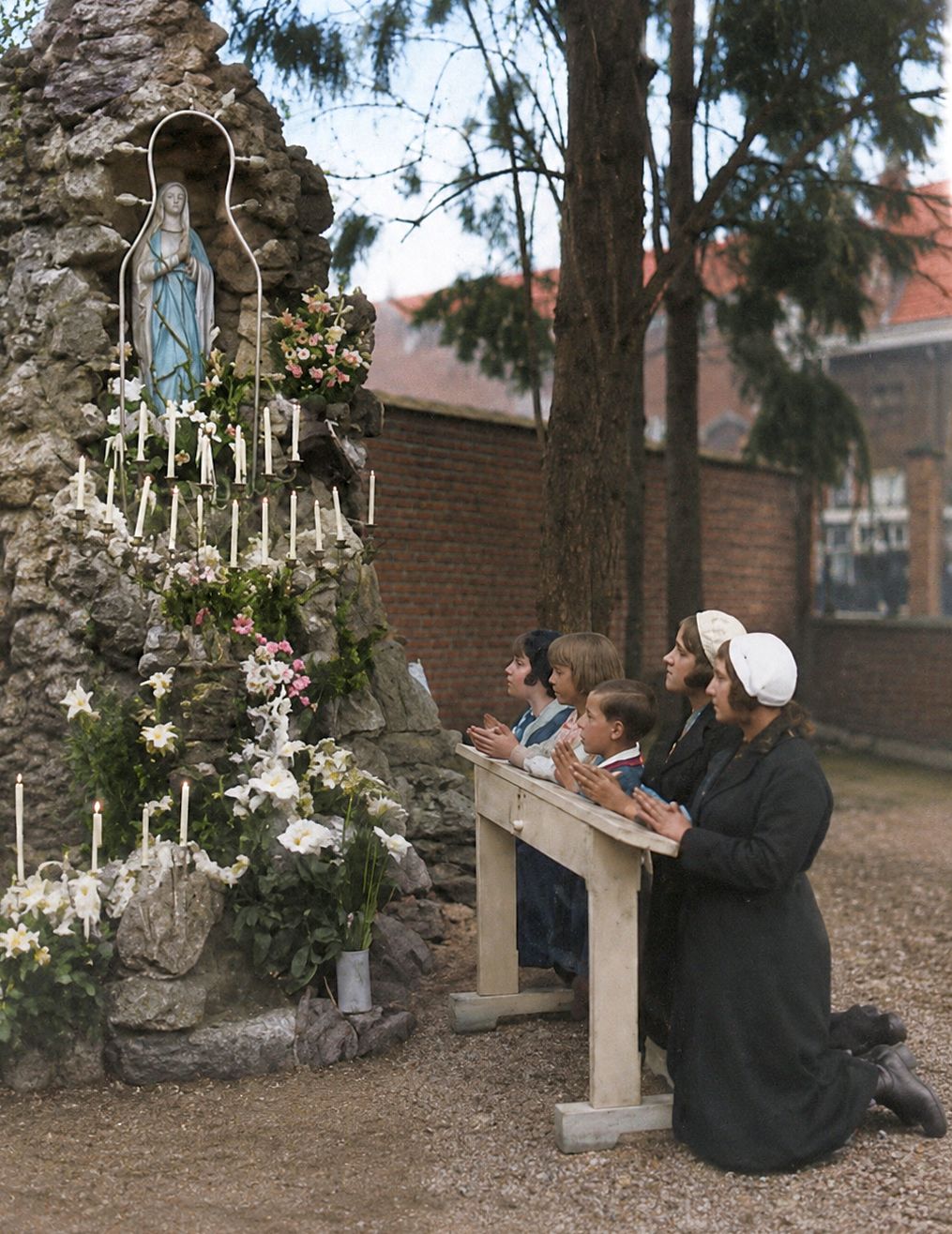
Even this photo is rarely reproduced or included in the narrative.
In this sense, the archaeology of the grotto is not about recovering stones but about recognizing the intentional silences embedded in the sanctuary’s present form. The absence becomes a kind of artifact in its own right, a reminder that sacred memory is not merely preserved but actively constructed. The grotto’s disappearance is therefore not a footnote but a clue: a material indication of how the sanctuary has shaped the story it tells, and of what it has chosen not to tell.
8. Epilogue – the afterlife of visions
The story of Beauraing does not end with the children, nor with the crowds, nor with ecclesiastical approval. Its real ending lies in the transformation of a fleeting, ambiguous, socially volatile event into a stable cultural memory. What began as uncertain experiences in a muddy convent garden became a polished devotional landscape, refined through repetition, architecture, publishing, investigation, omission, and institutional endorsement.
Read cumulatively, the pattern is clear: early uncertainty, visual priming, child-witness synchronization, crowd reinforcement, weak documentation, Rex publicity, Church sorting, symbolic consolidation, and later spatial curation. None of these requires deliberate fraud by the children. Indeed, the more interesting hypothesis is that sincerity and construction coexisted from the beginning.
Memory is never neutral. Institutions preserve the past by producing it. They decide which elements become central, which become atmosphere, and which are allowed to vanish. The children remain sincere, but their sincerity is absorbed into a narrative larger and more durable than anything they themselves could have controlled.
Beauraing, then, is where something happened and where a story was chosen, refined, and made durable. The sanctuary’s serenity is the final layer of that process: a calm surface laid over a turbulent origin. To walk its paths is to encounter the memory of those events as curated by an institution skilled in the art of shaping the sacred.
Beauraing’s final meaning lies not in the visions alone but in the memory of the visions. It is a reminder that the sacred is not only revealed; it is edited.
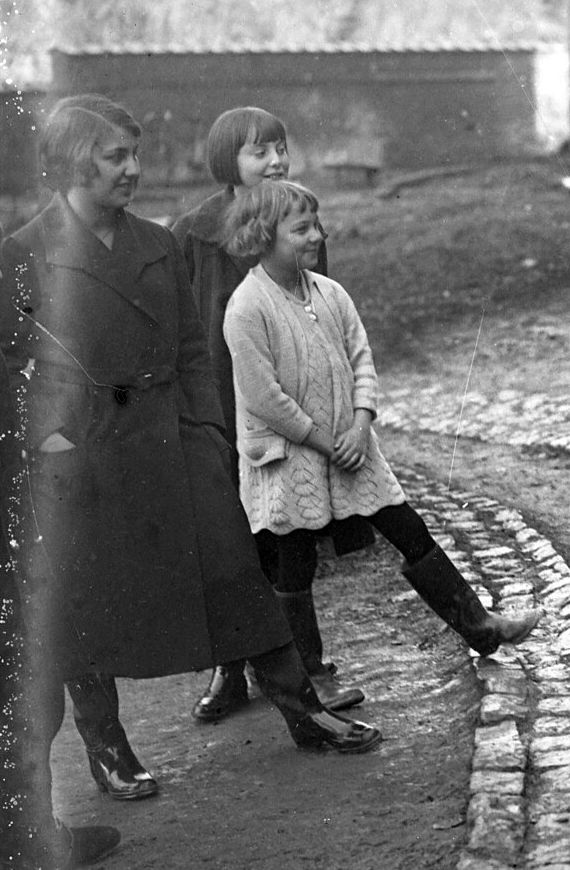
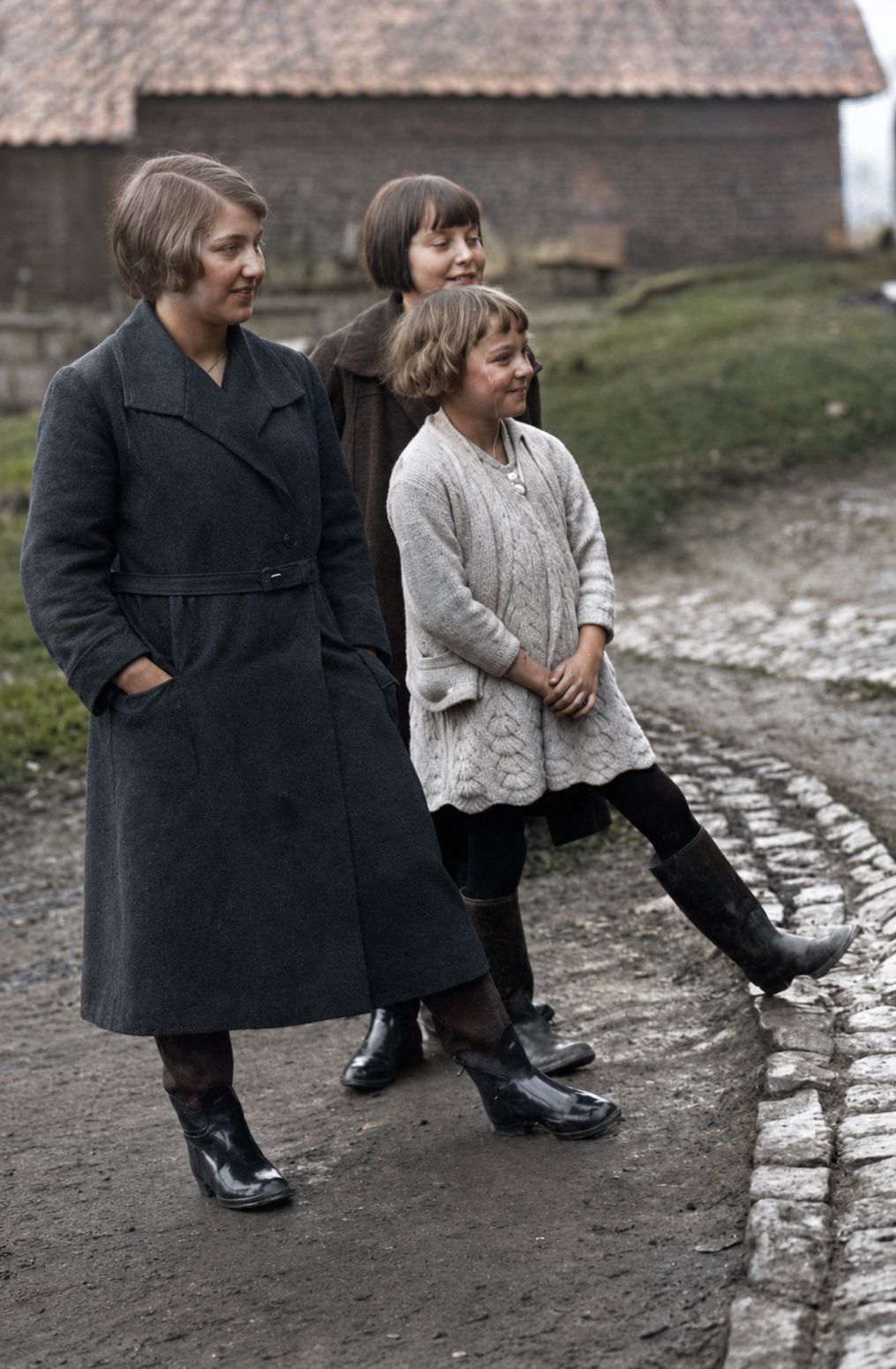
Fernande, Gilberte & Gilberte
NOTICE: several images used in this article were originally of poor quality or in bad condition and have been digitally enhanced and sometimes colorized using AI models.