A visit to Beauraing today begins in an atmosphere of curated calm. The Sanctuary of Our Lady of Beauraing sits just beyond the town center, a landscaped devotional park that feels more like a retreat garden than the site of a mass‑vision wave. Paved paths guide visitors past lawns, flowerbeds, and devotional statues. The serenity is striking, especially when one remembers that in the winter of 1932–33, thousands crowded into this same space, jostling for a glimpse of five children who claimed to see the Virgin Mary.
Most visitors begin at the hawthorn tree, now fenced off and elevated slightly above the garden. In 1932 it was simply a garden tree in the convent schoolyard, surrounded by mud and trampled earth as crowds pressed forward. Today it is a curated relic, framed by candles and flowers. Visitors pause, take photographs, or stand quietly. The tree is no longer a witness to events; it is a symbol of memory.
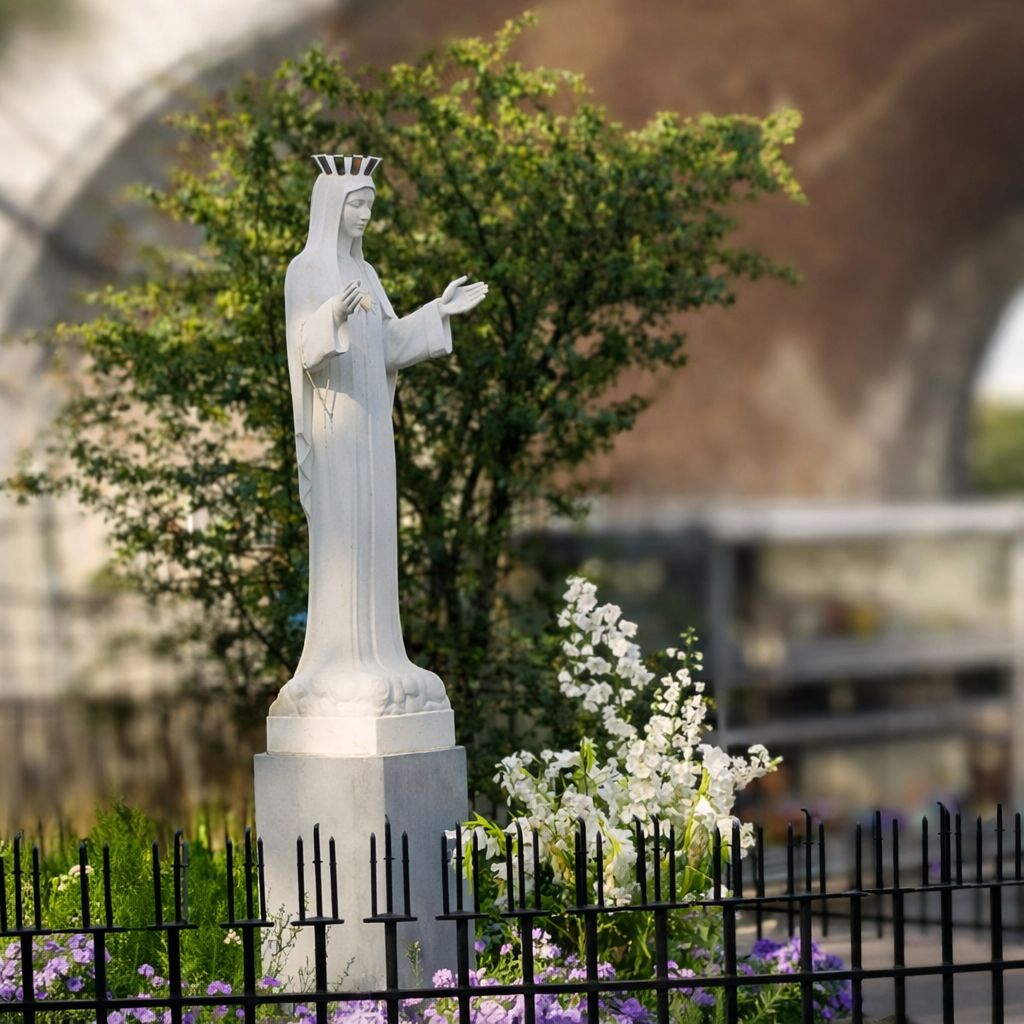
A few steps away stands the statue of the Virgin with the Golden Heart, now the sanctuary’s visual centerpiece. The radiant heart motif has become the defining emblem of Beauraing. It appears on mosaics, prayer cards, and signage, giving the impression that it was central from the beginning rather than introduced only late in the children’s visionary sequence. The sanctuary’s design subtly elevates this late‑emerging detail into the core of the narrative.
The Chapel of the Apparitions offers a quiet, controlled space for reflection. Soft lighting and devotional art create an atmosphere of reverence. It is difficult to imagine the original scenes: children standing rigid and unresponsive, crowds kneeling or crying, the air thick with expectation. The chapel replaces the unpredictability of those nights with contemplative stillness.

Visitors often continue along the Rosary Way, a sculpted devotional path through the gardens, before entering the modern basilica, built to accommodate large pilgrim groups. Its architecture conveys institutional stability and the Church’s endorsement of the site.
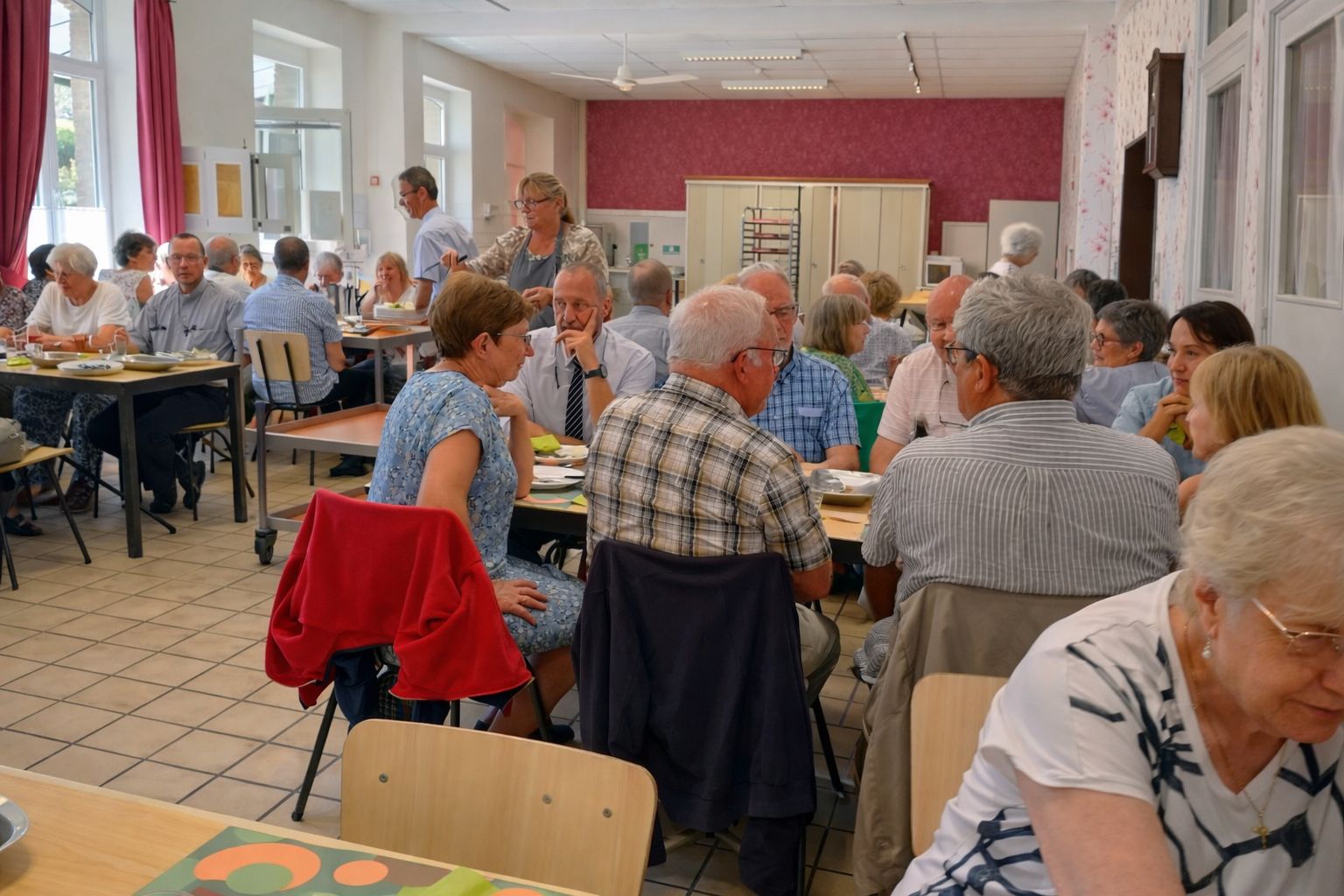
Afterward, many stop at the pilgrim refectory for a simple meal, before lighting a candle in one of the designated areas. The final stop is the gift shop, where books, statues, and official histories present a unified, devotional narrative.
A present‑day visit to Beauraing is peaceful and orderly. It is also a carefully curated memory landscape, where the complexities of the original events have been smoothed into a stable story suitable for pilgrimage.
The Official Narrative
The official account of Beauraing begins with the kind of quiet provincial setting that, in retrospect, seems almost designed to heighten the contrast with what followed. In late 1932, the town was an unremarkable Ardennes community of two thousand inhabitants, its rhythms shaped by the parish church, the schools run by the Sisters of Christian Doctrine, and the castle ruins overlooking the valley. Nothing in this landscape suggested that it was about to become the focal point of a national devotional surge. Yet on the evening of 29 November, five children – Fernande and Albert Voisin, Andrée and Gilberte Degeimbre, and Gilberte Voisin – set out to fetch a sibling from the convent school, and the narrative that would later be canonized as “the apparitions” began.
According to the children, the first encounter was abrupt. While waiting at the school door, Albert cried out: he saw a lady dressed in white, walking a meter above the railway viaduct. The girls turned and, as the story goes, saw her too. Sister Valéria, who opened the door, initially dismissed the claim. Yet when she returned with Gilberte Voisin, she too reportedly glimpsed the figure. The children fled home in fear, and the first thread of the official narrative was established.
The next evening, at roughly the same hour, the children returned and again reported the same figure. On 1 December, accompanied now by parents and neighbors, they saw the apparition first on the viaduct, then near a holly tree in the convent garden, and finally beneath a hawthorn tree near the gate. This last location became the fixed point of all subsequent visions. The children fell to their knees in unison, while the adults saw nothing. The Sisters, uneasy, closed the garden and attempted to halt what they feared was a childish “comedy,” even releasing the convent dogs. Yet when the children returned on 2 December, the apparition appeared beyond the gate – and the dogs, in a detail the official narrative preserves with quiet satisfaction, lay silently on the ground.
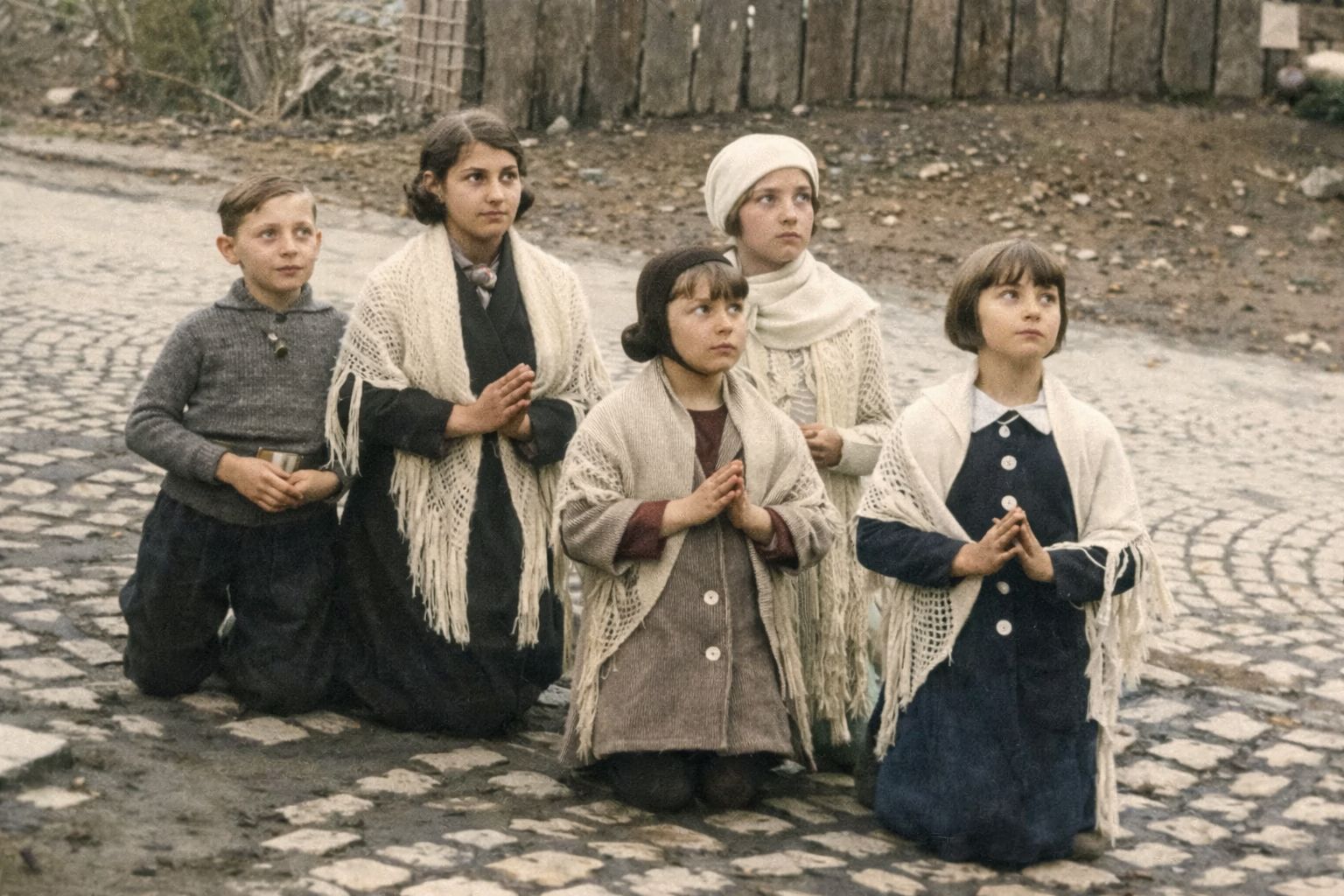
That evening, Albert asked the figure, “Are you the Immaculate Conception?” She smiled and nodded. When he asked what she wanted, she spoke for the first time: “Always be good.” Later that night she repeated the question – Is it true that you will always be good – a moment that would later be cited as evidence of her maternal solicitude.
From this point, the narrative accelerates. The apparitions continued daily, and the crowds grew with remarkable speed. By 3 December, 150 people stood in the street; by 8 December, the Feast of the Immaculate Conception, between ten and fifteen thousand pilgrims filled the garden and surrounding roads. Doctors and psychologists subjected the children to tests during their ecstasies—bright lights, needle pricks, even a burning match. The children showed no reaction and bore no marks. Their statements, taken separately, remained consistent. These details, repeated in official accounts, serve as the narrative’s evidentiary spine.
Through mid‑December, the figure appeared silently, smiling, hands open. On 17 December she asked for “a chapel.” On 21 December, pressed for her name, she replied: “I am the Immaculate Virgin.” On 23 December she explained her purpose: “So that people might come here on pilgrimage.” The narrative thus acquired its teleology: the apparitions were not merely events but invitations.
On 29 December, a new motif appeared: between her open arms the children saw a radiant Heart of Gold, encircled by rays. This symbol, which would later dominate the sanctuary’s iconography, emerged only at this late stage. That same evening she warned that the apparitions would soon end. On 30 December she urged: “Pray, pray very much.” On 1 January: “Pray always.”
The final apparition occurred on 3 January 1933 before a crowd of thirty thousand. One by one, the children received individual messages. To the three youngest she entrusted personal secrets. To Andrée: “I am the Mother of God, the Queen of Heaven. Pray always. Goodbye.” To Gilberte Voisin: “I will convert sinners.” To Fernande, who had continued praying even when she saw nothing: “Do you love my Son? Do you love me? Then sacrifice yourself… for me. Goodbye.”
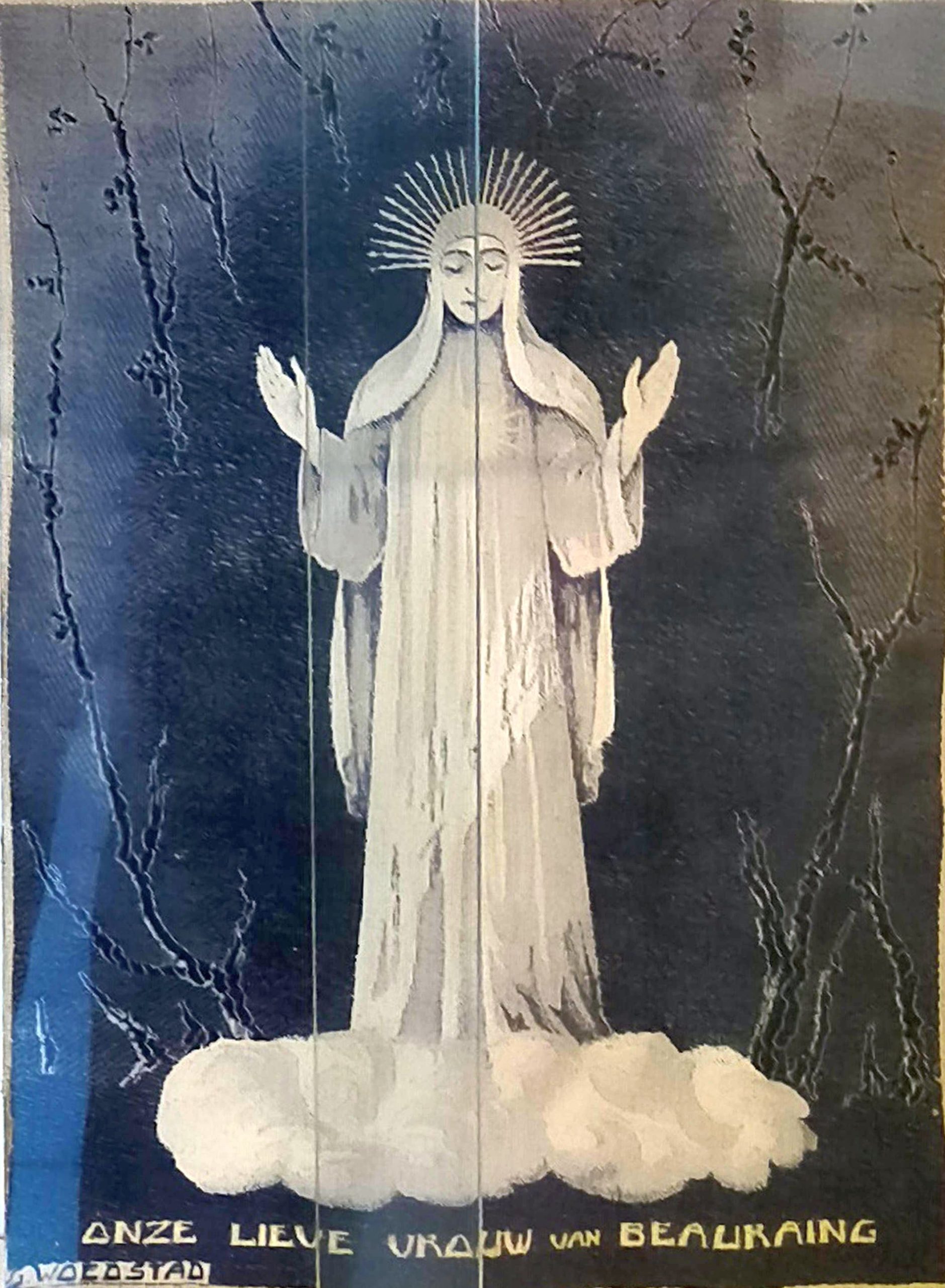
Throughout the visions, the children described the figure with consistent detail: youthful, clothed in a long white dress crossed by three azure rays, head veiled, crowned with light, and—after 29 December—bearing a rosary and the Golden Heart.
Ecclesiastical Inquiry and Recognition
The Church’s treatment of the events followed a familiar trajectory. The children were questioned repeatedly by clergy and civil authorities; their accounts, the official narrative emphasizes, remained consistent. In 1935, Bishop Thomas‑Louis Heylen of Namur opened an investigation. After his death, Bishop André‑Marie Charue continued the work. In 1942, the Holy See authorized him to proceed toward canonical judgment. On 2 February 1943, he permitted public devotion to Our Lady of Beauraing.
This phrase—permitted public devotion—is central. It does not declare the apparitions historically factual or supernaturally certain. It simply allows Catholics to venerate the site without doctrinal obligation. The Church’s official narrative highlights the children’s sincerity, the simplicity of the messages, and the spiritual fruits that followed: conversions, healings, and the growth of pilgrimage. It is a narrative designed to inspire faith, not to interrogate the psychological or social complexities of the events.
The chapel requested in the apparitions was eventually built, and Beauraing became a recognized place of pilgrimage. In the official memory, the winter evenings of 1932–33 remain moments of luminous intervention: five children, a lady in white, and a message of goodness, prayer, sacrifice, and the conversion of hearts.
What Recognition Means
The Church distinguishes between public revelation—the teachings of Scripture and apostolic tradition—and private revelation, which includes apparitions. Public revelation is binding; private revelation is not.
The Catechism states:
“They do not belong, however, to the deposit of faith. Their role is not to ‘improve’ or ‘complete’ Christ’s definitive Revelation.”
Even approved apparitions do not require belief. Approval simply means the Church finds nothing in the event that contradicts doctrine and that the associated devotion is spiritually beneficial.
Present day criteria, formalized in the 1978 Normae Congregationis, focus on orthodoxy (no doctrinal errors), psychological stability (no obvious pathology), moral integrity (no fraud or scandal), absence of manipulation (no financial exploitation), and spiritual fruits (conversions, prayer, charity). Notably, the Church does not require empirical evidence of supernatural origin. It does not attempt to prove that Mary literally appeared. It evaluates whether the devotion is harmless and pastorally useful. The Church’s approach is pastoral rather than forensic.
When Beauraing was investigated (1935–1949), the Church relied on the classical criteria laid out by Prospero Lambertini, later Pope Benedict XIV, in his monumental work De Servorum Dei Beatificatione et Beatorum Canonizatione (“On the Beatification of the Servants of God and the Canonization of the Blessed”) written between 1734 and 1738, this was the authoritative reference until the 1978 Normae Congregationis.
Lambertini’s criteria were surprisingly cautious and skeptical, and not substantially different from the 1978 guidelines:
- 1. Apparitions must be judged with “great prudence”
- He warned bishops not to rush to approve visions and to assume natural causes first.
- 2. The Church must examine the visionaries’ character
- Are they honest? Stable? Free from deception or delusion?
- 3. The content must contain nothing contrary to faith or morals
- This is the same criterion used today.
- 4. The Church must look for “signs of God’s hand”
- But these signs were spiritual fruits, not physical evidence.
- 5. Even approved apparitions do not require belief
- Lambertini explicitly stated that private revelations are never binding.
How these criteria were applied to Beauraing
When the Bishop of Namur investigated Beauraing in the 1930s–40s, he used the Lambertini framework:
- 1. Examine the children’s sincerity and psychological stability
- The commission interviewed them repeatedly. They appeared consistent and not obviously pathological.
- 2. Ensure no doctrinal errors
- The messages were simple: prayer, love, devotion. Nothing controversial.
- 3. Look for spiritual fruits
- Pilgrimages, conversions, healings, renewed devotion.
- 4. Ensure no fraud or manipulation
- The children did not seek money or fame.
- 5. Avoid declaring supernatural origin
- The final declaration in 1949 was cautious:
“We judge that the apparitions are worthy of belief.”
This is classic Lambertini language — permission, not assertion.
- The final declaration in 1949 was cautious:
Just like today, the Church did not require physical evidence, photographs, scientific verification, historical certainty, or proof of supernatural origin. The Church was evaluating harmlessness and spiritual usefulness, not historical truth. The reason why the Church doesn’t require supernatural proof, is because the Church explicitly teaches that apparitions add nothing essential. They are not necessary for salvation, they are not part of doctrine, hence they are not binding.
There is historical precedent of apparitions the Church approved… and then quietly regretted. These are cases where apparitions were approved locally, but later found to be dubious, fraudulent, or psychologically unstable. But devotion had already taken root, and the Church avoided reversing the decision to prevent scandal. Some examples include:
- Our Lady of La Salette (1846): one visionary later became involved in apocalyptic cultism
- Our Lady of All Nations (Amsterdam): devotion permitted, but messages later condemned
- Our Lady of Montichiari (Rosa Mystica): devotion tolerated despite serious doubts
These explain why “harmlessness” far outweigh questions of authenticity.
Hynek–Vallée as a Framework for Understanding Beauraing
It may seem counterintuitive to begin an analysis of Marian apparitions by invoking the intellectual toolkit of UFO researchers. Yet the work of J. Allen Hynek and, more importantly, Jacques Vallée, offers one of the most coherent frameworks for studying events that sit at the intersection of perception, culture, and social contagion. Vallée’s contribution was not to collapse religious visions into extraterrestrial encounters, but to recognize that both belong to a broader class of structured anomalous experiences – events that reveal more about human meaning‑making than about the literal content of what was seen.

Beauraing, viewed through this lens, becomes less an outlier and more a familiar pattern.
Hynek’s Taxonomy: The First Attempt at Order
Hynek’s early work was an attempt to impose structure on a chaotic field. His classification system—still widely cited—divided UFO reports into types based on proximity and interaction:
- Nocturnal Lights
- Daylight Discs
- Radar‑Visual Cases
- Close Encounters of the First, Second, and Third Kind
The value of Hynek’s system was not that it explained anything, but that it organized the reports in a way that made patterns visible. It was a taxonomic move: before one can interpret a phenomenon, one must first sort it.
This impulse – to classify before explaining – is equally useful for Marian apparitions. Apparition waves, too, have their types:
- solitary visionaries vs. clusters
- single events vs. repeated sessions
- private visions vs. public performances
- symbolic elaboration vs. static imagery
Beauraing falls squarely into the “repeated, clustered, public” category. A type that, in Vallée’s terms, is especially prone to narrative convergence and symbolic escalation.
Vallée’s Shift: From Objects to Patterns
Where Hynek sought order, Vallée sought structure. His key insight was that anomalous events, whether UFO sightings, fairy encounters, Marian apparitions, or medieval miracles, share a common grammar. The content varies; the form does not.
Vallée’s shift can be summarized in one sentence:
The phenomenon is not the object; the phenomenon is the pattern.
Vallée’s System of Types: A Typology of Human Experience
Vallée proposed his own classification system, not of objects, but of encounter structures. His types include:
- Type I: Anomalous lights or objects
- Type II: Physical effects (traces, burns, electromagnetic disturbances)
- Type III: Entity encounters
- Type IV: Abduction or immersive visionary states
- Type V: Communication events (messages, teachings, symbolic content)
Beauraing, interestingly, sits at the intersection of Type III and Type V:
- Type III: The children reported a luminous entity with humanoid form.
- Type V: The entity delivered simple, culturally familiar messages.
This does not imply equivalence between UFO entities and Marian figures. It implies that the structure of the encounter – entity + message + repeated sessions + symbolic elaboration – is shared across domains.
Vallée’s typology is therefore not about categorizing the supernatural; it is about categorizing how humans experience and narrate the extraordinary.
Cultural Vocabulary and the Adaptability of the Phenomenon
One of Vallée’s most enduring observations is that anomalous encounters adapt to the symbolic vocabulary of the time. Medieval Europe saw angels and demons; 19th‑century America saw airships; the late 20th century saw black triangles. The phenomenon – whatever its ontological status – expresses itself through available imagery.
Witness Clusters and Narrative Synchronization
Vallée repeatedly emphasized that close‑knit witness groups produce highly synchronized narratives. This is not evidence of deception; it is evidence of:
- shared interpretation
- emotional contagion
- mutual reinforcement
- group identity formation
Repetition, Ritual, and Symbolic Elaboration
Vallée noted that repeated encounters at the same location often lead to symbolic elaboration. Early reports are simple; later ones acquire new motifs. This is a ritual dynamic: repetition narrows attention, heightens expectation, and deepens trance.
The Social Function of Anomalies
Vallée’s most provocative idea – his “control system” hypothesis – suggests that anomalous events function as feedback mechanisms within a culture. They do not deliver information; they modulate belief, identity, and cohesion.
Whether one accepts this literally or metaphorically, the insight is useful: apparition waves, like UFO flaps, emerge during periods of social tension and serve to reorganize meaning. They are symbolic responses to instability.
Characteristics of the Reported Entity
Analysis of the Entity’s Appearance
- Female, luminous, elevated
- Age: Appears as a young woman (late teens–20s).
- Dress: Long robe, described as luminous, white or pastel blue, stylized.
- Described with a crown or radiance.
- Holds a rosary; encourages its use.
- Bearing a glowing heart (later stylized as the “Golden Heart”)
- Silent or speaking only to the children
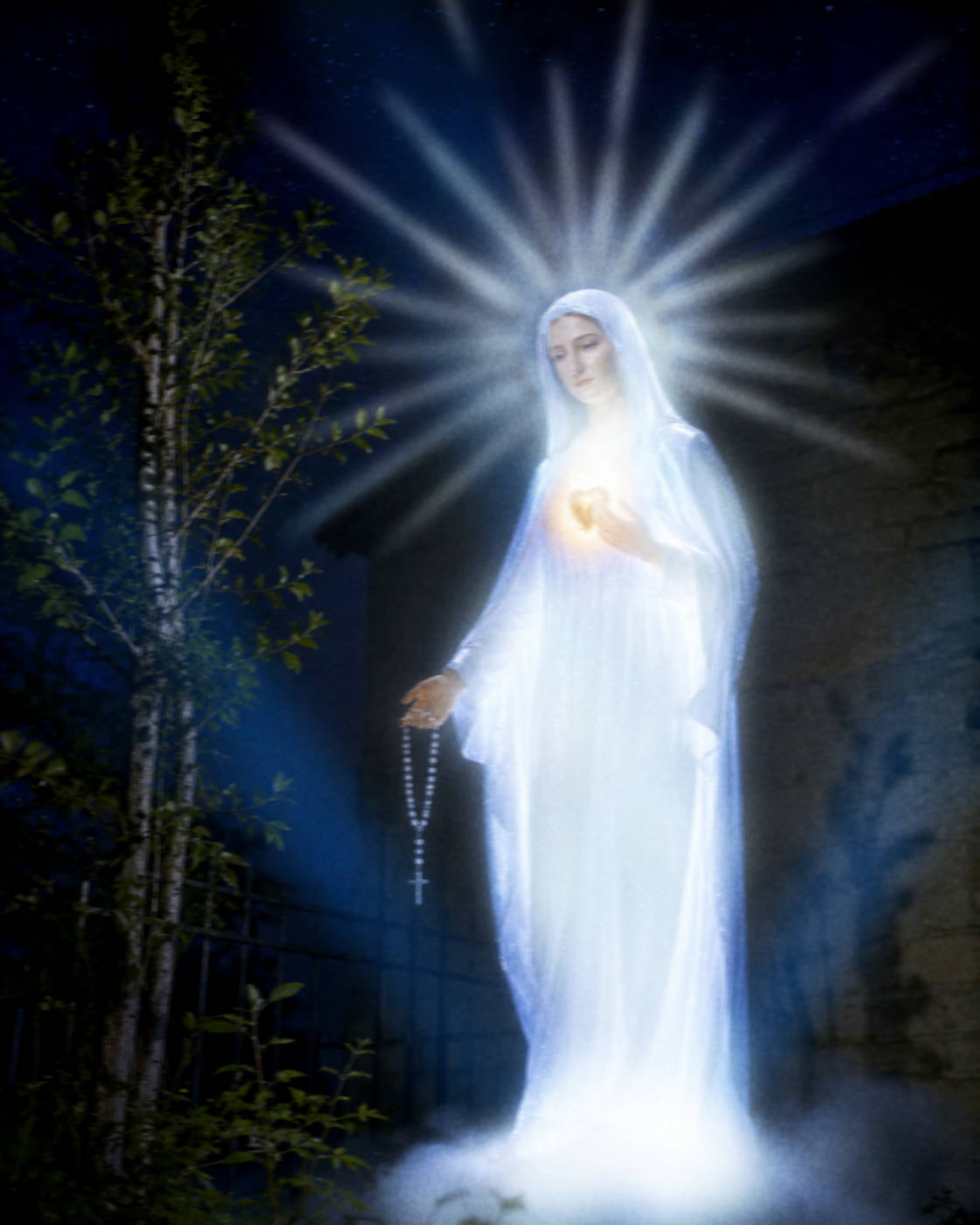
The Golden Heart
The Golden Heart is not a historical attribute of Mary. It is a devotional symbol, representing love, compassion, emotional purity, and Marian intercession. It aligns with the Sacred Heart tradition, which itself is a medieval and early‑modern development.
The theological concept behind the symbol comes directly from the Gospel of Luke: during the Presentation of Jesus in the Temple, the holy man Simeon prophesies to Mary: “And a sword will pierce your own soul too.” Luke also notes twice that Mary “treasured all these things, pondering them in her heart.”
During the Middle Ages, Catholic mystics began focusing intensely on the human anatomy of Christ and Mary to emphasize their humanity.
- St. Anselm and St. Bernard (12th Century): These theologians wrote extensively about the emotional and spiritual depth of Mary’s heart, laying the groundwork for visual devotion.
- St. John Eudes (1601–1680): A French priest regarded as the “Father of the Devotion to the Sacred Hearts,” Eudes popularized the physical depiction of the heart. He promoted public liturgical feasts dedicated to the Heart of Mary. In 1648, he published a book featuring a prototype of the symbol: a single heart representing the combined love of Jesus and Mary.
By the late 17th and 18th centuries, artists began painting Mary’s heart with specific, standardized symbols to distinguish it from the Sacred Heart of Jesus (which features a crown of thorns and a cross on top). The Immaculate Heart symbol is defined by three core visual elements:
| Visual Element | Meaning & Symbolism | Origin Context |
|---|---|---|
| The Piercing Sword | Represents her intense grief and sorrow during the Crucifixion. | Derived directly from Simeon’s biblical prophecy in Luke 2:35. |
| The Wreath of White Roses | Represents her purity, sinlessness, and the dogma of the Immaculate Conception. | White roses have traditionally symbolized virginal purity since medieval heraldry. |
| The Flames and Light | Represents her burning, unquenchable love for God and humanity. | Inspired by the Holy Spirit (often depicted as fire) and her divine charity. |
The symbol moved from localized European devotion to a global Catholic icon due to two major events in France and Portugal:
- The Miraculous Medal (1830): In Paris, Saint Catherine Labouré’s vision included an image for the reverse side of a medal. It explicitly featured two hearts side-by-side: the Sacred Heart of Jesus crowned with thorns, and the Heart of Mary pierced by a sword. Millions of these medals were distributed globally.
- Our Lady of Fatima (1917): In Portugal, three shepherd children reported seeing Mary holding her heart in her hand, surrounded by thorns. Mary explicitly requested the establishment of the “Devotion to the Immaculate Heart” to bring peace to the world during World War I. Following Fatima, mass-produced holy cards, paintings, and plaster statues depicted Mary pointing directly to her glowing, rose-wreathed, sword-pierced heart. This imagery became a staple in Catholic homes and parishes worldwide.
Thus even before Beauraing, the Immaculate Heart of Mary was widely depicted with flames, flowers, swords, or radiance. Gold was a common symbolic color for divine love. So a glowing golden heart on Mary is not a conceptual leap; it’s a small variation on existing imagery.
The Golden Heart also only appeared after repeated sessions, early visions did not mention the heart. Only after many evenings, with crowds gathering, clergy questioning, emotional intensity rising, and the children entering trance-like states did the “Golden Heart” appear in the narrative. This is classic “vision elaboration”. In visionary psychology, repeated sessions often lead to narrative expansion, symbolic enrichment, increased detail, and convergence on culturally familiar motifs. This happens in Marian apparitions, UFO abductions, séance phenomena, spiritualist circles, and hypnotic regressions. The longer the phenomenon continues, the more symbolic detail accretes.
The heart appears after the children were already treated as visionaries. By that point, they had a role to perform, they were under intense observation, were emotionally invested, and were expected to “receive messages”. Adding a symbolic element like a glowing heart is exactly what happens when a narrative stabilizes and deepens.
| Apparition | Symbol added later in the sequence | Interpretation |
|---|---|---|
| Lourdes | The title “Immaculate Conception” appears only after weeks | Narrative crystallization |
| Fatima | The “Miracle of the Sun” was not predicted until late | Escalation under crowd pressure |
| Medjugorje | The Queen of Peace title emerges gradually | Symbolic elaboration |
| Beauraing | The Golden Heart appears after repeated séances | Same pattern |
The Golden Heart is exactly what you’d expect from Belgian Catholic children in 1932. Belgium had strong Sacred Heart devotion, especially in Wallonia, where Sacred Heart statues, Sacred Heart processions, Holy cards, catechism illustrations, and Sacred Heart badges/medaillons were extremely common. The children were immersed in this imagery. If anything, it would be surprising if the children didn’t eventually introduce a heart motif.
The Blue Dress
The association between Mary and blue stems from the Middle Ages, blending medieval art trends, biblical symbolism, and the royal status of a heavenly queen. Three main historical and theological factors solidified this connection:
- Imperial Status: Originating in the Byzantine Empire around 500 A.D., blue was considered the color of an empress. When artists depicted Mary as the “Queen of Heaven,” they dressed her in blue to signify her supreme royal dignity.
- The High Cost of Pigment: During the Renaissance, blue paint (specifically ultramarine) was made from crushed lapis lazuli, a rare gemstone imported from Afghanistan. Because it was often more expensive than gold, patrons and artists reserved it for the holiest figure in the painting: Mary.
- Biblical Typology: The Old Testament instructed that the Ark of the Covenant be covered with a “cloth of solid blue” (Numbers 4:6). Christian tradition equates Mary to the “New Ark” because she carried the living Word of God, making blue the perfect symbolic color.
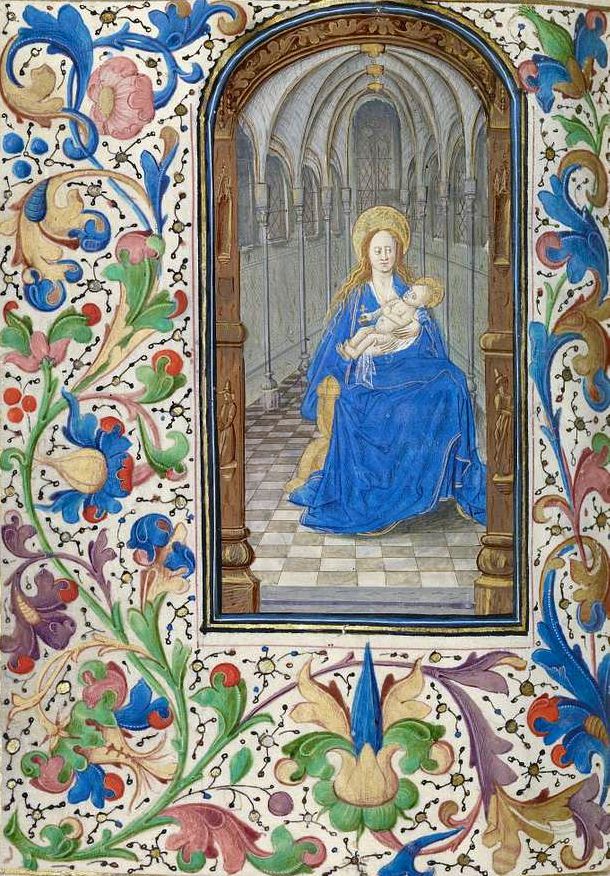
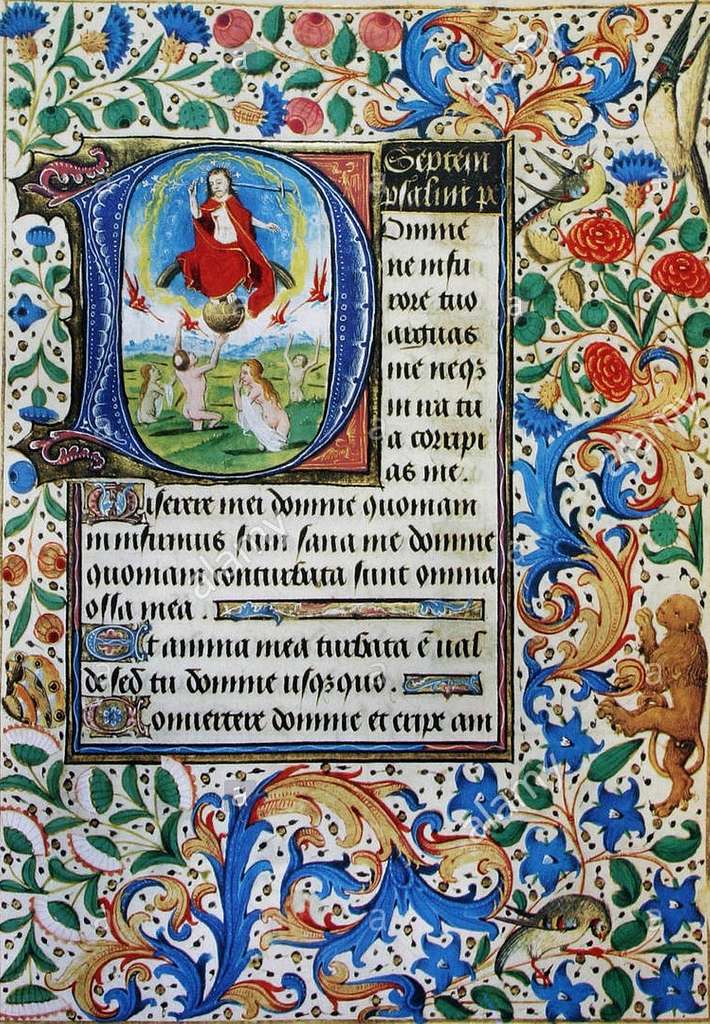
The transition of Mary’s signature color from deep, regal ultramarine to a soft pastel or powder blue occurred primarily during the 19th century, driven by the invention of synthetic paint, highly publicized 19th century Marian apparitions, and a shift in theology and culture.
For centuries, true ultramarine required crushing rare lapis lazuli gemstones. In 1828, French chemist Jean-Baptiste Guimet successfully formulated “French Ultramarine” using cheap, abundant materials like clay, soda, and sulfur. Because blue paint was suddenly cheap and mass-produced, artists and church decorators no longer had to use it sparingly as a pure, concentrated glaze. Instead, they began heavily mixing the new synthetic blue with zinc white or lead white. This mechanical shift in paint-mixing gave birth to the soft, powdery “Marian blue” we see in modern statues.
The physical shift in paint chemistry perfectly aligned with a wave of major Marian apparitions in France, where visionaries explicitly described Mary wearing lighter shades:
- The Miraculous Medal (1830): In Paris, Saint Catherine Labouré reported a vision of Mary standing on a globe with rays of light streaming from her hands. Devotional art and medals commemorating this event popularized depicting Mary in a soft, luminous light-blue mantle or surrounding her with light-blue enamel.
- Our Lady of Lourdes (1858): In southern France, 14-year-old Bernadette Soubirous saw a vision of a “tiny maiden”. Instead of a heavy medieval royal cloak, Bernadette explicitly described Mary as wearing a simple pure white dress with a bright, light-blue sash around her waist.

While Renaissance ultramarine symbolized majesty and the high material cost of devotion, pastel blue shifted the focus toward her gentleness, humility, and accessibility to ordinary people. As the Catholic Church formalized the dogma of the Immaculate Conception in 1854, theological focus shifted from Mary’s role as an Imperial Queen to her role as the sinless, gentle “Spiritual Mother” of humanity. Pastel tones visually represented this new emphasis on approachable purity, innocence, and heavenly peace. By the early 20th century, mass-produced plaster statues painted in soft baby blue became standard in Catholic churches and schools worldwide.
In short, the Beauraing dress is iconographic rather than historical. It reflects the mental template of Mary held by Catholic children in 1932, not the clothing of a woman from Roman‑era Galilee.
The Crown
The representation of Mary wearing a crown, stars, or an aura of light evolved in stages from the 12th century through the 17th century, transitioning from a symbol of European royal authority to a cosmic, mystical vision. This imagery developed through distinct artistic eras, rooted heavily in a specific biblical passage and geopolitical events. The concept of Mary as a crowned queen first explicitly exploded in Western European art during the 1100s.
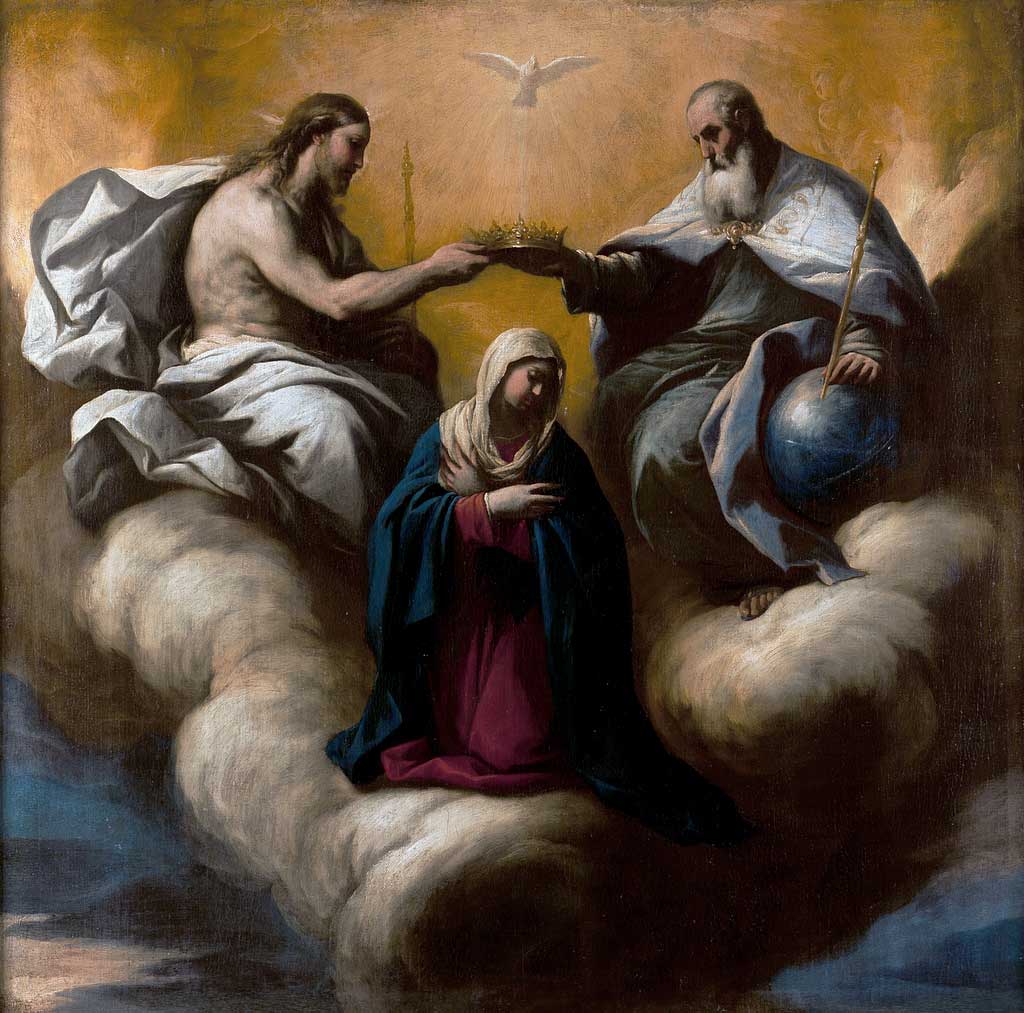
- The “Throne of Wisdom”: Early medieval art usually showed Mary simply as a seat or throne holding the Christ child.
- Influenced by theologians like Saint Bernard of Clairvaux, artists began depicting the “Coronation of the Virgin”. The earliest examples appeared as cathedral stone carvings in France (such as at Notre-Dame de Paris and Chartres Cathedral) and apse mosaics in Rome (at Santa Maria in Trastevere). These works depicted Christ or an angel physically placing a traditional, jewel-encrusted royal crown onto Mary’s head to solidify her title as Regina Caeli (Queen of Heaven).
- The shift from a physical gold crown to a celestial halo of twelve stars became definitive during the Counter-Reformation and the Baroque period (16th–17th Century). This imagery is taken directly from the New Testament’s Book of Revelation 12:1, which describes a cosmic vision: “A great sign appeared in heaven: a woman clothed with the sun, with the moon under her feet and a crown of twelve stars on her head.” Catholic theologians historically interpreted this woman as a symbol for both the Church and Mary.
- The Counter-Reformation Boost: When Protestant reformers rejected Marian devotions in the 1500s, the Catholic Church responded by exalting Mary’s heavenly power even more aggressively. They took the powerful, apocalyptic language of Revelation and instructed artists to paint her with those exact cosmic symbols.
- Artistic Standardization: In 1649, Spanish painter Francisco Pacheco published an influential guide on religious art. He laid down strict rules for depicting the Immaculate Conception: Mary was to be painted hovering in the sky, surrounded by an aura of sunlight, standing on a crescent moon, and wearing a floating circle of exactly twelve stars instead of a heavy metal crown. Masters like Diego Velázquez and Bartolomé Esteban Murillo popularized this look across the globe. The rays of light or glowing aura (often called a mandorla or glory) developed to visually depict the phrase “clothed with the sun.” Instead of a simple circular halo around her face, the light expanded to envelop her entire body.
- Symbolism of the Stars: The twelve stars themselves were interpreted as representing the twelve tribes of Israel (the Old Covenant) and the twelve Apostles (the New Covenant), showing her authority over all of salvation history.
Historically, Mary of Nazareth would not have worn a crown. This is a post‑biblical theological construct.
The crown signals theological elevation, not historical realism. It marks the apparition as a religious symbol, not a person.
The Rosary
Mary appears holding a rosary – this creates a logical contradiction: Mary is depicted using a devotional object invented over a millennium after her lifetime, designed for prayers addressed to herself.
The Rosary has roots in several early Christian prayer traditions. Third-century Christian hermits and monks in Egypt (known as Desert Fathers) used stones and later prayer ropes to keep track when praying the 150 Psalms. Various forms of “the Jesus Prayer” (such as “Lord Jesus Christ, Son of God, have mercy on me.”) became popular. The short prayer was said over and over again in a type of mantra while counting beads. The Our Father was also prayed 150 times, using a string of beads with five decades referred to as a Paternoster (Latin for “Our Father”)
590 AD: The Hail Mary used to only be one line from Luke’s Gospel: “Hail Mary, full of grace, the Lord is with thee.” In 590 AD, Pope Gregory the Great invited Catholics to pray the Hail Mary during the Mass on the Fourth Sunday of Advent. This was the beginning of the prayer’s popularity.
1050 AD: Later, the words of Elizabeth to Mary were added to the Hail Mary prayer: “Blessed art thou among women and blessed is the fruit of thy womb.”( Luke 1:39-44) At this point, more people started praying the Hail Mary repetitively, using beads to keep track.
Early 1100s AD: Following the ancient tradition of repetitive prayer, St. Alvery would recite 150 Hail Mary prayers every day, he would also genuflect for one hundred of them and lay prostrate for the last fifty.
1214 AD: St. Dominic, the founder of the Dominican Order, had a vision of Mary, who told him about the Rosary. Dominic made it his mission to spread the Rosary wherever he went. He encouraged lay Catholics to gather in small groups to pray an early version of the Rosary together.
1261 AD: Pope Urban IV added the name of Jesus to the end of Elizabeth’s words: “Blessed art thou among women and blessed is the fruit of thy womb, Jesus.”
1555 AD: St. Peter Canisius published the Hail Mary in his catechism with almost the entire final petition. His version read: “Hail Mary, full of grace, the Lord is with thee. Blessed art thou among women and blessed is the fruit of thy womb, Jesus. Holy Mary, Mother of God, pray for us sinners.”
1566 AD: Eleven years later, the Catechism of the Council of Trent included, for the first time, the entire petition, concluding with the words “now and at the hour of our death. Amen.”
1568 AD: The Hail Mary was officially approved as the current version.
1597 AD: The first recorded use of the term “Rosary” was published.
1917 AD: Mary appeared to three shepherd children in Fatima, Portugal, giving them many messages, including a call to pray the Rosary every single day for world peace. She invited them to add on a short prayer to every decade: “O my Jesus, forgive us our sins, save us from the fires of hell, and bring all souls to heaven, especially those in most need of your mercy.” This new update to the Rosary is called “The Fatima Prayer.”
Like the Golden Heart, the appearance of the rosary in the Beauraing visions occurred only after many sessions, and is entirely in line with what Catholic children of 1930 would be expected to see.
Entity Appearance Summary
Taken together, the elements of the Beauraing figure – the blue dress, the crown, the rosary, the Golden Heart – form a coherent iconographic whole. They are:
- entirely post‑biblical,
- rooted in European Catholic imagery,
- symbolically consistent,
- historically impossible,
- and reflective of collective religious imagination rather than antiquity.
The entity’s appearance is thus best understood as a visionary construct shaped by cultural expectation: a figure assembled from the devotional repertoire available to the children, rather than an encounter with a first‑century Jewish woman.
Inferred Characteristics of the Entity’s Behavior
| Characteristic | Inferred Behavior / Evidence From Reports | Implication for Entity Model |
|---|---|---|
| Locomotion | Witnesses said the figure “came walking in the air” or approached from above the railway embankment. | Entity follows continuous spatial movement, not teleportation; motion is smooth, directional, and coherent. |
| Continuity of Time | Apparitions lasted minutes; entity remained present until leaving; no sudden disappearance mid‑interaction. | Entity operates within normal temporal flow; no time dilation or discontinuities reported. |
| Single‑Location Presence | Only one apparition at a time; never reported simultaneously at multiple sites. | Entity behaves as a localized phenomenon, not omnipresent or multi‑locational. |
| Non‑Teleportation | No reports of instantaneous appearance; entity always “arrived” and “departed.” | Suggests spatial continuity; apparition follows a path rather than blinking in/out. |
| Responsiveness to Children | Entity reportedly stayed longer when children begged it to remain. | Implies reactive behavior, at least within the children’s perceptual framework. |
| Selective Visibility | Only the five children saw the entity; adults saw nothing. | Entity is perceptually selective or experience is witness‑dependent (psychological or neurological gating). |
| Stable Visual Form | Descriptions remained consistent: luminous female figure, robe, golden heart. | Entity has a fixed iconographic template, not a shifting or amorphous form. |
| No Physical Interaction | No environmental traces, no shadows, no temperature changes, no sound. | Entity is non‑physical or interacts only with perception, not matter. |
| No Environmental Effects | Plants, ground, objects unaffected; no EM anomalies. | Entity does not exert measurable physical force. |
| Psychological Impact | Children entered trance‑like states; reduced pain response; intense emotional arousal. | Entity induces altered states of consciousness, possibly internally generated. |
| Message‑Driven Behavior | Entity delivered ideologically coherent messages (prayer, devotion). | Behavior is symbolic, not biological; consistent with culturally shaped visionary experience. |
| Predictable Repetition | Apparitions occurred repeatedly over weeks, often at similar times. | Entity follows patterned recurrence, typical of psychological or ritualized phenomena. |
| No Independent Adult Confirmation | Adults never saw the figure despite being present. | Strong evidence for subjective perception, not external physical presence. |
Taken together, these characteristics point toward an entity that:
- Behaves as if it occupies space and time normally
- Exhibits continuity of movement
- Appears localized and non‑teleporting
- Shows reactive behavior (staying longer when asked)
- But is visible only to specific witnesses
- And produces no physical effects on the environment
Locomotion and Spatial Behavior
- Continuous movement – entity approaches by “walking in the air,” not teleporting.
- Directional arrival and departure – always comes from a direction (railway embankment) and leaves by receding.
- Single‑location presence – never appears simultaneously elsewhere.
Implication: The phenomenon behaves as if it occupies normal space, with continuous motion, not instantaneous displacement.
Temporal Behavior
- Normal time flow – apparitions last minutes; no time distortion.
- Predictable recurrence – repeated over weeks, often at similar hours.
- Duration modulated by witness interaction – entity “stays longer” when children beg.
Implication: The entity behaves as if embedded in ordinary temporal continuity, not outside time.
Perceptual Characteristics
- Selective visibility – only children see it; adults do not.
- Stable iconography – consistent female figure, robe, golden heart.
- No physical interaction – no shadows, sounds, or environmental effects.
Implication: The phenomenon is perceptual, not physical – likely internally generated or psychologically mediated.
Physical Effects
No physical traces (burn marks, impressions, electromagnetic anomalies, etc.) or environmental effects were reported.
Psychological Effects
- Trance‑like states – children become rigid, unreactive.
- Reduced pain response – but never tested rigorously.
- Emotional arousal – awe, fear, devotion.
Implication: The entity induces (or coincides with) altered states of consciousness.
The Most Fragile Element of the Beauraing Dossier
Among the recurring claims in the Beauraing retellings is the assertion that the children did not react to pain during the apparitions. Pinpricks, burns, sudden noises, attempts to pull or shake them – none, it is said, elicited a response. They knelt on hard ground for long periods without discomfort. Whether every detail is historically precise or the product of later embellishment, this cluster of reports belongs to a familiar category in the study of visionary and trance phenomena: unverified physiological effects.
From a Vallée‑style perspective, this is the kind of detail that, in a UFO case, would be tentatively classified as a physiological effect of proximity – radiation, paralysis fields, or other exotic mechanisms. But Vallée also noted that such claims are almost always the least reliable part of any dossier. They are asserted, not measured; witnessed, not tested; and socially inhibited to the point of being unverifiable. Beauraing fits this pattern exactly.
The Socially Inhibited Test
The tests that did occur were shaped by the setting: observers were dealing with children, in a religious context, during what many believed was a sacred event under the eyes of crowds and clergy. Under those conditions, no one was going to scratch a child’s skin with a steel nib, apply a chemical irritant, or press a genuinely hot object against them, or perform a proper neurological reflex test. Even if someone had wished to test the claim rigorously, the social pressure to avoid “hurting the visionaries” was overwhelming.
The result is an evidentiary vacuum. No baseline pain response was recorded. No comparison between apparition‑state and normal‑state behavior exists. No physiological measurements were taken. No medical professional conducted a controlled examination during an apparition. What remains are anecdotes – interesting, but scientifically inert.
If one treats Beauraing as a Close Encounter, the claim of analgesia would require four conditions:
- repeatability,
- measurability,
- correlation with proximity,
- independent verification.
Beauraing meets none of these. The analgesia is not repeatable outside the visionary state, not measured, not correlated with distance to the entity, and not independently verified. In Vallée’s typology, this places the claim squarely in the category of unverified physiological effects—a class of evidence that is rhetorically powerful but empirically fragile.
Psychophysiological Mechanisms
From a scientific standpoint, several well‑documented mechanisms can produce temporary reductions in pain perception during intense emotional or religious experiences.
- Altered states of consciousness
- Trance and dissociation narrow attention so sharply that external stimuli are deprioritized. The children’s focus on the perceived entity could easily have blunted their awareness of minor discomfort.
- Stress‑induced analgesia
- High arousal – fear, awe, ecstasy – can trigger endogenous pain‑blocking chemicals. Soldiers in battle, accident victims, and participants in religious ecstasy often report not feeling injuries until later.
- Social and expectancy effects
- Once the children were framed as “visionaries,” they were under intense pressure to maintain the role. Remaining motionless and unreactive could be partly voluntary, partly automatic. Small stimuli might be consciously ignored or under‑reported to avoid contradicting the narrative.
- Observer bias and retrospective sharpening
- Witnesses already inclined toward a miraculous interpretation may over‑interpret normal stoicism as total imperviousness. Later retellings tend to sharpen the effect: “they didn’t flinch” becomes “they couldn’t feel pain.”
Psychological Effects Summary
The Beauraing reports align more closely with human psychophysiology under intense religious experience than with the effects of an external physical agent:
- no lasting biological anomaly was reported,
- the effect was state‑bound, occurring only during the apparitions,
- the pattern tracks emotional arousal, not spatial proximity,
- and the claims lack controlled verification.
From a critical‑investigative standpoint, the simplest model is that the “entity” functioned as a trigger for an altered state in the children – one capable of producing temporary analgesia and reduced responsiveness without requiring any physical mechanism.
This does not diminish the sincerity of the children or the intensity of their experience. It simply places the phenomenon within a well‑documented class of visionary states, where psychological absorption and social context can produce effects that observers later interpret as miraculous.
Beauraing versus Other Major Apparitions
| Case | Witness Type | Entity Behavior | Physical Effects | Message Content | Cultural Patterning |
|---|---|---|---|---|---|
| Beauraing (1932–33) | 5 children | Walks in air; stays longer on request; localized | None | Prayer, devotion, “I am the Immaculate Virgin” | Strong Marian iconography; Golden Heart motif |
| Fatima (1917) | 3 children | Appears monthly; consistent form | Sun phenomenon (contested); ground drying | Repentance, prayer, secrets | Apocalyptic tone; Portuguese Catholic imagery |
| Lourdes (1858) | 1 child (Bernadette) | Static figure in grotto | Spring emerges; healings (unverified medically at the time) | Penance, prayer | Local Marian devotion; white dress/blue sash |
| Medjugorje (1981–present) | 6 teens | Appears on schedule; long dialogues | None confirmed | Peace, conversion | Modernized Marian imagery; ongoing messages |
Comparative Conclusions
- Beauraing is closest to Lourdes in perceptual style (static luminous figure, no physical effects).
- It lacks the mass‑witness environmental anomaly claimed at Fatima.
- It lacks the extended conversational content of Medjugorje.
- Its Golden Heart motif is strongly symbolic, not historical.
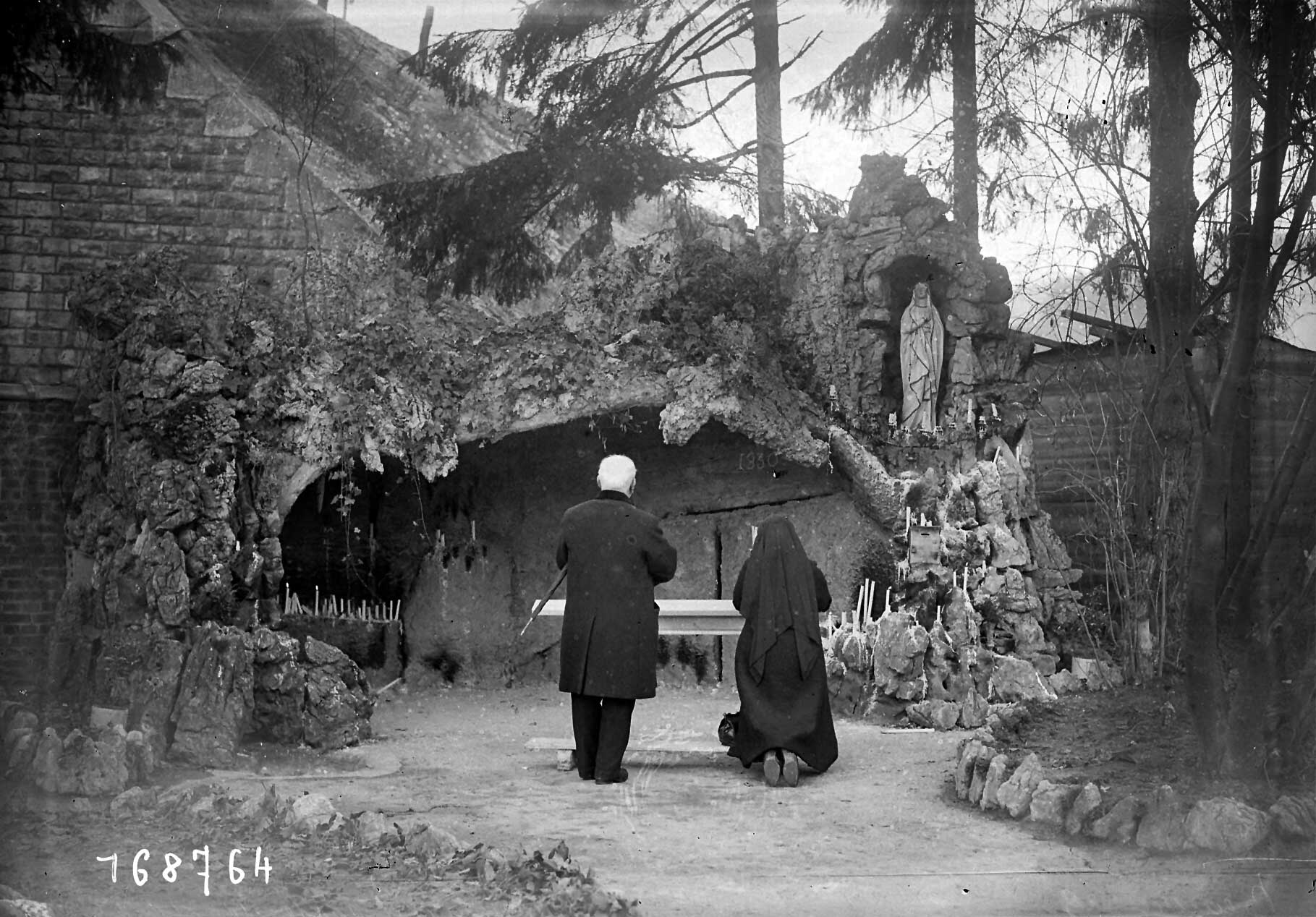
Coincidentally, there was actually a “Lourdes grotto” at the school of the Sisters of Christian Doctrine where the children attended, so perhaps the similarity to Lourdes should not surprise us:
Psychological Profile of the Child Witnesses
The temptation, when confronted with the Beauraing testimonies, is to treat the children as transparent conduits: innocent observers who simply reported what they saw. Yet the more one examines the internal structure of their accounts – their consistency, their emotional tenor, their group dynamics – the more it becomes clear that the witnesses themselves are part of the phenomenon. Not in the sense of fabrication, but in the quieter, more intricate sense in which human perception, expectation, and social reinforcement shape what is experienced and how it is remembered.
A Cohesive Witness Cluster
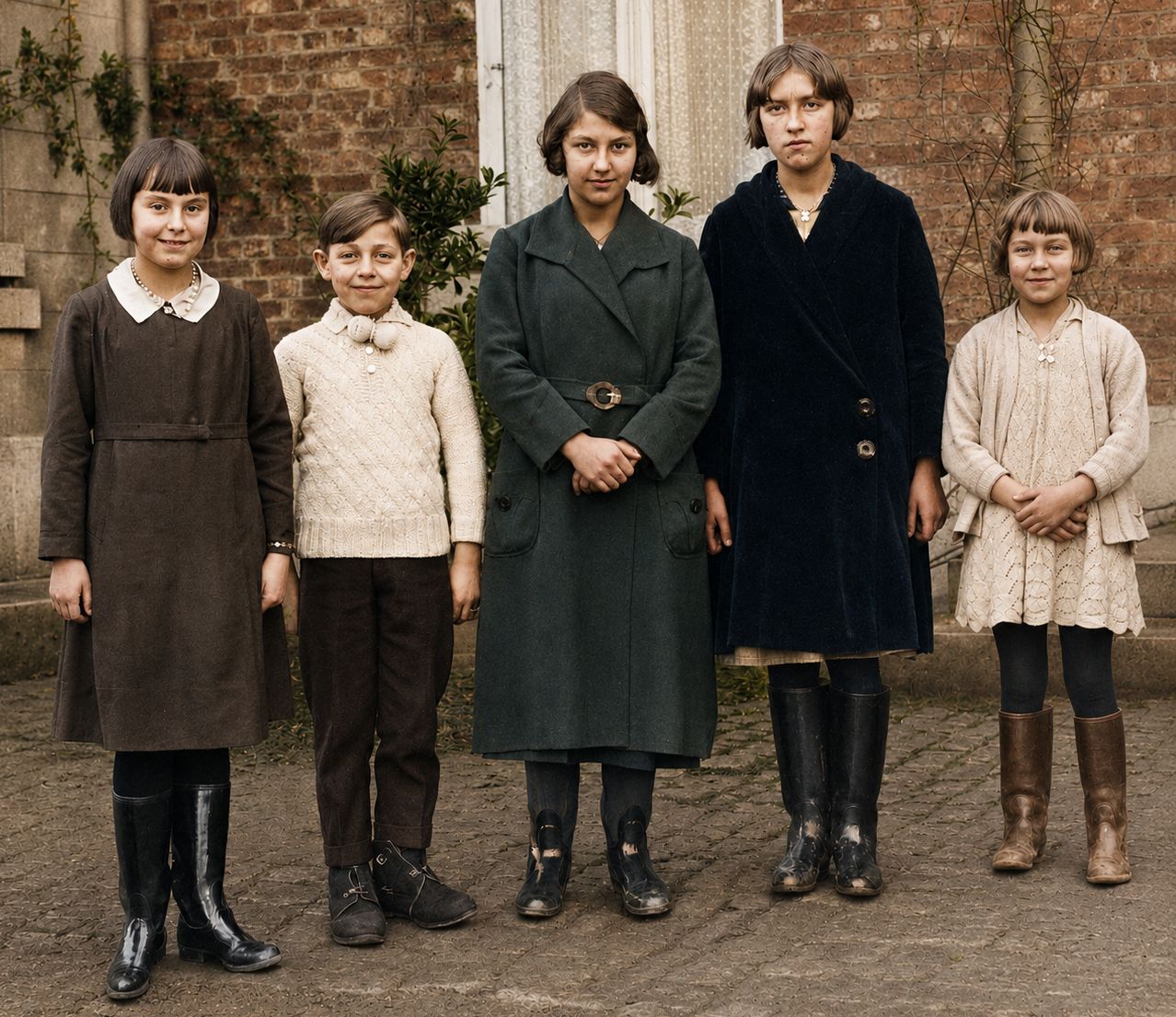
The five children formed two sibling groups, the Voisins and the Degeimbres, who lived within a few dozen meters of each other. They walked to school together, played together, and were interviewed together. In any investigative field – whether one studies UFO flaps, poltergeist outbreaks, or the more prosaic domain of police eyewitness testimony – such a cluster is immediately recognized as high‑cohesion. High cohesion does not imply collusion; it implies shared interpretation, shared emotional states, and a tendency toward narrative synchronization.
Sibling groups, in particular, exhibit well‑documented patterns: they reinforce each other’s perceptions, resist contradicting one another in public, and often converge on a common account even when their initial impressions differ. When the age range spans roughly nine to fifteen, as it did in Beauraing, the effect is amplified. This is the developmental window in which imagination is vivid, peer conformity is strong, and dissociative absorption is unusually accessible. The group, in other words, was primed – psychologically and socially – to experience something together.
Suggestibility Without Gullibility
The children’s personalities, as inferred from their testimonies and behavior, show a pattern of high suggestibility. The term is often misunderstood. It does not mean credulity; it means an openness to emotionally charged interpretation, especially when the interpretive framework is already culturally available. A luminous figure appearing near a convent garden in 1932 Belgium does not require invention. It requires only the activation of a familiar template.
Children in this age range also respond strongly to adult attention. Once the first reports were taken seriously by clergy and parents, the emotional reinforcement was immediate. The children were no longer ordinary schoolmates; they were potential visionaries. In such circumstances, commitment to the narrative tends to increase, not because of deceit, but because the narrative becomes intertwined with identity.
Behavioral Markers of Altered States
Contemporary descriptions of the apparitions repeatedly mention rigid posture, fixed gaze, minimal blinking, and reduced responsiveness. These are not exotic traits. They are the classic signatures of dissociative trance, a state that appears across religious ecstasy, hypnotic induction, and certain types of close‑encounter reports. The children’s behavior during the visions – kneeling, crying, staring upward as if transfixed – fits this pattern with almost textbook precision.
One detail often cited by believers is the children’s apparent insensitivity to pain when tested by skeptical adults. The tests were crude, and the documentation uneven, but the behavior itself is unsurprising. Stress‑induced analgesia, narrowed attentional bandwidth, and the social pressure to maintain a visionary role can all produce a muted response to physical stimuli. None of these require a supernatural explanation; all are well‑attested in psychological literature.
Consistency as a Product of Reinforcement
The most frequently invoked argument for the authenticity of the Beauraing visions is the consistency of the children’s testimonies. Yet consistency, in this context, is not a mystery. It is the predictable outcome of three reinforcing mechanisms:
- Repetition: The children were questioned dozens of times. Repeated retelling stabilizes a narrative, even when the original memory was vague.
- Group interviews: Being questioned together encourages unconscious alignment. One child’s phrasing becomes the group’s phrasing.
- Social stakes: Once hundreds of pilgrims gathered nightly, the cost of contradicting the established story increased dramatically.
In investigative psychology, consistency is meaningful only when it contains what might be called a signature of the unexpected – details the witness could not have anticipated, information that resists cultural explanation, or anomalies that do not fit the expected template. Beauraing contains none of these. The imagery, the messages, the symbolism: all are precisely what one would expect from Catholic children of the period. The absence of novelty is not a flaw in the children; it is a clue to the internal origin of the experience.
The Internal Logic of a Shared Vision
When one places all these elements together – the cohesive witness cluster, the developmental stage, the suggestibility, the trance‑like behavior, the culturally saturated content – the pattern that emerges is not one of deception, nor of random hallucination, but of shared visionary experience. Such experiences are not rare. They appear in Marian apparitions, in revivalist movements, in UFO waves, and in medieval miracle reports. The underlying mechanisms differ in detail but converge in structure: a small group enters an emotionally charged state, interprets ambiguous stimuli through a shared cultural lens, and reinforces the interpretation through repeated retelling.
The Beauraing children were sincere. Their sincerity, however, does not settle the question of what occurred. Sincerity is compatible with misperception, with dissociation, with the subtle pressures of group identity. The phenomenon, viewed through this lens, becomes less a visitation and more a crystallization: a moment in which psychological, social, and cultural forces aligned to produce a coherent, compelling, and deeply meaningful experience.
Witness Summary
To analyze the children is not to diminish them. It is to recognize that visionary events are not merely things that happen to people; they are things that people participate in, shape, and sustain. The Beauraing witnesses were not passive recipients of an external message. They were active agents within a complex human process—one that reveals as much about the structure of belief and perception as it does about the apparition itself.
The Pressure of Crowds

The official narratives of Beauraing tend to treat the crowds as a passive backdrop, as though the visions unfolded in a vacuum and the thousands who gathered merely observed. Yet once the first reports circulated, the social environment changed so rapidly and so dramatically that the apparitions cannot be separated from the conditions under which they were witnessed. The children did not simply experience visions; they experienced them while being watched, while being expected, and eventually while being surrounded by thousands of adults who had come to see them see. In such a setting, the boundary between private perception and public performance becomes porous.
The Sudden Emergence of a Public Stage
Within days of the first vision, the convent garden transformed into a nightly gathering place. Dozens became hundreds; hundreds became thousands. The children found themselves at the center of a space that resembled, in structure if not in intention, a séance circle: a fixed location, a fixed hour, a fixed set of participants, and a shared expectation that something extraordinary would occur again.
The crucial point is simple: the children did not summon the crowds; the crowds imposed themselves on the children. This inversion of agency is characteristic of many apparition waves and revivalist movements. Once a community invests an event with spiritual significance, the individuals at the center lose control of the narrative. They become symbolic actors in a drama they did not write.
Performance Demand and the Loss of Autonomy
When hundreds of adults gather in silence, waiting for a group of children to enter a visionary state, the psychological pressure is immense. The children were no longer ordinary observers; they were “the visionaries,” a role that carries its own internal logic. Under such conditions, several well‑documented responses emerge:
- Role fixation: the child becomes the role assigned to them.
- Fear of disappointing adults: a powerful motivator, especially in pre‑adolescents.
- Heightened emotional arousal: the body prepares for an event before the mind interprets it.
- Dissociation: trance‑like states become more accessible.
- Automatic behavior: gestures and expressions repeat with ritual regularity.
None of this implies deception. It reflects the predictable effects of expectation, attention, and emotional contagion. The children were not performing in the theatrical sense; they were performing in the psychological sense – responding to a situation in which the safest, least disruptive path was to continue seeing what the crowd hoped they would see.
Reinforcement Loops: How the Crowd Shaped the Visions
Every time a child announced “I see her,” the crowd reacted with a choreography of devotion: gasps, prayers, tears, kneeling, and a collective surge of emotion. This response acted as a powerful form of positive reinforcement. The children’s certainty deepened; the trance intensified; the narrative stabilized. The crowd, in turn, interpreted the children’s behavior as further evidence of authenticity.
This reciprocal dynamic – witnesses reinforcing the crowd, the crowd reinforcing the witnesses – is a familiar pattern. It appears in revivalist meetings, healing ceremonies, séance rooms, and UFO flaps where witnesses feel compelled to elaborate their accounts. The mechanism is not mystical; it is social.
Reinforcement also has a negative form. Had a child said, “I don’t see her today,” the likely response would have been disappointment, questioning, or suspicion. Children are exquisitely sensitive to adult disapproval. Maintaining the visionary role was, in psychological terms, the path of least resistance.
The Ritual Structure of Repetition
The apparitions did not occur sporadically. They occurred:
- at the same place,
- at the same time,
- with the same witnesses,
- under the same emotional conditions.
This repetition created a ritual frame, even if no one intended it. Rituals, whether religious or secular, function by narrowing attention, heightening expectation, and synchronizing emotional states. In such environments, trance becomes easier, and visionary content tends to elaborate over time.
The late appearance of the Golden Heart motif is a case in point. It emerged only after many evenings, once the narrative had stabilized and the symbolic vocabulary of the visions had begun to expand. In psychological terms, this is visionary elaboration – a deepening of imagery under sustained social and emotional pressure.
Synchronization Through Proximity
The children’s proximity – living near one another, walking together, playing together, being interviewed together – made narrative convergence almost inevitable. This does not suggest collusion; it suggests the ordinary mechanisms of shared memory and mutual reinforcement. In any other investigative context, such a witness cluster would be flagged as high‑risk for synchronization. In Beauraing, it was treated as evidence of reliability.
Cultural Scripting and the Shaping of Content
Crowds do not merely observe; they carry expectations. In 1932 Belgium, a Marian apparition was expected to involve:
- a luminous female figure,
- gentle or silent demeanor,
- simple devotional messages,
- elevation above the ground,
- a heart motif or other familiar iconography.
The children’s visions gradually aligned with these expectations. This is not manipulation; it is cultural scripting. When a community anticipates a particular form of sacred encounter, the imagery tends to follow the template already embedded in collective imagination.
Why the Visions Continued
Had the children been alone, the visions might have lasted a single evening. But with thousands watching, the social meaning of the event intensified. The children were locked into a role; the trance states deepened; the symbolic content expanded; the narrative acquired momentum. The apparitions lasted thirty‑three evenings not because the phenomenon required that duration, but because the social environment sustained it.
Crowd Effect Summary
The structure of Beauraing – rapid crowd formation, ritual repetition, escalating symbolism, synchronized witnesses – is not unique. It mirrors patterns seen in other apparition waves, in revivalist surges, and in certain UFO clusters. The specific imagery differs; the underlying dynamics remain remarkably consistent.
The Wider Context: Belgium’s Apparition Wave of 1932–33
The official narrative of Beauraing presents the events as a discrete eruption of grace: a small town, a handful of children, a luminous figure, and a message of prayer. What disappears in that devotional framing is the dense historical atmosphere in which the visions occurred. Belgium in 1932–33 was not a neutral backdrop. It was a country under strain – economic, political, and religious – and these pressures formed the psychological and cultural substrate from which the apparition wave emerged. To understand Beauraing, one must understand the landscape that made such events not only possible but almost predictable.
Belgium as Pressure Cooker
Belgium entered the 1930s in a state of quiet instability. The Great Depression struck the country with particular force: industrial contraction in Wallonia, unemployment in mining regions, and a pervasive sense of insecurity. The political climate was equally unsettled. Mussolini had consolidated power in Italy; Hitler was on the cusp of doing the same in Germany; communism had entrenched itself in the USSR. Belgium, still carrying the trauma of German occupation during the First World War, felt squeezed between ideological extremes.
Religious tensions added another layer. Wallonia, including the region around Beauraing, was undergoing rapid secularization. Socialist and anticlerical movements were gaining ground. Catholic elites feared a collapse in religious practice and loyalty. In such a climate, Marian devotion – already a powerful cultural symbol – became a repository for anxieties about identity, continuity, and protection.
This combination of economic strain, political anxiety, and religious insecurity created a fertile environment for visionary phenomena. Apparitions do not arise in a vacuum; they arise where symbolic reassurance is most needed.
The Belgian Apparition Wave
Beauraing was not an isolated event. Between 1932 and 1933, Belgium experienced an apparition epidemic: more than forty sites reported visions of Mary, luminous figures, or supernatural messages. Hundreds of children and adults claimed encounters. Crowds gathered at many locations. The Church investigated most of these claims and rejected all but two – Beauraing and Banneux.
The scale of the wave is documented in Tine Van Osselaer’s Apparition Fever, which shows how visionary claims proliferated through social contagion. Reports spread quickly; observers flocked to new sites; clergy and medical professionals attempted to evaluate the visionaries. The pattern resembles what sociologists call a “collective effervescence”: a moment when shared emotion and expectation generate new experiences that reinforce the very conditions that produced them.
The official story rarely mentions this wider wave. Doing so would place Beauraing within a broader pattern of mass visionary behavior rather than as a singular divine intervention.
Why Beauraing and Banneux “Succeeded”
The Church’s approval of Beauraing and Banneux was not arbitrary. It reflected a set of criteria that ecclesiastical commissions have applied since the nineteenth century. These criteria can be summarized as follows:
A. Consistency and Stability
Both sites involved small, stable groups of visionaries whose testimonies remained coherent over weeks. There were no major contradictions and no evidence of fraud.
B. Observability
The events occurred in manageable settings—a convent garden in Beauraing, a rural path in Banneux – where clergy could observe the children repeatedly.
C. Doctrinal Simplicity
The messages were devotional rather than apocalyptic or political. They contained no theological innovations.
D. Devotional Fruit
Both sites developed into pilgrimage destinations with claims of healings and sustained prayer activity.
E. Institutional Process
Each underwent formal investigation by episcopal commissions, culminating in approval in 1949.
These factors distinguished Beauraing and Banneux from the dozens of other sites, many of which involved contradictory testimonies, chaotic public settings, sensational predictions, or visionaries whose psychological profiles raised concerns.
Why the Other Sites Faded
The rejected apparition claims followed a different pattern. Many involved single, unrepeatable visions. Others featured visionaries who contradicted themselves under questioning. Some produced political or apocalyptic messages that the Church viewed as signs of imagination or hysteria. Several sites became disorderly, with large crowds, emotional contagion, and expectations of miracles on demand.
In short, the majority of the forty‑plus sites lacked the stability, observability, and doctrinal clarity that ecclesiastical authorities required. They were part of the wave, but not part of the institutional memory.
Apparition Waves in Comparative Perspective
The Belgian wave fits a broader historical pattern: Marian apparitions tend to erupt during periods of intense social, political, or religious stress. A brief comparison illustrates the point.
| Case | Historical Context | Visionary Pattern | Interpretive Parallel |
|---|---|---|---|
| Lourdes (1858, France) | Post‑Revolution anticlericalism; social upheaval | Poor child visionary; local tensions | Apparition as counter‑symbol to secularization |
| Fatima (1917, Portugal) | Anti‑clerical regime; WWI trauma | Child visionaries; apocalyptic overtones | Apparition as response to war and ideological fear |
| Medjugorje (1981–, Yugoslavia) | Communist repression; ethnic tension | Teen visionaries; long‑running messages | Apparition as spiritual counter‑narrative |
| Belgium (1932–33) | Depression; rising fascism/communism; Catholic anxiety | Many sites; many visionaries; two approved | Apparition as response to ideological and religious instability |
The common thread is not theological content but sociological function. Apparitions emerge where communities feel threatened, where identity is contested, and where symbolic reassurance becomes psychologically valuable.
Cultural Scripting and the Absence of the Unexpected
One striking feature of the Belgian wave is the uniformity of its imagery. The visions almost never contained elements outside the expected Catholic repertoire. Luminous female figures, white robes, heart motifs, simple devotional messages – these were precisely the images circulating in statues, holy cards, and parish iconography of the time.
This is not evidence of fabrication. It is evidence of cultural scripting: when a community anticipates a particular form of sacred encounter, the imagery tends to follow the template already embedded in collective imagination. The late appearance of the Golden Heart in Beauraing fits this pattern of symbolic elaboration under repeated ritual conditions.
A Parallel Case: The Belgian UFO Wave of the 1990s

The structural similarity between the 1932–33 apparition wave and the Belgian UFO wave of 1989–1992 is difficult to ignore. The content differs – luminous triangles instead of luminous ladies – but the underlying dynamics are remarkably consistent.
| Feature | 1932–33 Marian Wave | 1990s UFO Wave |
|---|---|---|
| Social tension | Economic depression; ideological fear | Cold War end; NATO tensions; media anxiety |
| Witness clusters | Children in small towns | Police officers, civilians, pilots |
| Cultural imagery | Marian iconography | Black triangles, aviation motifs |
| Crowd formation | Thousands gathering nightly | Mass sightings; public vigils |
| Institutional response | Ecclesiastical commissions | Military and scientific investigation |
| Narrative evolution | Golden Heart motif emerges | Triangular craft becomes dominant form |
| Lack of anomalies | No unexpected details | No physical evidence despite many reports |
The comparison is not meant to equate the two phenomena but to highlight a shared structure: collective expectation, ambiguous stimuli, cultural templates, and reinforcement loops. Vallée’s insight – that visionary and UFO waves follow similar psychological and sociological patterns – finds a clear illustration in Belgium’s two major flaps, separated by sixty years but united by structure and geography.
The parallels are especially strong. In both cases, a sudden wave of sightings occurs, reports multiply rapidly, media coverage amplifies the phenomenon, and witnesses influence each other’s descriptions. The most famous photograph of the Belgian UFO flap – the Petit‑Rechain image – was later revealed to be a hoax, yet it shaped public perception for decades. Both phenomena are real as social events, but not necessarily as external entities.
What the Official Story Leaves Out – Historical Context Summary
The sanctuary’s devotional narrative smooths away the complexity of the historical moment. It omits the economic and political tensions, the multiplicity of apparition claims, the mechanisms of social contagion, and the parallels with other visionary waves. By isolating Beauraing from its context, the official story transforms a collective phenomenon into a singular miracle.
A more critical‑investigative reading does not deny the sincerity of the children or the spiritual meaning the events hold for believers. It simply restores the missing layers: the pressures of a country in crisis, the dynamics of mass visionary behavior, and the cultural scripts that shape what is seen when people expect to see the sacred.
The Problem of Divine Restraint
The devotional literature surrounding Marian apparitions tends to present them as moments of luminous intervention: the Queen of Heaven descends, speaks, consoles, and departs. Yet once one steps outside that narrative frame, a series of awkward questions arise – questions that theologians, historians, and even bishops have raised with varying degrees of candor. Why do apparitions occur under dubious conditions? Why do they choose liminal witnesses? Why are the messages so bland? And why, if these events are genuine intrusions of the transcendent, do they leave the world so conspicuously unchanged?
These questions are not irreverent. They are simply the natural consequence of taking the phenomenon seriously.
The Geography of the Margins
One of the most persistent features of Marian apparitions is their location on the social periphery. Visionaries tend to be children, adolescents, or otherwise marginal figures – those least equipped to resist the interpretive pressure of their communities and least likely to be scrutinized with rigor. This is not unique to Beauraing. It is the pattern at Lourdes (a sickly miller’s daughter), Fatima (illiterate shepherd children), Medjugorje (teenagers in a communist state), and countless lesser‑known cases.
The same structure appears in non‑religious visionary waves. UFO abductions disproportionately involve individuals in liminal psychological or social states. Medieval miracle reports cluster around the poor, the young, and the socially precarious. The margins are where altered states, dissociation, and visionary absorption are most accessible – and where communities are most willing to accept extraordinary claims without demanding extraordinary evidence.
The pattern is cross‑cultural. It is also, from a theological standpoint, puzzling. If the Queen of Heaven wishes to communicate with humanity, why does she choose the demographic least able to articulate, verify, or defend the message?
The Blandness of the Messages
Another striking feature of Marian apparitions is the content of the messages themselves. They are almost always doctrinally safe, emotionally gentle, and theologically unadventurous. The vocabulary is drawn from the devotional repertoire of the witnesses and the expectations of the surrounding culture. The messages tend to be variations on a theme:
- Pray.
- Repent.
- Love Jesus.
- Say the rosary.
- Be good.
They are never:
- “Here is the cure for tuberculosis.”
- “Here is how to prevent the next World War.”
- “Here is a verifiable miracle that will convince the world.”
- “Here is a piece of information unavailable to your culture.”
The Church itself acknowledges this limitation. In its doctrine of private revelation, it states that such messages are not meant to add to the deposit of faith, not meant to provide new knowledge, and not binding on the faithful. Belief in them is permitted, not required.
This raises an uncomfortable implication: if the messages are indistinguishable from the devotional clichés of the period, how does one distinguish divine communication from cultural echo?
The Absence of Evidence
The third puzzle is the conspicuous lack of physical evidence. Marian apparitions almost never produce measurable phenomena. No photographs, no physical traces, no scientifically verifiable miracles. Even the famous “Miracle of the Sun” at Fatima dissolves under scrutiny: eyewitness accounts contradict one another, no astronomical anomaly occurred, and the event was not observed outside the immediate crowd.
The Church’s investigative criteria reflect this ambiguity. It looks for:
- consistency of testimony,
- psychological stability,
- doctrinal orthodoxy,
- devotional fruit.
It does not require:
- physical evidence,
- scientific verification,
- repeatable miracles,
- external corroboration.
This is why Beauraing, despite producing no physical phenomena whatsoever, could still be approved. The Church is not looking for empirical confirmation; it is looking for harmlessness.
The Problem of Divine Restraint
The sharpest question, however, concerns the apparent inefficacy of the apparitions. If Mary can appear to children in a convent garden, why does she not appear to those whose decisions shape the fate of millions?
- If she can materialize in Beauraing, why not in Berlin in 1933?
- If she can speak to shepherd children, why not to Stalin?
- If she can encourage prayer, why not discourage genocide?
- If she can offer rosaries, why not offer germ theory?
The standard theological answer is that God respects human freedom and does not intervene in history in ways that would override it. Yet this explanation introduces a contradiction. God respects Hitler’s freedom, but not the freedom of a twelve‑year‑old visionary? God refrains from preventing mass slaughter, but not from encouraging devotional practices?
The tension is widely acknowledged in theological literature, though rarely addressed in popular accounts.
The Church’s Actual Position
When one strips away the devotional language, the Church’s stance on apparitions is surprisingly modest:
- Apparitions may be psychological or spiritual experiences.
- They may or may not be supernatural.
- They are not historically verifiable events.
- They are not doctrinally important.
- They are permitted because they inspire devotion.
- They are not required because they are not essential.
This position is pragmatic. It allows the Church to embrace the devotional energy generated by apparitions without committing itself to their literal historicity. It also explains why the Church approves so few cases and rejects most: the goal is not to authenticate supernatural events but to manage religious enthusiasm.
Summary: Theological Irony
The irony, if one is inclined to notice it, is that the very features believers cite as signs of authenticity – humble witnesses, simple messages, lack of spectacle – are the same features that make apparitions indistinguishable from culturally scripted visionary experiences. The Queen of Heaven, if she is indeed the author of these events, appears to have adopted a communication strategy that is indistinguishable from the workings of human psychology.
This does not disprove the phenomenon. It simply reframes it. Apparitions may be less about divine intervention in history and more about the symbolic vocabulary through which communities negotiate fear, identity, and hope. They occur where meaning is needed, not where information is lacking.
A Landscape of Manufactured Memory
The modern sanctuary at Beauraing presents itself as a place of peace, devotion, and gentle continuity. Manicured lawns, paved walkways, devotional statues, and the gleaming basilica create an atmosphere of quiet reverence. Yet this serenity is not a remnant of the past; it is an artifact of curation. The Beauraing of today is not the Beauraing of 1932–33. It is the Beauraing that has been deliberately constructed, stabilized, and ritualized over ninety years of institutional memory‑work.
The original events were chaotic: muddy ground, jostling crowds, emotional contagion, and children thrust into a role they could not control. The sanctuary’s present‑day calm is therefore not continuity but transformation – a transformation from lived experience into heritage.
Designed to Forget the Chaos
The sanctuary’s physical layout functions as a memory‑management system. The visitor is guided along a linear path – hawthorn tree, Golden Heart statue, Chapel of the Apparitions, Rosary Way, basilica – each step reinforcing a simplified narrative: Mary appeared here, she revealed her heart, she asked for prayer, people responded. The path is not neutral. It is a script.
What is absent from this script is as telling as what is included. There is no trace of the Belgian apparition epidemic, no hint of the crowd pressure, no acknowledgment of trance states or narrative synchronization, no reference to the social tensions of Depression‑era Wallonia. The sanctuary presents a distilled memory, not a historical reconstruction.
The Sanitized Relic
The hawthorn tree – once an ordinary garden tree surrounded by mud and crowds – is now fenced, elevated, and framed as a sacred relic. The transformation is architectural as much as symbolic. The tree is no longer a witness to a messy social event; it is a curated object, a controlled node of devotion. The chaos has been removed, the ambiguity erased. Spatial sanitization becomes a form of memory shaping.
The Retroactive Icon
The Golden Heart motif, which emerged only late in the sequence of visions after repeated sessions and escalating crowd pressure, is now omnipresent. Statues, mosaics, plaques, and devotional art foreground it as the central symbol of Beauraing. The sanctuary thus retroactively elevates a late‑stage elaboration into the defining feature of the entire phenomenon. Symbolic consolidation replaces historical sequence.
The Chapel and the Basilica: Emotional and Institutional Reframing
Inside the Chapel of the Apparitions, soft lighting, quiet music, and devotional art create an atmosphere of contemplative calm. The real events were noisy, crowded, emotionally volatile, and socially pressured. The chapel replaces intensity with tranquility. It reframes the emotional memory of the apparitions, transforming a collective frenzy into a private devotional moment.
The basilica performs a different function: institutional monumentalization. Its architecture communicates legitimacy and stability. It is the Church’s way of saying, without words, This happened. This matters. This is part of our story. The building itself becomes a theological argument.
The Gift Shop as Narrative Filter
The gift shop and information center complete the memory‑machine. Books, holy cards, statues, and pamphlets present a harmonized version of the children’s testimonies. None mention the apparition epidemic, the rejected sites, the psychological dynamics, or the social contagion. The narrative is filtered until only the devotional core remains. What was once a complex social event becomes a simple spiritual story.

Present Site Summary
To walk the sanctuary with a secular, analytical eye is to see a landscape designed to stabilize a once‑unstable story. The physical layout guides the visitor through a curated narrative. The symbols are elevated far beyond their historical origins. The chaotic social dynamics of 1932–33 are erased. The children’s psychological states are unacknowledged. The site functions not as a historical exhibit but as a memory‑shaping machine. One is not visiting the past. One is visiting the Church’s memory of the past.
Beauraing today is a place where history has been transformed into memory, and memory into heritage. The sanctuary presents a serene, curated version of events that were once chaotic, ambiguous, and socially complex. The children were sincere; the pilgrims who come today are sincere. The skeptical view does not diminish their experiences. It simply recognizes that visionary phenomena arise at the intersection of culture, psychology, and social dynamics – and that the stories we tell about them are shaped as much by what we choose to remember as by what actually happened.
The Church’s recognition of Beauraing does not assert historical or supernatural certainty. It simply permits belief. This allows the sanctuary to function as a place of prayer and reflection without requiring visitors to accept the apparitions as literal events. In this sense, Beauraing is less a site of revelation than a site of memory construction: a place where narrative has been stabilized, ritualized, and woven into the fabric of Catholic heritage.
The apparitions may or may not have occurred as described. But the memory of them – carefully curated, architecturally embodied, and ritually maintained – has become a durable part of the landscape. Beauraing is no longer the place where the events happened. It is the place where the story of those events has been preserved, refined, and made to endure.
Epilogue – Memory, Authority, and the Afterlife of Visions
The story of Beauraing does not end with the children, nor with the crowds, nor even with the ecclesiastical approval that eventually fixed the apparitions within the Church’s official repertoire. Its real ending – if “ending” is the right word – lies in the slow, deliberate transformation of a fleeting social event into a stable cultural memory. What began as a cluster of ambiguous experiences in a muddy garden has become a polished devotional landscape, a narrative refined through repetition, architecture, and institutional endorsement. In this sense, Beauraing is less a miracle site than a case study in how authority shapes remembrance.
Memory, after all, is never neutral. It is curated, pruned, and arranged. Institutions – religious or otherwise – do not merely preserve the past; they produce it. They decide which elements to elevate, which to soften, and which to quietly let fall away. The hawthorn tree becomes a relic; the Golden Heart becomes a central icon; the chaotic crowds become a footnote. The psychological complexity of the children, the social tensions of 1932 Wallonia, the wider apparition epidemic – these are not denied, exactly, but they are not part of the story the sanctuary chooses to tell.
This is not deception. It is the ordinary work of cultural memory. Every community, whether religious, national, or familial, constructs narratives that stabilize identity. The Church’s role in Beauraing is simply a particularly clear example of this process. It took a volatile, ambiguous event and gave it form: architectural, liturgical, symbolic. The basilica stands not as evidence of what happened, but as evidence of what the Church decided was worth remembering.
Seen from this angle, Beauraing becomes a mirror held up to a broader human tendency. We do not remember events as they were; we remember them as they have been shaped – by authority, by ritual, by repetition, by the quiet erosion of inconvenient details. Visionary phenomena, whether Marian apparitions or UFO flaps or medieval miracle cycles, follow the same trajectory. They begin in uncertainty and end in narrative. The transition is not accidental; it is the mechanism by which communities transform experience into meaning.
Authority plays a paradoxical role in this process. It does not create the visions, but it determines their afterlife. It decides which stories become shrines and which become curiosities. It filters the raw material of human experience into a form that can be transmitted, taught, and believed. In doing so, it shapes not only what is remembered, but what future generations imagine the past to have been.
Beauraing, then, is not simply a place where something happened. It is a place where a story was chosen, refined, and made durable. The sanctuary’s serenity is the final layer of that process: a calm surface laid over a turbulent origin. To walk its paths is to encounter not the events themselves, but the memory of those events as curated by an institution skilled in the art of shaping the sacred.
In this light, the apparitions become almost secondary. What endures is the narrative, the architecture, the ritual, the heritage. The authority that once evaluated the children’s testimonies now maintains the memory of those testimonies, ensuring that the story remains coherent, devotional, and useful. The past becomes a landscape, and the landscape becomes a lesson—not about what was seen, but about how communities choose to remember what was seen.
Beauraing’s final meaning, therefore, lies not in the visions but in the memory of the visions. It is a reminder that the sacred is not only revealed; it is edited.